Part Of: [Mental Architecture v1.5] sequence
Overview
This data collection effort will become larger over the coming months. Eventually, I hope to break this up into a more formal knowledge representation system. It would be nice to create (inter-referencing, version-controlled) tables & software models containing:
- Behavior Explananda Database: Linking modules or modular circuits to different behaviors.
- Lesion Explanada Database: Counting how many syndromes can be explained on the current architecture.
- Confidence Distribution Model: Formalizing my Bayesian intuitions on the architecture, and linking to various streams of evidence & constraint.
- Cortical Maps: Displaying localization information topographically, and noticing areas where localizations overlap (logically possible, but worthy of further research)
Implementation Notes
This document is not close to representative of my entire research project, but it is better to have at least something written down.
Finally, please note that Schema Memory, Semantic Memory, and Episodic Memory are not represented in what follows. These memory systems each comprise their own representational format, but following the principle that “modules tend to save their work near where they are computed”.
Without further ado, here is my December 2015 mapping between my mental architecture, and the brain.
Modular Localizations
The following are cognitive networks (or streams, or circuits) which have been fully or partially localized. Here lie 17 distinct networks.
- The Action Instigator stream is responsible for activating and deactivating motor activity. It corresponds with the task-positive network and task-negative network.
- The Face Computation network, which includes the Face Detector, Facial Identity Lookup, and Face Expression modules.
- The Body Detector network, which includes Body Part Detector and Whole Body Detector modules.
- The Attention (Top-Down) network, which includes the Preparatory Set circuit, and the Task Switching circuit.
- Localization: The Preparatory Set circuit operates in cingulo opercular PFC.
- Localization: The Task Switching circuit operates in fronto-parietal PFC.
- Theory Basis: I am leveraging A dual-networks architecture of top-down control (Dosenbach et al, 2008)
- The Attention (Bottom-Up) network comprises the Salience Computation circuit and the Salience Orientation circuit.
- Localization: The Salience Computation circuit operates in the dorsal frontal lobe. This is the home of the salience map.
- Localization: The Salience Orientation circuit operates in ventral frontal lobe, including Frontal Eye Fields, and is strongly right-lateralized.
- Theory Basis: I am leveraging The Attention System of the Human Brain: 20 Years After (Petersen and Posner, 2012).
- The Attention (Arousal) network comprises the top-down attention network.
- The Audio (Spatial) stream, which includes a left-lateralized Language Production module.
- The Audio (Perceptual) stream, which includes the Voice Recognition and left-lateralized Language Comprehension modules.
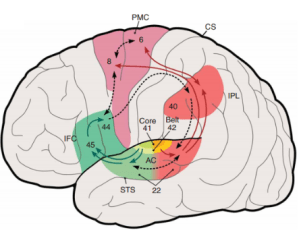
- Theory Basis: I am leveraging The Cortical Organization Of Speech Processing (Hickok and Peoppel, 2007)
- The Event Analysis complex, which comprises a Biological Motion and a Causal Inference module.
- Localization: The Biological Motion module operates in the Superior Temporal Sulcus.
- Localization: The Causal Inference module, whose location is unknown…
- The Global Broadcasting network uses the Thalamus as a relay station to construct a global workspace.
- The Intimacy network, which comprises an Attachment and an Attraction module
- Localization: the Attachment module operates in the location is the “senior executive of the emotional brain”; the Orbitofrontal Prefrontal Cortex.
- Localization: The Attraction module, whose location is unknown…
- The Location Detector network, which comprises a Place Inference and a Landmark Inference module.
- The Memory Metacognition network, including the Recognition Heuristic and Confidence Heuristic modules.
- The Smell stream begins with the Olfactory Bulb. It is the only sense organ that is not first routed into the Thalamus.
- The Taste stream begins with the Gustatory Cortex.
- The Vision (Action) stream (which travels dorsally towards the parietal lobe) also begins with the Primary Visual Cortex.
- The Vision (Perception) stream (which travels ventrally towards the temporal lobe) begins with the Primary Visual Cortex.
The following are cognitive networks which I have not yet localized. Here lie 4 distinct networks.
- The Folk Mechanics network, which computes expectancies based on, e.g., the continuity of motion and other physics principles
- The Folk Math network, which includes the Subitizing module.
- The Identity Maintenance network, which includes the Identity Constructor, Identity Evaluator, and Identity Stabilizer modules.
- The Reputation complex, including the Caregiving module (partially mediated by oxytocin) and the Appreciation module (its functional sibling).
The following are cognitive modules which have been fully or partially localized. Here lie 14 distinct modules.
- The Action Engine module operates in the Primary Motor Cortex.
- The Action Evaluator operates in the Premotor Cortex.
- The Action Planner module operates in the Supplementary Motor Area.
- The Agent Classifier module, which links to the Amygdala…
- The Embodied Self module operates in the Primary Somatosensory Cortex.
- The Memory Heuristic (Effort) module, which constructs the Feeling Of Effort, lives somewhere in the Prefrontal Cortex (PFC),
- The Homeostasis Regulator operates in the Hypothalamus.
- The Pavlovian Conditioning module operates in the Posterior Parietal Cortex.
- The Memory Constructor (Frame) module, which lives somewhere in the Prefrontal Cortex (PFC) …
- The Memory Constructor (Episodic) module operates in the Hippocampus.
- The Memory Constructor (Semantic) , which may be near the Lateral Occipital (LO) Complex…
- The Normative Centroid module, which lives somewhere in the Ventro-Medial Prefrontal Cortex, and activates the Amygdala.
- The Conflict Monitor module, which lives in the dorsal Anterior Cingulate Cortex (dACC).
- The Intuition Override module, which operates in the right Ventrolateral Prefrontal Cortex (rVPC).
The following are cognitive modules which I have not localized. Here lie 9 distinct modules.
- The Counterfactual Simulator module
- Theory Basis: this module is adapted from Alan Leslie’s work, and Mindreading (Nichols and Stich, 2003).
- The Lie Detection module
- Theory Basis: Default Credulity theory, as defined by Gilbert (1991) How Mental Systems Believe.
- The Metaphor Linker module
- The Mind Reading module
- The Moral Rigidity module
- Theory Basis: Sacred Value Protection Model. Thinking the unthinkable: sacred values and taboo cognitions (Tetlock, 2003)
- The Social Processing (Fairness) module.
- The Social Processing (Exclusion) module
- The Social Processing (Authority) module
- The Symbolic Marker module

 Fewer Lacunae