The Lives of the Stars

Part Of: Demystifying Physics sequence
Followup To: Deep Time
Content Summary: 1100 words, 11 min reading time.

Why does the Earth orbit a slow-burning hydrogen bomb? And why is the night sky illuminated with trillions of such explosions?

Let’s find out.

Preliminaries

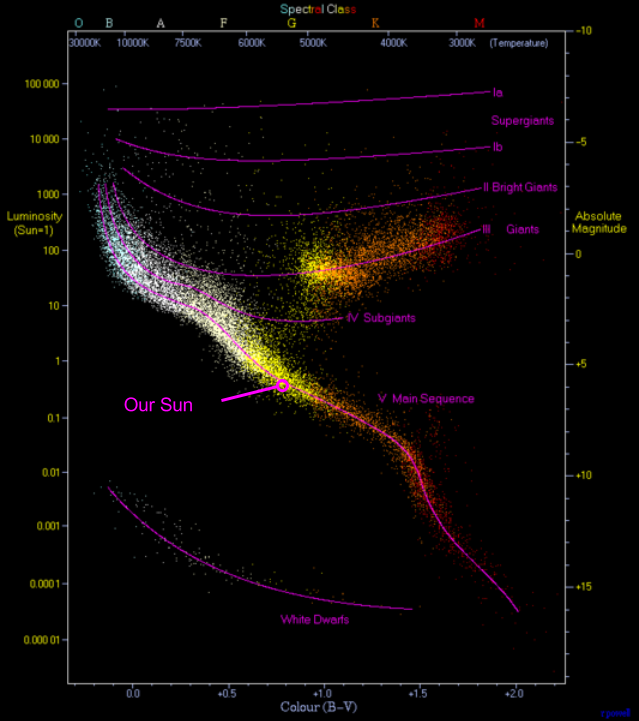
Stars emit light. The most important characteristics of light are brightness and color.  A Hertzsprung-Russell (HR) Diagram puts brightness on the x-axis, and color on the y-axis.  In this way, a star can be represented by a single point.

What happens if you plot the location of all visible stars onto the same HR diagram? The result is rather striking:
Stellar Evolution- Main Sequence Stars

Most stars seem to fit inside a continuous swathe known as the Main Sequence. Why?

As we will see, there are five stages in the stellar lifecycle:

  1. Formation: Clouds congeal into protostars.
  2. Dwarf Phase: Hydrogen begins to fuse.
  3. Giant Phase: Hydrogen runs out, switch to helium fusion and beyond.
  4. Fuel Crisis: nuclear fusion runs out of raw materials.
  5. Termination: whatever remains of the star slowly becomes cold.

Stars spent 90% of their lives as dwarves. The radiation of dwarves vary continuously based on solar mass. This explains the Main Sequence.

As we will see, the five life-stages of the stars differ based on how big they are:

Stellar Evolution- Lifecycle Flowchart (1)

The Dynamics of Stars

Stars are born when hydrogen clouds begin to collapse in on themselves.

If gravity was the only force in play, all stars would quickly become black holes. But compressed gases develop high outward pressure. So there are a tension:

Stellar Evolution- Force Interactions (1)

Phase 1: Protostars

Star formation begins when a molecular cloud begins to collapse into a dense core. As this core accretes mass, gravity’s pull intensifies. Soon, the site of collapse becomes a protostar.

Protostars are not yet hot enough to induce fusion. But the compression of gravity still makes these objects extremely hot. Once their radiation blows away surrounding clouds, the appear on what is called the stellar birthline of the HR diagram.

  • Small protostars are called T Tauri stars.
  • Large protostars are known as Herbig Ae/Be stars

As protostars mature, they become more hot and dense. On the HR diagram, their signatures will move from the stellar birthline towards the main sequence.

Stellar Evolution- Phase 1

HR movement is not movement in space. “Travel” away from the stellar birthline means that protostars are growing hotter (left) but less bright (down).

Phase 2: Dwarves (Main Sequence)

The interior of the Sun is not homogenous. The closer to the center, the more extreme the climate. If the protostar is large enough, the core of the star will become so intense, that it will trigger nuclear fusion, releasing enormous amounts of energy. If space was not a vacuum, and the sound of the Sun could travel to Earth, its volume would equal that of a motorcycle.

Nuclear fusion { hydrogen → helium } depletes hydrogen, and creates helium. The helium core of the star expands, as hydrogen is depleted.

  • Small dwarf stars are called yellow dwarves.
  • Large dwarf stars are called blue dwarves.

Over 90% of a star’s lifetime is spent in this dwarf phase. 

Stellar Evolution- Phase 2

Stars are the crucible of matter. What does this mean?

The Primordial Era produced only hydrogen clouds, intermixed with helium. How is it possible for our bodies to be 65% oxygen? Hydrogen does not spontaneously become oxygen, after all.

With few exceptions, all naturally occurring substances were forged in the heart of stars. Nucleosynthesis describes how the raw material of the Big Bang was forged into the chemically diverse world of modernity. In the dwarf phase, we only see the construction of helium. We will soon see nuclear fusion carried much further.

Stellar Evolution- Nucleosynthesis (1)

We are literally made of starstuff.

Phase 3: Giants

Eventually, stars run out of hydrogen fuel. At this point, helium atoms are so hot that they start to fuse: { helium → carbon }. This new kind of fusion changes the thermal output of the star, which leaves the main sequence.

Helium-burning stars expand dramatically. For this reason, we call main-sequence stars dwarves, and post main-sequence stars giants.  

Again we see a difference along solar mass:

  • Small stars in their giant phase are too small to combust carbon. These are red giants
  • Large giants can combust further elements. These are red supergiants

Stellar Evolution- Phase 3

The interior of red supergiants, therefore, is shaped a bit like an onion, with each deeper layer “raising” the atomic number of its exterior. But why does this chain stop at iron?

Iron has the lowest mass per quark: fusing iron consumes energy, instead of creating it.  

Stellar Evolution- Fusion Limits (1)

Small Stars: Fuel Crisis & Termination

Red giants eventually radiate away most of their mass. 😦 Thus, gravity slowly loses its hold on the star, and the outer shells are propelled outward by thermal pressure. This ejection of inert hydrogen is known as a planetary nebula.

The abandoned cores of a shell comprise white dwarves. Since these objects have no source of fuel, they slowly cool, resulting in down-right movement on a HR diagram:

Stellar Evolution- Phase 5- Small Star

Large Stars: Fuel Crisis & Termination

In contrast to smaller stars, supergiants die in fantastic ways. Their iron core is unstable, and will eventually explode in a supernova. Supernovae are no trifling matter. Their outputs are often brighter than their host galaxies (trillions of stars). If a nearby star in the Milky Way were to go supernova, it would obliterate the human race.

supernova

If the core survives the explosion, it becomes a neutron star. Neutron stars are rather dense. One teaspoon of its material would weigh more than ten Pyramids of Giza. Neutron stars are highly magnetic, and rotate quite swiftly: this is the root cause of quasars.

But sometimes the core will be even more dense. In this scenario, it will fully collapse into itself; ripping the fabric of spacetime to become a black hole. Black holes are a bit like predators; they “hunt” and “eat” other stars. At their center, most galaxies possess a supermassive black hole (SMBH). Our galaxy’s SMBH (Sagittarius A*) is fortunately 26,000 light-years away from Earth.

Stellar Evolution- Phase 5- Large Star (2)

The Story of Our Sun

As we have seen, the universe is 13.8 billion years old, and stars began to form 13.4 billion years ago. We can categorize stars by birthday into three stellar populations.  

The earliest stars were chemically simple because the universe contained nothing but hydrogen and helium. But as nucleosynthesis progressed, the universe began to accumulate more complex atoms. The second generation of stars had small amounts of metal. The last generation had substantial metal content.

Did you know that planets outnumber stars? There are about 200 billion stars in the Milky Way, and about 220 billion planets.

Planets are recent inventions. They are created only if a nebula sufficiently high metallic content. In that case, a protoplanetary disc will orbit the protostar, which will ultimately condense into extrastellar satellites.

As a recently-created star, born only 4.6 billion years ago, the Sun’s birthing nebula was sufficiently metallic to create such a disc. This disc eventually consolidated into our eight planets. The Sun is now in its second phase of life, a yellow dwarf. 5.5 billion years from now, it will – like so many of its brothers and sisters – start burning helium as a red giant.
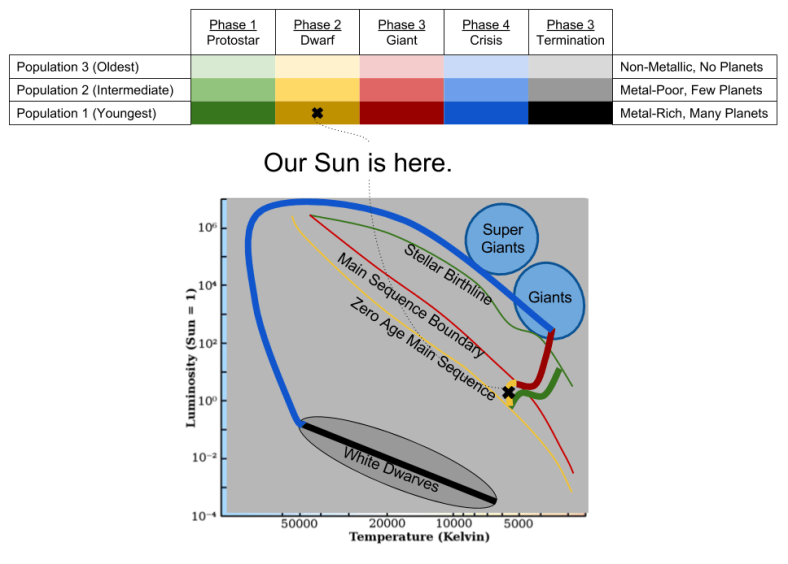
Stellar Evolution- Our Sun (3)

Takeaways

Stellar Evolution- Lifecycle Flowchart (1)

 Until next time.

An Introduction To Primate Societies

Part Of: Anthropogeny sequence
Content Summary: 900 words, 9min read

Introduction

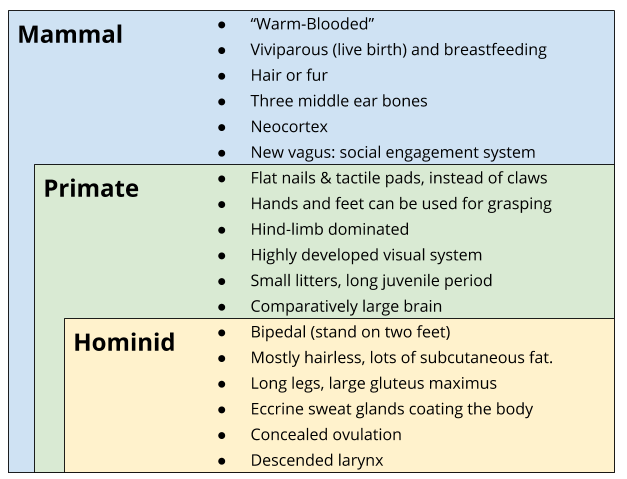
Primates are relatively young branch of the mammalian clade. Their anatomical characteristics are as follows:

Primates_ Anatomical Cladistics.png

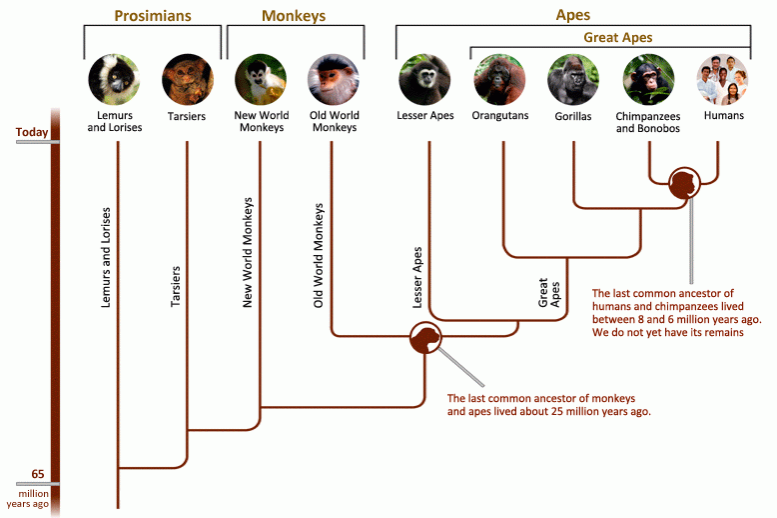
There are three kinds of primate: prosimians (e.g., lemurs), monkeys (e.g., macaques), and apes (e.g., humans).

Primate Societies- Phylogeny

Primates are known for their large brains and a social lifestyle. Today, we will explore the dynamics of primate societies (defined as frequently interacting members of the same species).

There are three components of any society: the mating system (including sexual dynamics), the social organization (spatiotemporal organization of interaction), and the social structure (relational dynamics & social roles).

Sexual Dynamics

Because DNA is creepy, it programs bodies to make more copies of itself. Men and women are programmed with equally strong imperatives for gene replication (reproductive success). But female pregnancy powerfully breaks the symmetry:

  • Women spend more metabolic & temporal resources rearing children.
  • Women are certain that their offspring is their own, men can experience ambiguity.
  • A single woman can only produce one child at a time, a single man can impregnate many women concurrently.

It is because of pregnancy that males court females, and females choose males.

For females, paternal care is of tantamount importance: finding a mate willing to share the burden of raising a child. For males, fecundity is key.

We can see echoes of this asymmetry today. In all human cultures observed,

  • Women tend to be more jealous of emotional infidelity. Men have more violent reactions to sexual infidelity.
  • Women are statistically more interested in male social status and resources. Men pay comparatively more attention to physical beauty.

These gender differences arise as a response to the biological mechanism of pregnancy.  These are contingent facts, nothing more. Species with male gestation, such as the seahorse, witness the reversal of such “gender roles”.

Four Mating Systems

From a logical perspective, there are exactly four possible mating systems.

Primate Societies- Mating Systems and Species (2)

Which mating system is biologically preferable? That depends on your gender:

  • Females benefit from polyandry, with multiple males available to raise offspring.
  • Males maximize their genetic impact with polygyny.

Most primates are polygynous. Why? 

The answer is geographic. To survive, an animal must travel to surrounding land, locating flora or fauna to satisfy its metabolic budget. The amount of land it covers is known as its territory. The more fertile the land, the smaller the territory (less need to travel).

To mate with a female, a male will – of course – enter into that female’s territory. Thus, we can visualize each mating system from the lens of territory:

Primate Societies- Mating Systems and Territories

Mating systems are determined by female territory size.

  • If males can encompass the territories of multiple females, males will select polygyny (or, more rarely, promiscuity).
  • Otherwise, if females do not live in defensible groups, males will typically revert to monogamy (or, if females are sparse, polyandry).

In turn, female territory size is determined by environmental conditions. If the terrain is sparse, a female must travel further to sustain itself, and vice versa.

Our causal chain goes: plentiful land → smaller female territory size → polygyny. This is the Environmental Potential for Polygyny.

Three Social Organizations

The vast majority of primates are group living: they forage & sleep with bisexual groups of at least three adults. They spend most of their waking lives in the presence of one another. In other mammals, such group living is much less common.

Primates (e.g., humans) did not originally choose to live in groups because of their sociality. Predation risk induced group living. Only afterwards did primate brains adapt to this new lifestyle.

Some primates are exceptions to this rule. Two other, rarer, varieties of primate social organizations exist:

Some primates are solitary, foraging on their own. These species tend to be nocturnal. With less predation risk, individuals need not share territory.

Other primates live in pair bonds, a male-female pair. The attachment system is employed by infants to attach to their mothers: monogamous primates redeploy this system to support adult commitment. That said, primate monogamy only occurs when females live in an area that is difficult to defend.

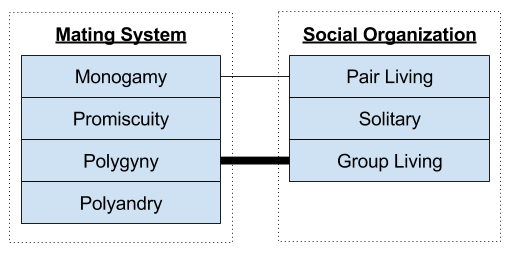
We have seen 4 mating systems, and 3 social organizations. These are not independent:

  • Pair living and monogamy correlate. However, few primates live in such systems (thin line)
  • Group living and polygyny correlate: both are promoted by overlapping female territories. Most primates occupy this arrangement (thick line).

Primate Societies- Mating System vs Organization (1)

Structure: Dominance Hierarchy

When animals’ territory overlaps, they often compete (fight) for access to resources (food and reproductive access).

Fighting is accompanied with risk: the stronger animal could be unlucky, the weaker animal could lose their life. Similar to human warfare, both sides suffer less when the weaker side pre-emptively surrenders. The ability to objectively predict the outcome of a fight is therefore advantageous.

Suppose the need for fight-predictions is frequent, and do not often change (physical strength changes only slowly over an animal’s life). Instead of constantly assessing physical characteristics of your opponent, it is simpler to just remember who you thought was stronger last time.

This is the origin of the dominance hierarchy. The bread and butter of dominance hierarchies is status signaling. Dominant behaviors (e.g., snarling) evokes submissive behaviors (e.g., looking away).

Social Systems- Dominance Examples (2)

Takeaways

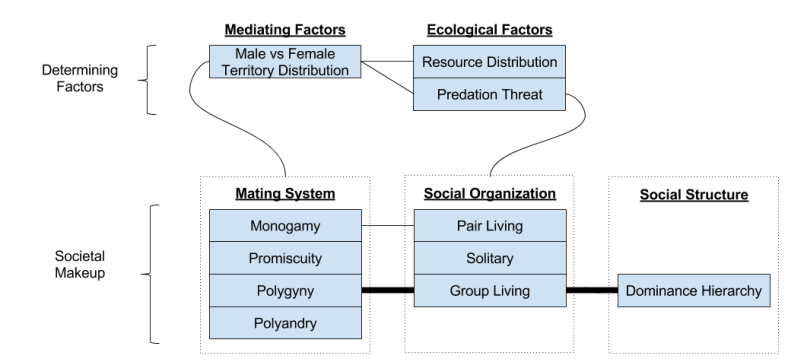
We have explored three aspects of primate societies: mating system, social organization and social structure. Each of these is driven by external, ecological factors.

Primate Societies- Systemic View (4)

Primate niches typically feature high predation risk and fertile terrain. These promote female grouping, which in turn attracts males to live with them in groups, under a polygynous mating system.  

Primates are unique for successfully living in groups throughout their long lifespan. To support this ability, primate brain volume increased, and came to provide increasingly sophisticated cognitive mechanisms & social structures.

We will explore the evolution of social structure next time. See you then!

References

  • Kappeler & Schaik, 2001: Evolution of Primate Social Systems.

An Introduction To Propriety Frames

Part Of: Demystifying Ethics sequence
Content Summary: 1000 words, 10 min read

Preliminaries

Two important debates in philosophy of ethics go as follows:

  1. Are our moral beliefs true, in some objective sense? 
  2. Is there some objective way to resolve moral disagreements, or claim moral progress? Or is it impossible to compare different moral systems?

For centuries, philosophers have wrestled with these issues. But the question of how minds construct morals in the first place, is underexplored.

Let me attempt to close the gap. In what follows, I describe probable mechanisms by which primates acquire intuitions about right and wrong.

We begin with a simple distinction:

  • Social attitudes (should / should not) are intuitions of socially appropriate behavior.
  • Moral attitudes (good / evil) are also judgments about behavior, but more associated with anger, inflexibility, and condemnation.

I submit that these two attitudes are weaved with the same fabric. To show this, I will address the following:

  1. What are social attitudes? 
  2. Why do our social attitudes have the specific contents that they do?
  3. Can moral attitudes be derived from social attitudes?

By the end, I hope you emerge with a clear understanding of how social and moral attitudes are constructed, shared, and used.

Propriety Frames

We are constantly immersed in highly structured interactions. The volume of these experiences can make social rules seem obvious: they become practically invisible. But by traveling to a sufficiently remote culture, or even spending time around a severely autistic person, we may begin to appreciate the sheer complexity of social norms.

Consider a typical evening at a fancy restaurant: how many social rules can you think of? Here are a few examples of “breaking the rules”:

  1. The waiter states he is not in the mood to take your order.
  2. Several guests are engaged in a foodfight.
  3. The food is dumped directly on the table.
  4. On taking a bite, you realize that your meal is actually plastic: an artistic creation designed purely for visual effect.
  5. An extravagant item on the menu is free of charge.
  6. Instead of payment, the manager comes out to request that you wait tables next weekend.

This list could go on for many pages. It may take a while to generate such a list, but you could immediately recognize if any one of thousands of such “rule violations” occur. This suggests that your brain contains vast amounts of social information. But how is this information acquired? How is it retained?

In social psychology, schema or frames are often employed as useful ways to bundle collections of facts. Frames can nest within one another. For example, our restaurant expectations are a propriety frame with three constituents: Host-Guest, Eating, and Place Of Business. Surprises {1, 2} are violations of the host-guest frame, {3, 4} countermand the eating frame, {5, 6} negate the place of business frame.

Propriety Frames- Restaurant Example (3)

Propriety frames store knowledge of socially appropriate behaviors, just as semantic memory retains factual knowledge. Whereas semantic memory can be communicated in simple sentences, norms are communicated in larger narrative structure. Norm synchronization plays a large role in the human delight in stories

This simple model provides great insight into common social experiences. When you watch a mother instruct her son to not to yell in the store, you are watching the child install an update to his Shopping frame. When a family exchanges gossip around a campfire, they are synchronizing their frames.

Frame Attractors

How are propriety frames represented within the brain?

A clue comes from semantic representation. It seems that the brain has not one, but three languages through which it encodes facts:

  1. Prototypes are bodies of statistical knowledge about a category. A Dog prototype could store properties that are diagnostic of the class of dogs.
  2. Exemplars are bodies of knowledge about individual members of a category. An Dog exemplar would be e.g., of the last dog you saw.
  3. Theories are bodies of causal, functional, and nomological knowledge about categories. A Dog theory would consist of such knowledge.

A frame doesn’t need to be huge lists of rules. It is more flexibly encoded as a prototype: a statistical “center of gravity” which represents a behavioral ideal. This prototype need not correspond to observed behavior, just as you can understand triangles without encountering a geometrically perfect triangle.

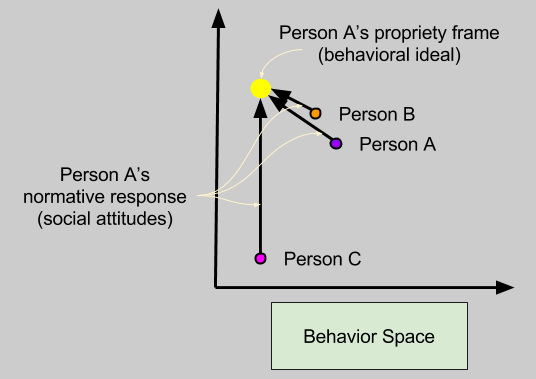
Let us imagine behavior space, where complex behaviors are compressed into dots at a single location. In this picture, our propriety frame is just another point.

On this metaphor, violations of social rules are simple vector calculations, from observed behavior to that person’s moral standard. A propriety frame is an attractor which compares all observed behavior to itself.

Propriety Frames- Prototypes As Attractors (1)

If propriety frames were simple lists of rules, it would be hard to explain why some violations appear worse than others. By using prototypes, the brain preserves severity information. The larger the vector, the more salient the violation.

A Physical Mechanism

Recall that brains are organized into two perception-action loops:

  • The Somatic Loop processes the world: it maps perception → action
  • The Visceral Loop processes the body: it maps feeling → motivation.

Semantic memory is extremely perceptual in nature. Sense data travels from skin, eyes, ears, and coalesce into perceptual object files such as Dog.

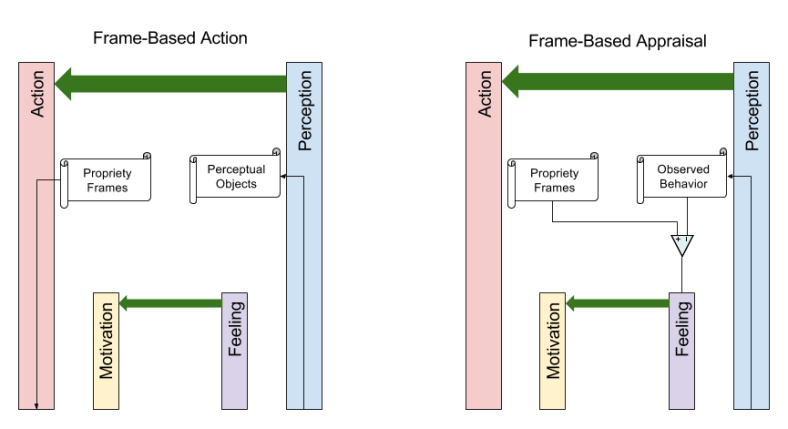
In our discussion so far, we have described the role of frames in social appraisal. However, propriety frames serve two distinct functions:

  1. Action: The Restaurant Frame produces motor command signals, which travel towards primary motor cortex, then down the brainstem.
  2. Appraisal: The Restaurant Frame compares its behavioral ideal to observed behavior. The output of this comparison is then delivered to our limbic systems. This is why inappropriate behavior can cause an emotional reaction, and also motivate us to act (e.g., to exchange awkward looks).

Propriety Frames- Two Loops (5)

Hume once remarked that it is hard to see how descriptive science can relate to prescriptive attitudes. However, the solution to this is-ought gap has become clear. Cognitive science can bridge the gap by describing how propriety frames drive our motivational apparati.

Summary

The brain contains many knowledge systems. Propriety frames are just another such system.  

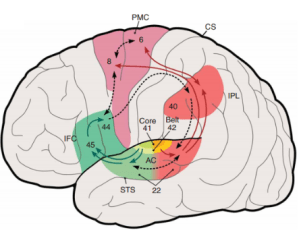
Consider the sentence “So, Jane and I visited this restaurant, and the waiter says to me …”. As your brain’s Visual Word Form Area (VWFA) processes the symbols within that sentence, your brain will automatically retrieve information about the people, nouns, and social conventions relevant to that sentence. This information is then brought into the Global Workspace of conscious attention.

Propriety Frames- Situation Canvas (1)

Propriety frames are simply another service provided by our wonderful brains. 🙂 Next time, we will explore how this system comes to develop specific judgments about behavior.

Until next time.