[Sequence] Decision Making In Chess

grandmaster_tournament

Designed for people who know little more than how the chess pieces move, this series introduces the game, and scans its results for lessons we can apply to how we understand life more generally.

  1. An Introduction To Chess.  Surveys chess culture and illustrates chess evaluation, bringing attention to the often-subconscious nature of the latter.
  2. Decision Trees In Chess. Explores how the decision trees and the minimax algorithm can capture the entirety of chess gameplay.
  3. The Chess SuperTree. Having exploring single-move decisions, this post zooms out to consider the game of chess as a whole – its complete game tree.
  4. The Psychology Of Chess. Compares these computer science & game theoretic approaches to chess with hints on how the brain uses somatic markers & heuristics to decide more efficiently.

An Introduction To Chess


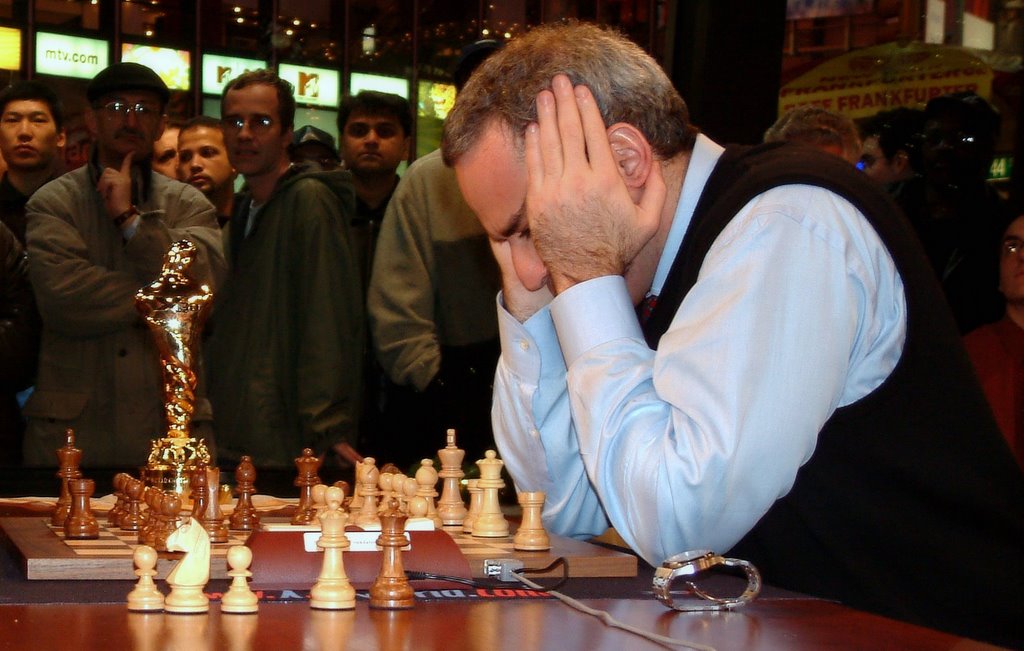
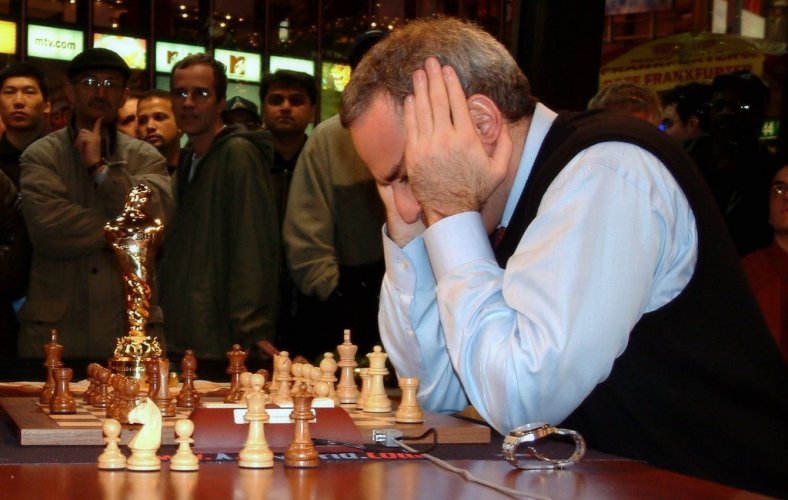
kasparov

Content advisory: if you know how chess pieces move, this article should be accessible to you.

Table Of Contents

  • Introduction
    • Why Does This Article Exist?
    • Notation & Scoring
    • Ratings & Phases
    • How Chess Games Are Won
  • How To Understand A Chess Position
    • Introducing My Starting Position
    • Towards Board Analysis
    • Why Are Goals Important In Chess?
    • Finding A Goal
    • Anticipating The Other Player
    • How Does Chess Become Less Mysterious?
  • How To Evaluate A Chess Decision
    • Introducing My Solution
    • Analyzing Decision Outcome
    • Towards Judgment
  • Conclusion
    • Takeaways

Introduction

Why Does This Article Exist?

I have played chess professionally since I was a teenager. Today, I want to share with you this private world. I will use a correspondence game (multiple days per move, instead of seconds per move) to do this. We will together walk through several decisions made by myself and my opponent.

My reasons for exploring chess are not contained to sharing an interesting piece of my life. I hope to use this material to explore certain themes useful in attempts to integrate artificial intelligence and cognitive psychology. But that’s for later. For now, if you leave this article with a better idea of how chess players make decisions, I will be content.

In a former life, I taught chess to hundreds of six-year-olds. While clearly my readership here will need more guidance, I will do my best to accomodate. 😉

Notation & Scoring

The 64 squares of the chessboard have names. Rows (also called ranks) are 1-8, columns (also called files) are a-h.

square_names

Piece symbols are:

  • King: K
  • Queen: Q
  • Rook: R
  • Bishop: B
  • Knight: N
  • Pawn: [blank]

Algebraic notation allows us to communicate chess moves. To do this, we simply combine the two symbols discussed above. There exist a few caveats regarding captures (x means capture) and when more than one piece can land on a particular square (originating rank or file is appended). Examples:

  • Ne4 would represent a Knight that moved to the e4 square.
  • gxf5 would represent a pawn on g4 that captures something on the f5 square.
  • Rec8 would represent a Rook on e8 moving to c8, if another Rook could have moved to the same location.

Chess players like to keep track of how large their army is, compared to their opponent.  However, it is not enough to count pieces: a queen is certainly worth more than a pawn. The following scoring system was instead invented, to facilitate comparison between different combinations of pieces:

  • King: [infinite points]
  • Queen: 9 points
  • Rook: 5 points
  • Bishop: 3 points
  • Knight: 3 points
  • Pawn: 1 point

Ratings & Phases

The chess community tracks playing strength with a fairly complex rating scheme: ELO ratings. Absolute beginners tend to perform around a 400 rating, those who play regularly-yet-casually trend towards 900, and world champions hover around 2800. The relationship between effort and rating is non-linear: almost all chess players will tell you that more time is required to rise from 1900 to 2100, than from 1200 to 1900. (My rating is currently 1903.)

The game of chess is traditionally divided into three separate phases: the opening, the middlegame, and the endgame. Since all games start from the same position, chess players have gradually accumulated common wisdom in the form of opening lines. Professional chess players will often memorize the first 5-15 moves of nearly every possible (interesting) game: to fail to memorize these lines is to risk independently trying to reconstruct them, failing to compute the optimal sequence, and finding yourself at a disadvantage (for this reason, tournament preparation can be quite competitive, and taxing). Similarly, endgames typically feature very few pieces, its complexity becomes tractable, and memorization returns to the fore as an extremely important tool.

It is a very normal sight to see grandmaster chess players play their first opening moves quickly, consume hours lost in thought during the middlegame, and as soon the endgame result is clear either resign or offer a draw – the end result being nearly inevitable. Arguably, the middlegame retains the most interest in the face of such professionalism. Why? Because our best minds have failed to tame its complexities.

How Chess Games Are Won

Chess games are won by checkmate: i.e., attacking the enemy King in a way it cannot escape. But checkmating is not an unpredictable “happening”. After your tenth chess game or so, you will start to notice that the cumulative strength of one’s army is predictive of the final outcome. This is why the scoring system above was developed: to allow for the prediction of victory.

Most absolute beginners have little difficulty accepting the scoring system.  The next realization, however, takes significantly longer to arrive. You see, for most players in chess, material advantages come about by accident. An understanding of attack and defense, the eyesight needed to anticipate “tricks”: these take a long time to mature (such mistakes feel like dropping a negative sign in a long algebra problem).

It takes a long time for the average human to transcend mistake-avoidance in chess. If you keep at it, your idea of how material advantages come about will slowly evolve. The key moment comes when both players are mature enough to avoid material-shedding mistakes. Despite this newfound sophistication, you are not guaranteed to avoid losing material. Why? Well… every so often, your opponent will make a series of attacking threats, and you will find yourself simply unable to generate an adequate defense response. Here come the critical question: how can one player be able to outpace his opponent in this way?

The answer lies in positional advantages, a concept much more subtle than material advantages. There are very many ways for a player to possess a positional advantage. These positional features include:

  • Pawn structure. Some pawn configurations are more stable and defensible than others.
  • Space. Some pawn configurations allow a player relatively more room to maneuver.
  • King safety. How many defensive resources does a player have near his King?
  • Piece development. At what rate has one managed to bring pieces into the fight?
  • Piece cohesion. Are one’s pieces working together well?
  • Initiative. Who is making more threats, and dictating the course of the game?

The above discussion can, perhaps, be represented with the following (rather crude) diagram:

Chess Advantages

How To Understand A Chess Position

Introducing My Starting Position

With these preliminaries out of the way, I can now to introduce you to real gameplay!

Consider the following. Each player have played 19 moves, I am playing as White, and it is my turn.

posA

Towards Board Analysis

Taking what we learned about How Chess Games Are Won, let us now conduct a material analysis and a positional analysis.

Black and White possess an equal number of pawns, knights, bishops, rooks, queen. Materially, then, the game is even. This equality is likely to persist: White shouldn’t play Bxe7 because Black can recapture Rxe7, and Black comes out ahead 2 pts. Similarly, if Black were to capture Bxc3, this isn’t necessarily wrong, but after Qxc3 material remains even (both players have lost 3 pts).

But chess is not just about the size of your army, it is how the army is being used. Let us scan through our positional features using a -5 to 5 scale (-5 is a strong Black advantage, 5 is a strong White advantage, 0 is equality):

  • Pawn structure: +0.2. (Both sides pawn’s coordinate well, and are not particularly vulnerable to attack.)
  • Space. +2.0. (My pawns have advanced, on average, 1 or 2 steps further.)
  • King safety. -1.8. (My King doesn’t have a guardian Bishop, and my pawns are further advanced.)
  • Piece development. +0.2. (No pieces are “stuck at home” anymore.)
  • Piece cohesion. +0.8 (Black’s Bb7 and Rc8 aren’t particularly useful, White’s Rooks and Bishops are better coordinated.)
  • Initiative. +0.0 (Neither player has significant control over the pace of the game.)

I want to emphasize here that the above numbers are subjective: I made them up. But, as we shall see later, quantifying my “gut feelings” turns out to be extremely useful.

Let us also notice that most pieces, on both sides, are not attacking the pieces of the other player. There are simply too many pawns in the way. It turns out that, in clogged positions such as these, play tends toward aggressive pawn moves that serve to clear a path for one’s pieces. Such “jailbreaking” often happens after subtle maneuvering, where each player tries to get her pieces better positioned to capitalize on their coming freedom.

Why Are Goals Important In Chess?

Why should play tend to gravitate towards aggressive pawn moves? Consider what happens if one player contents himself with moving his pieces behind his wall of pawns. His opponent could then dictate when and where to bring the fight to the other player.

This kind of argument illustrates a central theme in chess: successful players tend to think in terms of goals. Once a goal is selected, a plan must then be constructed, to move the current situation towards the desired one. Let’s now turn to my starting position to see what this means, concretely.

Finding A Goal

White desires to find a goal from his current position. We’ve already agreed that aggressive pawn moves represent useful goals. But where?

Is White best advised to locate a Queenside strategy? Can White aggressively advance his a- or b- pawn on the Queenside? Not immediately: such moves (a5 and b4) would lose material. What if White were to, say, play Na2 – thus making possible a later b4 pawn advance (since both Queen and Knight can now recapture). This plan does not seem especially promising: after a future b4 cxb4, Black’s Queen and a Rook will suddenly be attacking our pawn on c4!

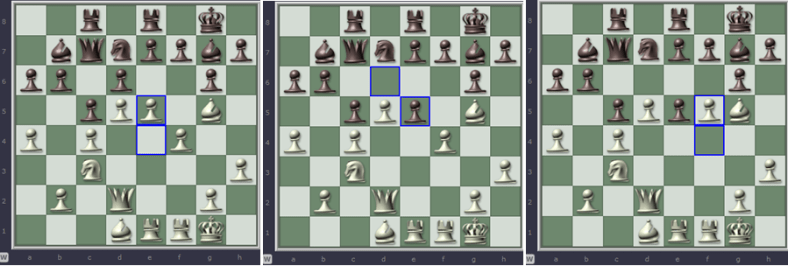
How about a Kingside strategy, with White advancing his g and/or h pawns? Too risky: White’s King is already rather exposed.  White’s biggest space advantage is in the center of the board, so let’s now restrict our attention there. The two candidates are: e5 and f5.

center_strategies

Can White afford to advance his pawn to e5 (left image)? Do the math! 20. e5 dxe5 21. fxe5 Nxe5 22. Rxe5 Bxe5. Black comes out way ahead (if you didn’t do the math, take my word for it :P).

So 20. e5 is no good. How 20. f5 (right image)? This is safe: gxf5 is met by exf5 – equality. But such a move allows Black’s Knight to land in the e5 square (Ne5), previously impossible when the f4 pawn could capture such a daring Knight. So, White seems in a quandary: he would like to increase his space advantage… but both pawn moves that could accomplish this seem deficient.

We know that White should be playing in the center. Perhaps White’s goal should be: arrange his pieces so that e5 does not lose material.

Anticipating The Other Player

What goals should Black try to pursue? Can we anticipate counterplay?

On the Queenside, b5 qualifies as a pawn break. For now, it loses material. Let us imagine a future position where it does not lose material. Is such a goal worthy of Black’s time? Perhaps: it will take a while to get his pieces ready, but it would give Black an attack.

On the Kingside, Black will hesitate to advance his pawns, due to safety concerns for his King.

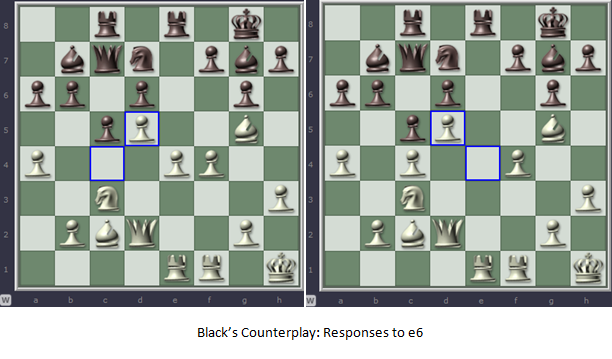
In the Center, f5 will ultimately weaken Black’s pawn structure. But what should happen if Black plays e6? White may hesitate to capture: dxe6 fxe6 gives up White’s space advantage. So, Black will have the opportunity to capture exd5, after which White will face a choice. The following image imagines this choice (after 20. Bc2 e6 21. Kh1 exd5):

center_counterplay

Recapturing cxd5 (left image) preserves his central dominance, but now White must fear a very powerful Queenside attack: Black may now play c4 and Nc5. This threat is sufficiently scary: White will probably recapture exd5 (right image).

This possibility adds some urgency to White’s plan: if Black is given opportunity to play e6, he will bring the game closer to equality by relieving spatial pressure by trading pawns and Rooks. Worse still, such a trade would prevent White from meeting his goal to play e5!

How Does Chess Become Less Mysterious?

Pause for a minute, and take stock of how you feel.  You probably feel lost, a bit like you’ve wandered into a foreign land.  It turns out that almost everyone encountering this material has a similar experience. But this feeling of confusion is important, so let’s try to understand it.

Perhaps the strangeness comes from unfamiliarity. Or, perhaps my arguments lack specificity! Would you become able to confidently teach this new understanding of chess to a friend, dear reader, if I had only made it more lengthy, more precise?

I doubt it. Such an “improvement” feels funny once you consider how chess is learned. Playing strength does not improve once playing strength by argumentation (conscious reasoning) alone: experience must play a role.  Let us name this observation, that language can express chess knowledge more easily than it can teach it, representational language asymmetry.

I have watched literally hundreds of games play out from this exact pawn structure, and I have developed a very sharp intuition for what kinds of strategies matter in this type of position. In this four-pawns-Benoni, of course White must not find a goal on the Queenside. Likewise, the solution I employ below seems shocking at first… but it is a highly stylized pattern that I have, again, evaluated in the context of dozens of other games.

I have noticed representational language asymmetry before, while teaching ESL last year.  In my view, learning chess is a lot like learning a language: personal practice and learning from the example of others is the most efficient way forward.

How To Evaluate A Chess Decision

Dear reader, where have we landed? We now know that White would like to break through in the center. We also know that White is in crisis: he would like to act before Black plays e6, but all available pawn breaks lose material. What should White do?

Rather than motivate how I addressed this challenge, let me simply show you. 🙂

Introducing My Solution

20. e5 dxe5
21. f5
posA123

Analyzing Position Outcome

Material analysis:

  • I have lost one pawn (but no more: 21 …gxf5 22. Rxf5 is simply a trade).

Positional analysis:

  • Pawn structure: -0.5 (Black’s e5 pawn is now unopposed by any White pawn, but the e7 pawn is no discouraged from moving)
  • Space. +3.5. (My pawn on f5 really cramps his style! )
  • King safety. +0.5. (My pawn on f5 is looking to remove one of Black’s King’s protective pawns)
  • Piece development. +0.0. (No real changes in this feature.)
  • Piece cohesion. +4.5 (My Rooks are now active, my Knight and Bishops are now well-positioned, his Bishop is now blocked).
  • Initiative. +2.0 (White has started to dictate which aspects of the game are worthy of attention.)

Towards Judgment

We can now directly compare before and after!  Copying the two sets of numbers I produced above:

Starting Score End Score Difference
Material: Points +0.0 -1.0 -1.0
Position: Pawn structure +0.0 -0.5 -0.5
Position: Space +2.0 +3.5 +1.5
Position: King safety -1.5 +0.5 +2.0
Position: Piece development +0.0 +0.0 +0.0
Position: Piece cohesion +1.0 +4.5 +3.5
Position: Initiative +0.0 +2.0 +2.0

We see that I have accepted losses in material and pawn structure, in exchange for gains in space, King safety, piece cohesion, and initiative. But how are we to know whether such a complex tradeoff is a decision worth making?

Recall our vocabulary words: positional advantage, material advantage. Now is the time to admit cumulative advantage into our corpus. If we wish to speak intelligibly about chess decisions, we simply must compress our analysis features into a single number (there is no room for incommensurability in chess!).  Here’s how I view the cumulative effect of my decision:

Starting Score End Score Difference
Estimated Total +0.4 +0.6 +0.2

Dear reader, how am I to convince you that such a total score is correct? Will I provide you with cute mathematics? A weighted average over the above features?

I cannot provide such a thing, because I do not possess it. The truth is, I don’t consciously use mathematical reasoning while playing chess! Rather, all of my valuations are written in the currency of intuitions, of emotional valence. And that is a deep and mysterious thing.

Conclusion

Takeaways

Congratulations! You survived to the end of this article. We have covered a lot of ground. 🙂

I’ll close by recapping the points I most want you to remember:

  • Positional advantages cause material advantages, which in turn lead to checkmate.
  • Positional advantages are composed of many different features, such as pawn structure or piece cohesion.
  • Goals are vital to success.
  • Evaluating a chess position is a largely subconscious experience, one that requires experience.

Enjoy the +100 bump in chess rating I just gave you! 😉
Exploring Biofeedback

Motivation

The integrative theorist approaches everyday life differently: familiarity is replaced with explanation. Some aspects of our existence are more explained than others. Observing a rainbow is a less mystifying experience than watching people laugh at a soap opera.

I enjoy watching yoga instructors summarize how various postures affect their bodies. Some of their explanations feel vacuous; perhaps “toxin cleansing” talk must be more satisfying emotionally, than intellectually. However, many of their observations are both manifestly true and surprising. Grist to the mill.

With more training in anatomy, many of these phenomena would cease to surprise. However, not all of these surface-level observations already have pre-packaged explanations. Let’s go exploring!

Requisite Concepts

Your brain likes to process information via topological maps. Your vision system processes information in this way, different locations in Area V1 strongly correspond with locations in your visual field. Our brain maintains other maps as well, including a map of your own body. This map cannot be consciously altered, and it may contain erroneous information (c.f., phantom limbs and the neuromatrix theory of pain).

Another requisite concept I will call sensory consilience. Humans possess equilibrioception. As Wikipedia explains, “the organ of equilibrioception is the vestibular labyrinthine system found in both of the inner ears.” How, then, are we to explain this observation known to those who practice yoga: closing one’s eyes makes one more susceptible to falling? Visual information is combined with balance information in perceptual centers of the brain, to create a strengthened notion of balance.

Lastly, I want to distinguish between the sympathetic and parasympathetic system. Speaking impressionistically: the sympathetic system prepares the body for “fight or flight” by raising heart rate, blood pressure, muscular readiness, etc; whereas the parasympathetic system returns the body to a more calm, restorative, sustainable physiological condition.

The Promise Of Biofeedback Therapy

Biofeedback therapy is an emerging technology that shows a good deal of promise. People who can watch their heartbeat on a monitor tend, on average, to be more quickly able to lower their pulse. Neurofeedback is a particularly interesting version of this therapy; for example, depressed patients may achieve symptom relief by introspecting while they have access to an fMRI image of their brains.

From a sensory perspective, what is going on? Without biofeedback, patients aren’t completely ignorant of their bodily state. We can be made aware of our elevated heartbeat by auditory means (throbbing), chemical means (headrush), etc. Biofeedback augments this pre-existent information with new, visual information from the monitor.  In other words, biofeedback encourages sensory concilience.  While the details of how these disparate data sources are combined remain elusive, we can safely conclude that the result of this computation updates the body map.

Sensory consilience is clearly a System 1 activity: no one consciously orchestrates how vision corroborates equilibrioception. Yet biofeedback opens new channels of sensory consilience, and these new channels require time to be installed. Just as with any other habit, it takes time for the new source of information to “bootstrap into your subconscious processes”.

Making Sense Of Dance

I’ve recently decided that rocking out in the car is fun. 🙂 But, dancing too energetically causes an interesting reaction: some muscles complain, but subsequently the entire body feels fatigued. Dancing in moderation seems to have the opposite effect: certain muscles report strength, and subsequently the entire body feels energized.

This type of observation surely informs the fact that many people engage in mild “hand motions” while enthusiastically talking, etc.

How do we make sense of this?

Emotion evolved to facilitate behavior.
Why is fatigue? Fatigue is the message that the body is ready to slow down (parasympathetic system)
Why is energy? Energy is the message that the body is ready to speed up (sympathetic system)

But evolution is a kluge. These emotions would subserve behavior more precisely if they addressed particular muscle groups. But they do not. Pumping a fist to the beat causes the legs to feel tired. Communication gestures that energize the whole body is a physical lie (you do not, on the basis of those signals, know that you are in better condition to run a marathon) that is employed for psychological reasons (resources that would have been paid to, say, digestion, are now redirected towards cognition).

Making Sense Of Remedial Smiling

Bikram Yoga is aerobic activity conducted in a room set to 100 degrees, 30% humidity. It is not uncommon to become overwhelmed, to not move until your body regains control of itself. The last time I went, after a particularly grueling set of poses, we laid on our backs and breathing hard through the nostrils, recovering. The instructor advised us to smile while exhaling. After trying out this suggestion, the advice seemed to bear fruit, but only if the magnitude of the gesture is controlled. In moments with extreme sympathetic activity, facial expressions made things worse; in moments where the parasympathetic system was just beginning to take over, a smirk was the optimum gesture.

This type of observation surely informs the fact that people suffering from melancholy are encouraged to force themselves to smile.

How do we make sense of this?

First, we need to admit some form of mental bidirectionality. Introspection is not the only way to edit your mental state: what you do can modify what you feel. But, we can become more specific than this. How could the act of smiling ever cause happiness?

Perhaps we could appeal to some mechanism that takes our current emotional state, and our current behavioral, as inputs.  It would then compare the two, and attempt to smooth out their differences. If we perceive ourselves smiling while slightly melancholic, perhaps these two signals will be reconciled within the body map. But if we perceive ourselves smiling while intensely melancholic, perhaps the reconciliation will fail and our self-image is instead linked to feelings of insincerity.

Conclusion

The above is too vague for my liking… I hope to improve on it later.

Let me close by bookmarking yoga-inspired observations that beg for explanation:

  • Why am I encouraged to close my eyes at the end of class, but not during it?
  • Why am I encouraged to almost always breath through my nose, rather than my mouth?

The Cognitive Redemption Of Social Science: Semiotics

Part Of: Psychology Musings sequence
Content Summary: 1100 words, 11 min read

The following discussion was motivated by this excellent book by Daniel Chandler.

The Reduction Of Sign

Semiotics is the study of signification. Whereas semantics addresses what things mean, semiotics addresses how things mean. I initially became curious about semiotics because of my interests in semantics, in memetics, and in philosophy of language. As it turns out, the field is closer to postmodern intellectual traditions than I am accustomed. I am used to approaching people like Derrida with suspicion; it is high time that I took such theorizing seriously enough to reproduce it.

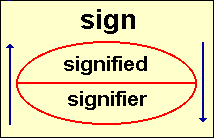
To get a feel for the semiotician’s theory of sign, let us first examine Saussure’s model: that of the signifier and the signified.

As Chandler explains:

A linguistic sign is not a link between a thing and a name, but between a concept and a sound pattern. The sound pattern is not actually a sound; for a sound is something physical. A sound pattern is the hearer’s psychological impression of a sound, as given to him by the evidence of his senses. This sound pattern may be called a ‘material’ element only in that it is the representation of our sensory impressions. The sound pattern may thus be distinguished from the other element associated with it in a linguistic sign. This other element is generally of a more abstract kind: the concept. (Saussure 1983, 66; Saussure 1974, 66) … Saussure’s original model of the sign ‘brackets the referent’: excluding reference to objects existing in the world. His signified is not to be identified directly with a referent but is a concept in the mind – not a thing but the notion of a thing.

It is almost embarrassingly easy to cast this directly to cognitive science. The signifier is the contents of perception bubbling up from transduced external signals. The signified is the concept bubbling up from long-term memory. Concepts may be fetched through a multitude of signals, and come in exemplar, prototype, and theory packages.

Can we explain why semioticians find it helpful to link signifier and signified? Yes! Within the human nervous system, there exist strong associative bonds between percept and concept: “sign” captures this natural kind.

To my knowledge, the cognitive science of semiotics has yet to find its wings: a vast, unexplored frontier. However, with this psychological reduction of “sign” in hand, we immediately find ourselves in a position to translate even the most arcane theorizing into an empirical framework. Two examples of such translations follow:

Quantifying the Peircean interpretant

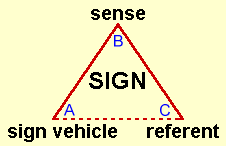
Let us first examine a conception of sign that rivals that of Saussure, one authored by American logician C.S. Peirce:

There exist two (approximate) parallelisms between the models of Peirce and Saussure:

  1. “sign vehicle” is loosely equivalent to “signifier”
  2. “sense” is loosely equivalent to “signified”

Only one leg of the triangle that is wholly novel. “Referent” refers to the category – the substance that concepts point towards.

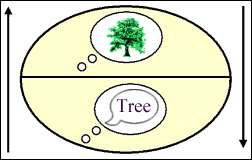
Let me zoom in on a subtlety of this model: Peirce held that sense (in his language, the interpretant) is itself a sign:

However, the interpretant has a quality unlike that of the signified: it is itself a sign in the mind of the interpreter…. Umberto Eco uses the phrase ‘unlimited semiosis’ to refer to the way in which this could lead (as Peirce was well aware) to a series of successive interpretants (potentially) ad infinitum (ibid., 1.339, 2.303).

So, more triangles may nest within the top of the above triangle! What are we to make of this?

Well, Peirce’s claim is not without intuitive support: it explains conceptual recursion well. For example, I could teach myself that “t” signifies the word “tree”, which signifies the concept of tree (whose referent is a thing that lives in dirt).

While this assertion produces interesting implications, it is not yet particularly falsifiable.
Can we use our cognitive reduction to cast this idea into a prediction? Yes.
If “sense” is a sign, there must exist some mechanism within concept retrieval that would activate subsidiary perceptions.
This is the beginning of a question that a brain scanner could answer.

Quantifying Freudian condensation

I was surprised to learn that Freud has influenced the development of semiotics, with his notion of condensation:

Psychoanalytic theory also contributed to the revaluation of the signifier – in Freudian dream theory the sound of the signifier could be regarded as a better guide to its possible signified than any conventional ‘decoding’ might have suggested (Freud 1938, 319). For instance, Freud reported that the dream of a young woman engaged to be married featured flowers – including lilies-of-the-valley and violets. Popular symbolism suggested that the lilies were a symbol of chastity and the woman agreed that she associated them with purity. However, Freud was surprised to discover that she associated the word ‘violet’ phonetically with the English word ‘violate’, suggesting her fear of the violence of ‘defloration’ (another word alluding to flowers) (Freud 1938, 382-3). If this sounds familiar, this particular dream motif featured in the film Final Analysis (1992). As the psychoanalytical theorist Jacques Lacan emphasized (originally in 1957), the Freudian concepts of condensation and displacement illustrate the determination of the signified by the signifier in dreams (Lacan 1977, 159ff). In condensation, several thoughts are condensed into one symbol, whilst in displacement unconscious desire is displaced into an apparently trivial symbol (to avoid dream censorship).

Now, it is important to avoid writing off condensation merely because the story of the young woman does not impress. In his Interpretation of Dreams, Freud produces numerous examples of condensation. Perhaps you, the reader, can bring to mind one of your own dreams to motivate the theory. Have you ever had a dream where you recognized the body of someone, but their face was of somebody else? Have you ever had a dream where an object “felt normal”, but was in important sense blurred? These are the sorts of evidences Freud would point to, as products of condensation.

While this assertion produces interesting implications, it is not yet particularly falsifiable.
Can we use our cognitive reduction to cast this idea into a prediction? Yes.
Condensation theory would predict that the percept-concept binding apparatus can be rearranged during the dream state.
This is the beginning of a question that a brain scanner could answer.

Conclusion

If you were charged with crafting a research programme to understand dreams, how would you proceed? The task is enormous: our ignorance dwarfs our knowledge, our data outpaces our models.

On the other hand, as the sciences move from armchair theorizing towards quantitative models, we see entire traditions abandoned in their wake. Few scientists pay much attention to psychoanalysis, or semiotics, or postmodern theorizing. And this is a shame – how much creativity and insight are locked behind the door of qualitative musings!

While the title of this post is amusingly grandiose, I find something genuinely exciting about the above kind of theorizing. It seems to address both of these pain points.

Design Principles of Moral Systems

Part Of: Demystifying Ethics sequence
Content Summary: 1000 words, 10 min read

Introduction

This post was initially inspired by musing on the judicial system, how “behind the curve” it is, and how its modus operandi is finally starting to change. What follows is intended to describe something more general than a singular process, however.

I want to emphasize that the below is not a distillation of some intellectual authority. These instead represent my own musings before I engage the relevant literature. Let’s begin with a common vocabulary:

  • Let normative structures refer to an arbitrary collation of moral judgments (e.g., some moral matrix presented by a talking head).
  • Let metanormatives refer to how normative structures should be constructed.

Why Present-Day Normative Structures Fail

In this section, I advance an argumentative frame, on top of which more detailed arguments may find a home.

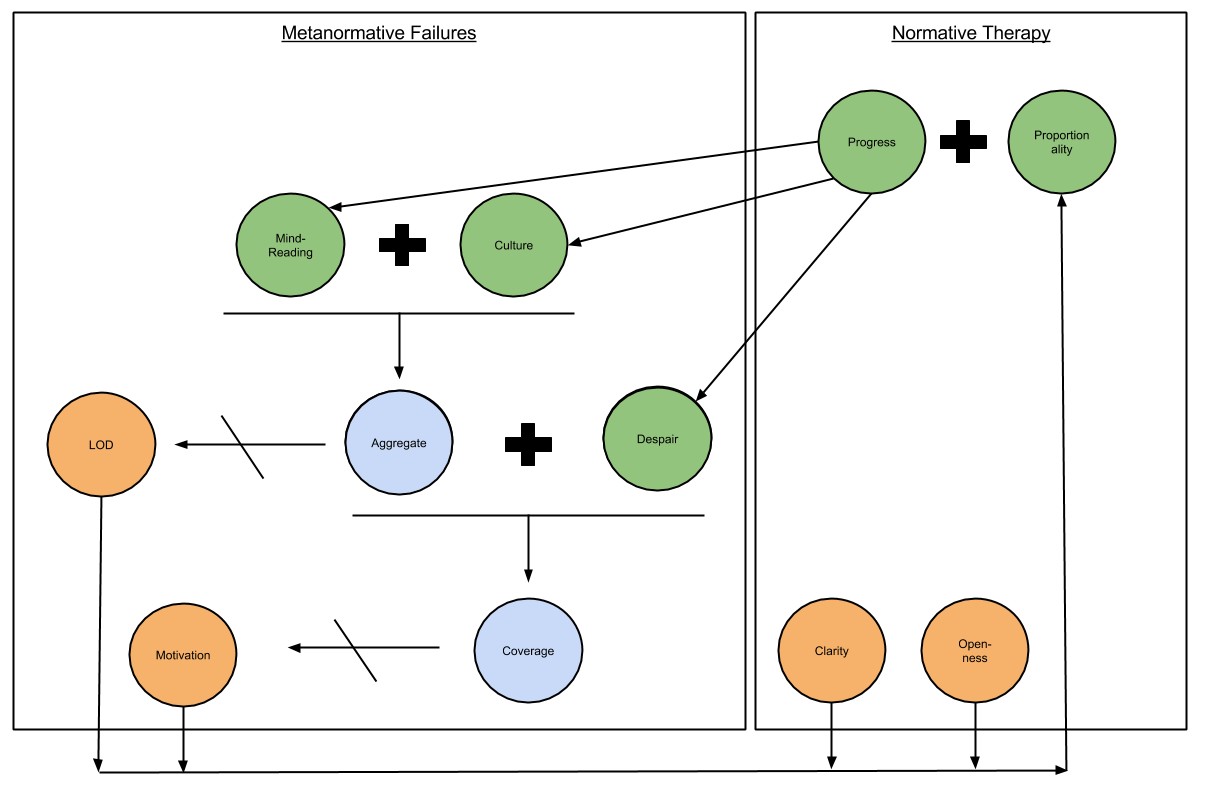
Metanormative Desiderata:

  • Level-Of-Detail (LOD): normative structures should ultimately be optimized at the person level.
  • Motivation: normative structures should point towards their ends in motivationally-optimal ways.

Empirical Premises:

  • Mindreading: It is difficult to model, or predict, the psychological capacities of oneself or others.
  • Culture: It is difficult to reliably facilitate the high-volume and/or high-complexity cultural transmission of normative signals.
  • Despair: It is not motivationally-optimal to be held to a normative structure beyond one’s capacities.

Causal Results:

  • Aggregation: Mindreading and Culture have caused normative structures to be expressed at the aggregate level.
  • Coverage: Aggregation and Despair have caused limited access to motivational-optimality for some population subsets.

Conclusion:

  • Aggregation violates LOD.
  • Coverage violates Motivation.

Thus, both of our metanormative desiderata do not obtain:

Metanormative Dissatisfaction

In the name of being understood, let me spend a few words further motivating my conclusions:

To say that “Aggregation violates LOD” is to say that human diversity precludes any one normative structure. Perhaps you can be excused from such generalizations as “all humans should strive to be selfless”. However, LOD calls for tailored normative matrices at the personal level. I want to know what I, Kevin, should do in any arbitrary situation S.

I will also clarify what it means to say “Coverage violates Motivation”. Let me zoom in on one “population subset”: the sociopath. Such an individual is biologically incapable of meeting aggregate-level normative impositions such as “everyone should care about the well-being of those around them”. The argument here, is that normative impositions should be explicitly tailored to the individual situation; for people like sociopaths, this would be something like, “sociopath X should put herself in situations where her non-empathic behavior can be held accountable”.

What Can Be Done?

Will these two metanormative failures persist into the future?

An intimidating question. Let me introduce new empirical arguments to help us get a handle on it.

Empirical Premises:

  • Progress: Scientific formalisms and technological advances will ultimately provide humanity with the ability to meaningfully alter “Mindreading”, “Culture”, and “Despair”.
  • Proportionality: metanormative principles, and not only those suggested here, will be realized in proportion to the product of their political support and the empirical resources available in their historocultural milieu.

I would be surprised if human limitations captured by Mindreading and Culture were not ameliorated in the coming decades. Such strides in our abilities will almost certainly cause changes in how our normative structures evolve. Despair is also grounded in our capacity to be motivated, a system that also affords change. All of these deserve to be modeled and understood.

Finally, let me put forward two additional metanormative principles, which may prove worthwhile to entertain.

Metanormative Principles:

  • Clarity: enthymematic premises within normative structures are best made explicit.
  • Openness: normative structures should move towards becoming more quantitatively modifiable to empirical findings, theoretical advances, and metanormative information.

I would defend Clarity in part because I view human normative structures (morality) as stemming from largely unconscious dispositions (c.f., Moral Foundations Theory). That is, the tendency of the human animal is to work with pre-installed normative structures without examining their contents. By rendering enthymemetic premises in language, one makes a larger percentage of the normative structure amenable to conscious rumination. It feels hard to argue against the utility of such an enterprise.

I would defend Openness by criticizing its converse. How can one go about arguing that our normatives need not be modified? If one claims that our answers are complete enough to be made rigid, surely a good counterargument could be made via inductive appeal to history. I find the claim that our answers are more motivating when they are inflexible, to be much more interesting. Perhaps I concede that this could be true in times of normative stasis, but that (a) one could “hide” such modifiability, and that (b) the absence of modifiability during normative upheaval leaves too wide a swath of the human population unable to truly participate in setting down a new direction.

With these defenses in place, I can here set down my twofold contention:

  • Given Proportionality and the popularity of LOD and Motivation, the existence of Progress will cause our normative structures to be refactored towards ones that don’t “fail” as readily.
  • Given Proportionality and my defenses of the new metanormative principles, if Clarity and Openness became more popular, perhaps our society would further improve (by some underdefined metric).

Normative Therapy

Conclusion

Let me conclude by presenting three criticisms of the above model.

  1. It is a naked argumentative frame, requiring more detailed argumentation before it can be considered complete.
  2. It is severely empirically impoverished; I need, at the bare minimum, to model how normatives are cognitively generated.
  3. I do not possess a theory on whether to build the following theoretical manifold higher than metanormatives (how to answer the question “how should metanormatives be constructed?”). If such a thing deserves to be built, I do not know if it be accomplished unburdened by trivial-recursion.

Fin.

Helen Keller

Last week, I attended a theater performance of Helen Keller.

The main theme of this Helen Keller performance was that words refer.  Her teacher, Anne Sullivan, spent hours and hours trying to associate words with objects.  She would have Helen hold an object, and spell their name into her hand in American Sign Language (ASL).  In her later autobiography, Helen reports having a “breakthrough moment”: sitting by a water fountain, she finally groks that the sign for water means the thing touching her hand.  She then proceeds to run around, learning the same words but “with newfound understanding”.

A few professors hosted a session afterwards to discuss the play with interested members of the audience.  The narrative presented by the actors and the professors, to explain Helen’s moment of insight was (predictably) crude.  Helen “discovered semantics” and “her intellect finally overcame her disability”.

Can cognitive science do better?  Of course.

Can I do better?  A little.  What follows is not as crisp and well-defined as I would like… but I would prefer it not exclusively live in my head.

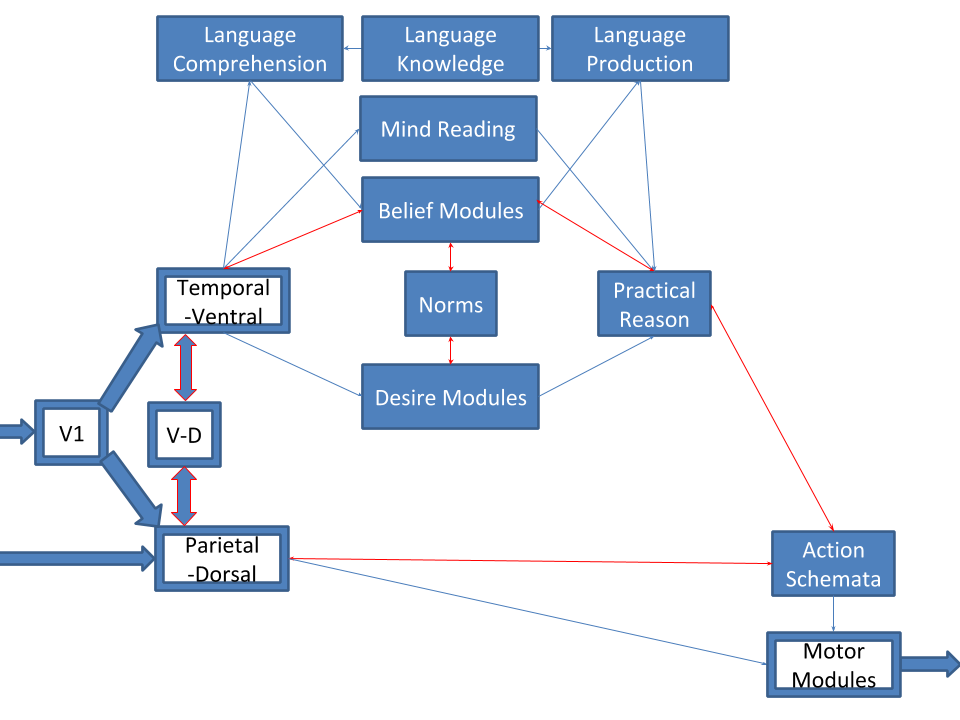
Let me first appeal to cognitive architecture as a whole.  I’ll leverage a model developed by Carruthers, because I am fond of its generality.

Mental Architecture (1)

I’ll have to leave an exploration of this schematic for another time.  The model is obviously incomplete, but sufficient for our purposes. The four hollow boxes on the left represent the sense of vision (more specifically, they capture the two streams of vision).

As Carruthers is careful to explain, the vision modules aren’t claimed to be the only input to the human mind.  Other sense modalities reside parallel to it, also serving as inputs to belief modules and desire modules.  Regrettably, Carruthers does a poor job at exploring how these different data vectors diverge, and how they interact.

Let me recapitulate what senses are.  How human beings sense is so much more than sight, sound, smell, touch & taste.  The Five Senses idiom stems from Aristotle and is as wrong as his physics.  An updated list:

  • Ophthalmoception (sight)
  • Audioception (hearing)
  • Olfacception (smell)
  • Gustaoception (taste)
  • Tactioception (touch)
  • Thermoception (temperature)
  • Proprioception (kinesthetic)
  • Nociception (pain)
  • Equilibrioception (balance)
  • Interoception (a word-bucket for various forms of internal chemical processes)

(It is currently fashionable to leverage -ception words to denote the physiological transduction aspect of sensation, and leave words like “pain” and “smell” to denote the subjective experiences stemming out of such processes.)

Humans engage with the external world with at least the above senses, all of which seem to have their own, distinct, type of sense organ (analogues of rods/cones in the eye).  Pain and touch are delivered by different cell types, etc.  Finally, it is not particularly controversial to claim that some senses provide more information than others.  In the course of human evolution, sight came to further displace smell, with respect to information bearing capacity.

At an early age, Helen lost both her sight and hearing – our two most familiar vehicles of language.  Her teacher attempted to install language via touch.  The mere process of enumerating the above list only now has inspired me to wonder how effectively language can be imprinted on still-other mediums.  There are no information-theoretic reasons why language cannot become embedded within pin pricks, within temperature, within smell… why then, is it rarely seen “in the wild”?

Even today, the process by which humans acquire language smells a little magical.  The solution has, as yet, eluded our finest minds.  We know this competency is most strongly expressed in early childhood; and that its awesome powers fade, but do not disintegrate, around the five year mark.  This is why learning a language as an adult “feels especially difficult”.  Anyways, the fact that Helen apparently language for the first time, at seven years old, is noteworthy.

I found myself referring to one of Fodor’s works quite a bit, throughout my experience watching the play (even though I haven’t read the book … haha).  I would characterize Fodor’s thesis as: subvocalization is not the loci of mental activity; rather, the mind reasons through its own language.  Let’s call this private language Mentalese.  This competency precedes language, is basal to our species – it is the stuff that enables the mind to refer.  On this model, even deafblind people like Helen have a concept of, say, her mother.  Her mother appears at certain times, feels a certain way; she expresses a range of behavior quite distinct from that of her father.  It is false to claim that Helen cannot form a thought. Although it is difficult for us to conceive of conscious rumination without linguistic subvocalization, that simply does not impair the functioning of working memory entirely.

It seems, then, that Helen can already refer to WATER in Mentalese.  What is the significance, then, of linking this representation to ASL?  I can think of two plausible benefits.

One is that languages (like English, or ASL) is theorized to imbue Mentalese with improved flexibility.  Language comprehension, and language production, modules may afford the subject with expanded powers of simulation and creativity.  This is where my lack of research into weak versions of linguistic relativity comes to bite me…

Another plausible benefit, is that marrying ASL to Mentalese allows other people to streamline the chain of communication.  Instead of translating Mentalese concepts to motor modules to complex behavior, they can instead encode those same concepts into ASL in a more compressed format.  Thus, instead of inferring behavior-triggered displeasure from repeatedly being constrained, Helen can more quickly infer her social milieu via an ASL encoding of “don’t hit people”.  This is where my lack of research into Theory of Mind (ToM), especially its maturation phases during childhood, comes to bite me…

The thrust of the above musings is that Helen’s “breakthrough” was themed her language modules and ToM modules contributing to her mental life in new ways.  This is much less naive than an appeal to “semantics” or to “intelligence outsmarting disability”.   However, the fact that I cannot even construct an compelling alternative theory, to contrast with the above Fodorian vision, speaks to the amateurish nature of these musings.

In addition to language, another theme explored in the play was Helen’s tantrums.  Specifically, her family had a permissive attitude towards this behavior (excusing it due to her condition); whereas her teacher was more willing to enforce social rules (with positive results in the long term).  I don’t yet understand the reasons behind tantrums, and I don’t understand why perpetually giving in seems to yield, on average, less happy children.

My instinct is that tantrums are an evolutionarily old mechanism by which one attempts to improve ones social status.  Perhaps, in children, discovering that you are not at the top of the dominance hierarchy, more effectively inculcates a desire to learn the social nuances of ones environment.  Perhaps the existence of boundaries simply provides more social information (in algorithmic complexity theory, a string of 1s has less information-content than a more balanced distribution).  But these are just musings that have not yet matured into theories…

In conclusion, I am not yet capable of producing a conclusion.  🙂  Fin.

Application: Phonological Loop

Today I started reading Alan Baddeley’s Working Memory, Thought and Action

working_memory_book

One of my reasons was to understand myself: I have long entertained the idea that there was something slightly abnormal about my memory.  This afternoon, I may have stumbled on an explanation of my difficulties. I wanted to share my idea because it nicely illustrates how theoretical concepts can enrich and improve people’s lives.

Context

When I was in high school, I got the standard pitch about long-term memory and short-term memory. It turns out that, here, curriculum lags research by several decades. Short-term memory as a conceptual entity was dismissed during the 1980s. Working memory was its replacement.

working_memory

In his book, Baddeley describes the two primary functional components of his model: the phonological loop, and the visuo-spatial scratchpad. The former is activated when you rehearse information, often subvocally (“that person at the wedding was named Audrey.. Audrey.. Audrey”).  This loop helps to reinforce memory traces, and has been shown to operate near the language centers of the brain (left hemisphere).  The scratchpad, by contrast, is associated with spatial reasoning (“if I take three lefts and then a right I’ll escape this corn maze”).  Neuroimaging has localized this mechanism to the right hemisphere of the brain.

Symptoms

  1. I read textbooks out loud to myself. Literature like Baddeley’s is often dense and requires careful attention. When I am not distracting anyone, I revert to this recitation exercise, and it helps me concentrate.
  2. I have always been a visually oriented creature. A detailed schematic holds more weight in my mind than a chapter’s worth of text.
  3. As I was being introduced to the notion of the phonological loop, I decided to try it for myself. During his experiments, Baddeley often directs his subjects to recite five or six letters or numbers to establish the loop. I began to subvocalize the first seven letters of the alphabet to myself, silently reciting ‘a’ through ‘g to myself over and over. But the singsong quality of this exercise did not persist, and before long I noticed that I was imagining typing those letters with my left hand.

Diagnosis

My phonological loop is weak.

In symptom 3 above, the acoustic qualities of my recitation weakened over time. Not content to watch the cycle deteriorate, my visuo-spatial sketchpad swung online with its image of a keyboard, significantly easing the task burden. Symptom 2 can be interpreted as a long-standing preference for the sketchpad. And what is Symptom 1 other than my mind being forced to augment the phonological loop with real, sometimes loud, verbal stimuli?

Concluding Thoughts

The point of the above is not medical, my symptoms are well within the range of a functional human being. Neither is this intended to be original research: I am just beginning to engage the professional literature.

All I am hoping to illustrate is how cognitive science can enrich how we understand our inner lives. With the theoretical tools outlined in the Context section above, I moved from a “that’s funny” stance towards something a little more informed. Perhaps I am on the right track, and should learn to accommodate my suite of genetic (dis-) endowments. Or, perhaps there is some proven technique to restore phonological loops and improve one’s GPA. 🙂 One can always dream.

The Periodic Table: Orbitals

Part Of: Demystifying Physics sequence
Content Summary: 600 words, 6 min reading time

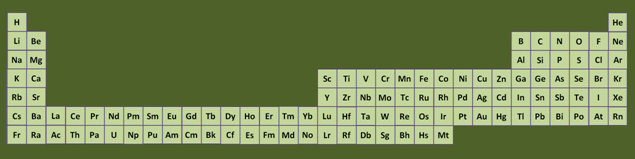
In this post, I would like to address the concepts of order and beauty within the Periodic Table. Below I have constructed the Periodic Table as it appears in most textbooks.

originaltable

This illustration is a nice snapshot of the order that its creator, Dmitri Mendeleev, had found within the elements. Indeed, all textbooks generally say the same thing: that these elements are arranged from left-to-right and then top-to-bottom in order of the amount of protons (the atomic number) in the nucleus. Arranging these atoms into the table produces a startling result: electrons within the same column behave in strikingly similar ways. The well-known elements of copper, silver and gold (located in the eighth column from the right, symbolized by Cu, Ag and Au respectively) illustrate this principle well: they are all strikingly less chemically reactive than nearby metals.

So goes the conventional wisdom. However, this brief synopsis of Mendeleev’s discovery is not comprehensive. As we look closer, in fact, we find irregularities that demand an explanation:

  1. Chemists have not discovered a last element; new elements continue to be created.
  2. Hydrogen and helium do not conform to their column’s traits as convincingly as other elements.
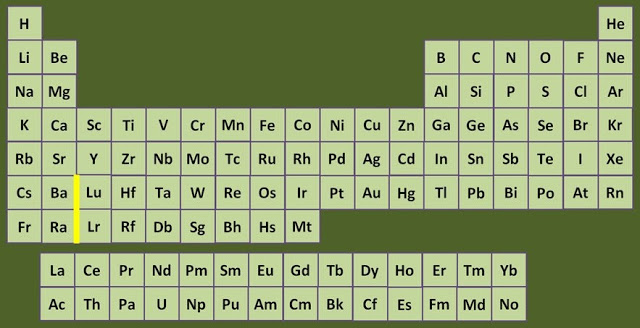
  3. The Lanthanide and Actinide series are housed apart from the table (the two detached rows fit “inside” the yellow strip on the above table).

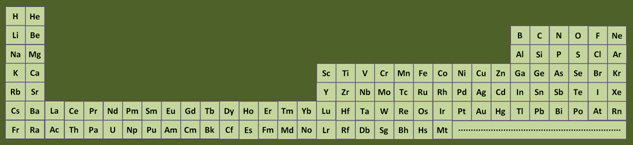
This last item means that the Periodic Table is, to a certain extent, oversimplified. The actual table looks like this:

actualtable

A lot less attractive, right? Well, before you leave dismayed by the chaos of nature, consider that the quantum mechanical approximation of orbitals can afford our table with an interpretation that can be considered beautiful. Let us assume that we are only interested in elements that are not ionized, then the order of an electron-based Periodic Table remains unchanged. Allow me to further reposition helium – one of the exceptional elements mentioned above – alongside hydrogren. Finally, I have added an extended ellipsis at the lower right of the table. This symbolizes our other observation that chemists continue to discover higher-order elements.

electrontable

Remarkably, we discover that with our light manipulations, we are now able to group our Periodic Table into four separate rectangles. It turns out that these rectangles represent orbitals, which stem from the principles of quantum mechanics. Below we have delineated the four known groups into orbitals s, p, d, and f. These symbols originate from spectroscopy, and are regrettably more historical than meaningful. They stand for sharp, principal, diffuse and fundamental.

orbitaltable

We have completely rearranged the Periodic Table into four separate rectangles, each of which represent different orbital types. In effect, we allowed a certain amount of ambiguity with respect to the macroscopic in order to obtain greater clarity in the smaller scale. In fact, we can continue our journey towards the foundations for the periodic table with another reorganization. The following idea (independently rediscovered by myself) was actually discovered in 1928 by Charles Janet.

janet_table

It is important to realize that this reorganization in no way changes the atomic number ordering of Mendeleev, it simply rearranges it. By moving the s-orbital block to the right, we have further compromised macroscopic interrelationships in order to furnish ourselves with meaningful patterns and predictive power.

Notice first the height of each orbital block.  A new block is introduced after every two rows.  Next, notice the width of each orbital block.  2, 6, 10, 14.  Divide by two: 1, 3, 5, 7.  If I were to tell you that the next orbital is named “g”, would you be able to predict its height and width within an extended Periodic Table?

My hope is that you are beginning to experience the periodic table as an dynamic snapshot of physical reality. In this article, I have zoomed in from the common behavior-oriented paradigm towards a more fundamental orbital approximation. For more information, please refer to the following series of video lectures provided by MIT.