Modularity & The Argument From Design

Part Of: Cognitive Modularity sequence
See Also: Fodor: Modularity of Mind
Content Summary: 1600 words, 16min read

Introduction

This post represents an argument for a particular thesis, known as massive modularity. This thesis, particularly popular among evolutionary psychologists, states that the mind is rife with mental modules, and that the cognitive life is the interplay between them.

What is a mental module? If you don’t have a clear grasp on what that means, I recommend just glancing my summary of Fodorian modularity. Bear in mind, though, that here the term is used somewhat differently: modules here may be some subset of the listed properties.

The following argument is not my own, it is rather an interpretation of Carruther’s argument, which is presented in this text, under Section 1.3.

Motivators From Biology

Carruthers starts by surveying the biological literature for instances of modularity. And he finds it, by the truckload:

There is a great deal of evidence from across many levels in biology to the effect that complex functional systems are built up out of assemblies of sub-components. This is true for the operations of genes, of cells, of cellular assemblies, of whole organs, of whole organisms, and of multi-organism units like a bee colony. And by extension, we should expect it to be true of cognition also, provided that it is appropriate to think of cognitive systems as biological ones, which have been subject to natural selection.

Amongst other sources, he cites the following research:

  • West-Eberhard, 2003. Developmental Plasticity and Evolution.
  • Seeley, 1995. The Wisdom of the Hive: the social physiology of honey bee colonies.

We thus possess considerable biological reason to believe that:

(3) Natural selection selects for modularity at a variety of different levels.

A Role For Evolvability

It’s one thing to observe natural selection promoting modularity, it is another to understand why it is doing so. To do this, we must appeal to the concept of evolvability.

Biological populations tend to conform themselves to ecological niches. That is, a species tends to adopt a particular survival strategy that exploits a certain subset of the local biosphere. Let me here decorate a concept I like to call niche distance: two species said to be in direct competition are so in virtue of the fact of short niche distance, etc. Thus, we could say that the niche distance between two types of weeds in your backyard is small, and the niche distance between the weed and the bald eagle is large.

The fact that niches change is one of the drivers for biological evolution. For example, as the earth warms in the coming centuries, mammalian species will need to acclimate to a different climate, which entails a changed vegetative response, which entails a need for change in eating patterns, etc. Such niche fluctuations are ubiquitous.

We know that evolution is driven by the engine of mutation. But mutation is simply a stochastic, quantum mechanical phenomenon:  there is no way to “speed it up”. Species typically cannot keep pace with niche fluctuations by directly modulating the rate of mutation. Rather, the genetic infrastructure of species must be able to harness mutations to keep pace with niche fluctuations. To put this concept of evolvability very crudely: natural selection does not only select for number of muscles, but also the ability to grow new ones.

(1) Evolvability is selected to allow for fluctuations within an ecological niche.

This video is a cute exploration of how evolvability may be supported in microorganisms by direct tampering of the genetic replication engine. But for larger organisms, the loci of behavior is trans-cellular. The sheer geometry of size compelled cells to become heterozygous, to constitute interdependent systems. The question of mutation containment, then, becomes central: is it possible for evolution to improve upon one function of an organism, without simultaneously affecting other functions?

Here, finally, is where modularity comes into play. One of the most important features of modularity is encapsulation: the hiding of information within specific containers. Rather than all functions affecting all other functions, computational processes erect walls around themselves, and communicate through them in a controlled fashion. Modular encapsulation is thus seen as a prerequisite for mutation containment:

(2) Modular subsystems are a necessary ingredient for evolvability.

Taken together, premise (1) and (2) support (3) in the following way:
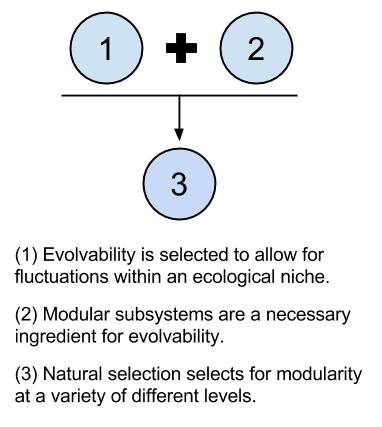
Massive Modularity- Argument From Design- Evolvability

Motivators From Computer Science

In the above section, we were given a nice intuition regarding Premise 2: that modularity affords for mutation containment. But perhaps this intuition can be buffered with evidence from somewhere else entirely:

The basic reason why biological systems are organized hierarchically in modular fashion is a constraint of evolvability. Evolution needs to be able to add new functions without disrupting those that already exist; and it needs to be able to tinker with the operations of a given functional sub-system – either debugging it, or altering its processing in response to changes in external circumstances – without affecting the functionality of the remainder. Human software engineers have hit upon the same problem, and the same solution.

Two of the most widely used languages nowadays are C++ and Java. Languages in this class are often described as ‘object-oriented’. Many programming languages now require a total processing system to treat some of its parts as ‘objects’ which can be queried and informed, but where the processing that takes place within those objects isn’t accessible elsewhere. This enables the code within the ‘objects’ to be altered without having to make alterations in code elsewhere, with all the attendant risks that this would bring; and it likewise allows new ‘objects’ to be added to the system without necessitating wholesale re-writings of code elsewhere. And the resulting architecture is regarded as well nigh inevitable (irrespective of the programming language used) once a certain threshold in the overall degree of complexity of the system gets passed.

Interestingly, since the need for modular organization increases with increasing complexity, we can predict that the human mind will be the most modular amongst animal minds. This is the reverse of the intuition shared by many philosophers and social scientists, who would be prepared to allow that animal minds might be organized along modular lines, while believing that with the appearance of the human mind most of that organization was somehow superseded and swept away.

We extract the following argument from the above appeal to object-oriented programming (OOP):

(4) Software engineering suggests that OOP (modularization) is necessary to manage increasing complexity.
(5) Biological systems are very complex.

These premises buffer our Premise 2.

(2) Modular subsystems are a necessary ingredient for evolvability.

Massive Modularity- Argument From Design- OOP

I particularly enjoyed the originality of this argument. Even though software engineering is notoriously bad at quantifying its practices, its trajectory surely sheds some light on other disciplines. As a computer scientist, this argument made me speculate what other trends, current or future, could be brought to bear on such questions. The interchange between computer science and cognitive neuroscience is broad… with things like neuromorphic computing flowing in one direction, and information theory flowing in the other…

Is Mind Subject To Natural Selection

This phase of the argument is the most philosophical. The question is whether mental processes are subject to the forces of natural selection.

Carruthers begins with a fairly uncontroversial premise:

(6) The central nervous system is subject to natural selection.

So much, so obvious. But the crux of the issue is how to relate mind and brain. Carruthers wants to argue that:

(7) The central nervous system underwrites the mind.

However, this premise falls squarely into a philosophy of mind morass. Carruthers suggests a way forward is to notice that most mainstream approaches (“anyone who is neither an an epiphenomenalist nor an eliminativist about the mind”) support such a premise (see this post for some definitions).

If we find ourselves sympathetic to 7, we are led by the nose to Proposition 8:

(8) Mental processes are subject to natural selection.

Massive Modularity- Argument From Design- Mental Evolution

How Many Minds

While the weight of this argument labors to support the reality of computational modules, we must also spare some words to motivate massive modularity. Carruthers, leveraging Simon, H’s 1962 paper The Architecture of Complexity, points out that the question is one of degrees. Let us try to imagine a modularity thesis that is non-massive:
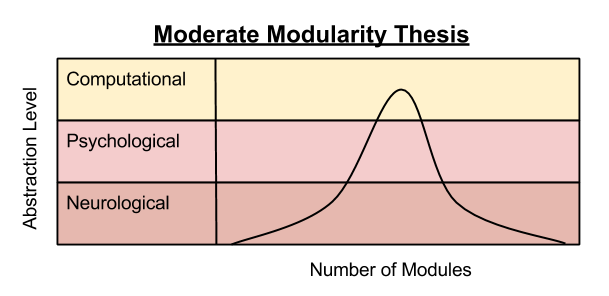
Moderate Modularity

The x-axis captures number of modules, the y-axis leverages David Marr’s concept of Tri-Level Analysis.  The concave shape of the curve represents the claim that, while the number of neurological functions may be large, the number of computational processes (e.g., belief, desire, motivation) is small.

In contrast, the shape of massive modularity thesis is convex:
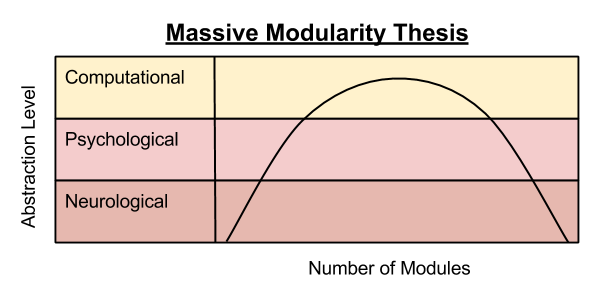
Massive Modularity

While Carruthers elsewhere motivates massive modularity by way of task analysis and ethological surveys, he here defends this latter thesis by appealing to the empirically-robust observation that the brain appears to process its algorithms in parallel, and this would be impossible without a relatively plentiful number of processing units. So we have stumbled upon our last premise:

(9) In the mind, massive modularity is computationally superior to moderate modularity.

Putting It All Together

All that remains is to glue together the sub-conclusions of the above arguments. Specifically, take the following propositions:

(3) Natural selection selects for modularity at a variety of different levels.
(8) Mental processes are subject to natural selection.
(9) Within the mind, massive modularity is computationally superior to moderate modularity.

From these, it is clear we have successfully motivated our thesis:

(10) Natural selection selects for massive modularity in the mind

The entire argument, then, is pictured below.

Massive Modularity- Argument From Design- Summary

Concluding Thoughts

While I happen to affirm Premise 8, I feel like Carruthers – and even more so myself – do a poor job at motivating it. This observation is particularly painful because it is arguably the central thesis of evolutionary psychology. Mental note-to-self: revisit that section of the argument.

All told, I find this argument fairly compelling, although I would like to get more clear on several of its distinctions.


Peirce: The Fixation Of Belief

Parent Index ]

Metadata

Article: The Fixation of Belief
Author: C.S. Peirce
Published: 11/1877
Citations: 1048 (note: as of 04/2014)
Link: Here (note: not a permalink)
Other Resources: Outline (found this via Google Search, but quality isn’t bad)

Summarization text is grayscale, review text (my take) is orange.

Preliminaries

Peirce kicks off this article with a historical survey, nicely showcasing the fact that the scientific enterprise is a quite recent phenomenon on this earth. This suggests that the construction of personal epistemologies is susceptible to cultural influences. As Peirce puts it, “We come to the full possession of our power of drawing inferences, the last of all our faculties; for it is not so much a natural gift as a long and difficult art.”

Peirce also gestures towards the following question: can the reliability of our faculties be evaluated on a domain-by-domain basis? Peirce invokes evolutionary theory in an important move:

Logicality in regard to practical matters is the most useful quality an animal can possess, and might, therefore result from the action of natural selection; but outside of these it is probably of more advantage to the animal to have his mind filled with pleasing and encouraging visions, independently of their truth; and thus, upon unpractical subjects, natural selection might occasion a fallacious tendency of thought.

While many of Peirce’s views on evolution show their age, this particular insight is remarkably prescient: modern philosophers are currently exploring precisely this vein. Once this research is cast to cognitive science, neuroscientists will find themselves in a position to speak quantitatively on the matter. If the above argument is born out by data, this would be a real victory for the pragmatist camp.

Doubt vs. Belief

Doubt is a singularly important notion to Peirce: he conceives it as the primary motivator for critical thinking.

Doubt is an uneasy and dissatisfied state from which we struggle to free ourselves and pass into the state of belief; while the latter is a calm and satisfactory state which we do not wish to avoid, or to change a belief to anything else. On the contrary, we cling tenaciously, not merely to believing, but to believing just what we do believe.

The self-preservation of belief is of particular interest to me. This phenomenon is explored in detail within social psychology and memetics.

The irritation of doubt causes a struggle to attain a state of belief. When doubt ceases, mental action on the subject comes to an end.

With this definition of doubt in place, Peirce goes on to rebut three erroneous conceptions of proof:

  1. The mere putting of a proposition into the interrogative form does not stimulate the mind to any struggle after belief. There must be a real and living doubt, and without this all discussion is idle.
  2. The premises of an argument need not be grounded in some firm metaphysical strata: they merely should be free from doubt.
  3. There is, then, no practical value in arguing a point after all the world is fully convinced of it.

This contextual backdrop resonates with anyone who has tried to persuade someone not subject to real and living doubt. There are times when words move the human heart, and times when they are “just words”. However, I am largely disappointed in this dichotomy as it stands. Questions concerning what underlies, motivates, or justifies doubt are unattended. Peirce may not have been in an empirical position to cognitively explain doubt, but surely he could have afforded to provide a more detailed sketch.

Peirce goes on to detail four methods for the fixation of belief. I will summarize each in turn.

Belief Fixation Method #1: Method of Tenacity

Peirce uses examples to shed light on this way of being:

I remember once being entreated not to read a certain newspaper lest it might change my opinion upon free-trade. “Lest I might be entrapped by its fallacies and misstatements,” was the form of expression. “You are not,” my friend said, “a special student of political economy. You might, therefore, easily be deceived by fallacious arguments upon the subject. You might, then, if you read this paper, be led to believe in protection. But you admit that free-trade is the true doctrine; and you do not wish to believe what is not true.” A similar consideration seems to have weight with many persons in religious topics, for we frequently hear it said, “Oh, I could not believe so-and-so, because I should be wretched if I did.” A man may go through life, systematically keeping out of view all that might cause a change in his opinions…

How, then, are we to evaluate such a method?

It would be an egotistical impertinence to object that his procedure is irrational, for that only amounts to saying that his method of settling belief is not ours. But this method of fixing beliefs will be unable to hold its ground in practice. The man who adopts it will find that other men think differently from him, and it will be apt to occur to him, in some saner moment, that their opinions are quite as good as his own, and this will shake his confidence in his belief. This conception, that another man’s thought or sentiment may be equivalent to one’s own, is a distinctly new step, and a highly important one.

Yes! In my language, I call this Symmetry Debiasing. I intend to write more on this; it has played a role in my own worldview maturation.

Now, this first method is typically localized to the individual. The second method solves the problem of socializing belief acquisition.

Belief Fixation Method #2: Method of Authority

Here, belief is a group activity. Doxastic content is something one inherits, and its contents are to be trusted.

Uniformity of opinion will be secured by a moral terrorism to which the respectability of society will give its thorough approval. Following the method of authority is the path of peace. Certain non-conformities are permitted; certain others (deemed unsafe) are forbidden. These are different in different countries and in different ages; but, whoever you are, let it be known that you seriously hold a tabooed belief, and you may be perfectly sure of being treated with a cruelty less brutal but more refined than hunting you like a wolf.

Evidence for this sort of thing is ubiquitous; with political infighting serving as a nice example.

Thus, the greatest intellectual benefactors of mankind have never dared, and dare not now, to utter the whole of their thought; and thus a shade of prima facie doubt is cast upon every proposition which is considered essential to the security of society.

I like to play a game when I read pre-modern philosophers discuss religion: count the number of sentences wasted in defensive posturing “always remember that when I say X I do not mean Y”. Keeping your eye tuned to this kind of historical artifact, which I call the Placating Price, is a good heuristic for approximating the degree of fear behind the artful prose of the academic. And it has been considerable. Reviewing the posthumous publication of Hume’s Dialogues Concerning Natural Religion underscores this point nicely.

For the mass of mankind, then, there is perhaps no better method than this. If it is their highest impulse to be intellectual slaves, then slaves they ought to remain.

Fighting words.

Belief Fixation Method #3: A Priori Method

Systems of this sort have been chiefly adopted because their fundamental propositions seemed “agreeable to reason”. This is an apt expression; it does not mean that which agrees with experience, but that which we find ourselves inclined to believe. Plato, for example, finds it agreeable to reason that the distances of the celestial spheres from one another should be proportional to the different lengths of strings which produce harmonious chords. Many philosophers have been led to their main conclusions by considerations like this…

This method is far more intellectual and respectable from the point of view of reason than either of the others… but its failure has been the most manifest. It makes of inquiry something similar to the development of taste; but taste, unfortunately, is always more or less a matter of fashion.

Philosophy has acquired a poor reputation in many intellectual circles for precisely this reason. Certain strains of metaphysics constitute, arguably, Diseased Disciplines. Peirce also manages to anticipate modern arguments towards the refactoring of analytic philosophy.

Belief Fixation Method #4: Scientific Method

Peirce goes on to sketch a method familiar to our modern ears: the scientific method.

20071210_ScientificMethod

He also makes the interesting move in tying the method to scientific realism (the belief that things like atoms really exist, are really embedded in spacetime). His defense of scientific realism is as follows

It may be asked how I know that there are any Reals. The reply is this:

  1. If investigation cannot be regarded as proving that there are Real things, it at least does not lead to a contrary conclusion; but the method and the conception on which it is based remain ever in harmony. No doubt of the method, therefore, arise from its practice, as is the case with all the others.
  2. The feeling which gives rise to any method of fixing belief is a dissatisfaction at two repugnant propositions. But here already is a vague concession that there is some one thing which a proposition should represent. Nobody, therefore, can really doubt that there are Reals, for, if he did, doubt would not be a source of dissatisfaction. The hypothesis, therefore, is one which every mind admits. So that the social impulse does not cause men to doubt it.
  3. Everyone uses the scientific method about a great many things, and only ceases to use it when he does not know how to apply it.
  4. Experience of the method has not led us to doubt it, but on the contrary, scientific investigation has had the most wonderful triumphs in the way of settling opinion. These afford the explanation of my not doubting the method or the hypothesis which it supposes; and not having any doubt, nor believing that anybody else whom I could influence has, it would be the merest babble for me to say more about it.

If there be anybody with a living doubt upon the subject, let him consider it.

Peirce and I even share a similar sense of humor. 🙂 I love this parody of Mark 4:23!

Concluding Thoughts

After reading this essay, I do not see myself walking around and categorizing people with Method 1, 2, 3, or 4 (nor even some linear superposition of all four). I am simply not persuaded that these epistemological preferences represent natural kinds.

One might imagine combining Methods 3 and 4, and then casting the three resultant categories to personal dispositions: one based on fear/simplicity/opportunism, another on social belonging, a third on the need for cognition. With this tripartite division of epistemology based on disposition, one could then layer on cultural distinctions, such as intuitive vs quantitative philosophizing. But even this, more sophisticated, account doesn’t feel precise enough for my liking.

Why spend time on this essay if I don’t agree with its central thesis? For one, it brings key questions to the fore:

  • How does doubt affect belief construction?
  • How do individuals go about constructing personal epistemologies?

But, more importantly, the journey to our destination was interesting.

I’ll close with Peirce explaining his preference for the scientific method.

Yes, the methods [besides the scientific method] do have their merits: a clear logical conscience does cost something – just as any virtue, just as all that we cherish, costs us dear. But we should not desire it to be otherwise. The genius of a man’s logical method should be loved and reverenced as his bride, whom he has chosen from all the world. He need not condemn the others; on the contrary, he may honor them deeply, and in so doing only honors her the more. But she is the one that he has chosen, and he knows that he was right in making that choice. And having made it, he will work and fight for her, and will not complain that there are blows to take, and will strive to be a worthy knight and champion of her from the blaze of whose splendors he draws his inspiration and his courage.

A man on fire…

Parent Index ]

[Sequence] C.S. Peirce & Pragmatism

Charles Sanders Peirce (1839-1914) has been called “the father of pragmatism”, “America’s greatest logician”, and “the most original thinker of his time”. He founded the field of semiotics (the study of signs, which I touch on here), invented abduction (inference to the best explanation), and anticipated the work of geniuses like Georg Cantor (mathematics of infinity), Claude Shannon (information theory), and Ernst Zermelo (set theory) by decades.

Peirce met with a fate not unusual for thinkers of caliber: much of his work only came to be fully appreciated posthumously. His writings were never consolidated in book form, and remained largely disorganized until collated into various anthologies.

An autobiographical snippet from a paper entitled Concerning The Author:

My book will have no instruction to impart to anybody. Like a mathematical treatise, it will suggest certain ideas and certain reasons for holding them true; but then, if you accept them, it must be because you like my reasons, and the responsibility lies with you. Man is essentially a social animal: but to be social is one thing, to be gregarious is another: I decline to serve as shepherd. My book is meant for people who want to find out; people who want philosophy ladled out to them can go elsewhere. There are philosophy soup shops at every corner, thank God!

The development of my ideas has been the industry of thirty years. I did not know as I ever should get to publish them, their ripening seemed so slow. But the harvest time has come, at last, and to me that harvest seems a wild one, but of course it is not I who have to pass judgment. It is not quite you, either, individual reader; it is experience and history.

For years in the course of this ripening process, I used to collect my ideas under the designation fallibilism; and indeed the first step toward finding out is to acknowledge you do not satisfactorily know already; so that no blight can so surely arrest all intellectual growth as the blight of cocksureness; and ninety-nine out of every hundred good heads are reduced to impotence by that malady – of whose inroads they are most strangely unaware!

Indeed, out of a contrite fallibilism, combined with a high faith in the reality of knowledge, and an intense desire to find things out, all my philosophy has always seemed to me to grow ….

In many ways, Peirce and I march to the beat of the same drum…

Reviewed essays:

Machery: Précis of Doing without Concepts

Content Summary: 2600 words, 26 minute read.

Introduction

There is no secret that the academic field of concepts is in disarray. In this article, Machery attempts to weave these disparate traditions into a compelling whole.  But first, a quote which serves to motivate what follows:

Why do cognitive scientists want a theory of concepts? Theories of concepts are meant to explain the properties of our cognitive competences. People categorize the way they do, they draw the inductions they do, and so on, because of the properties of the concepts they have. Thus, providing a good theory of concepts could go a long way towards explaining some important higher cognitive competences.

Summarization text is grayscale, my commentary is in orange.

Article Metadata

  • Article: Précis of Doing without Concepts
  • Author: Edouard Machery
  • Published: 11/2009
  • Citations: 178 (note: as of 04/2014)
  • Link: Here (note: not a permalink)

Section 1. Regimenting the use of concept in cognitive science

We start with definitions!

The world is not an undifferentiated sea of chaos. It has statistically noticeable patterns – “joints”. Let us call these delightful patterns in nature a category (or a natural kind). But categories are things in the world, and your mind must somehow learn these categories for itself. Plato once described the act of reasoning as: “That of dividing things again by classes, where the natural joints are, and not trying to break any part, after the manner of a bad carver.” (Phaedrus, 265e). This analogy – to carve nature at its joints – is what concept processes do. Concepts represent categories in your brain.

Let’s get specific about the properties of concepts. Machery defines concept as something that:

  1. Can be about a class, event, substance, or individual.
  2. Nonproprietary, not constrained by the underlying type of represented information.
  3. Constitutive elements can vary over time and across individuals.
  4. Some elements of information about X may not fit into the concept of X; let us call these data background knowledge.
  5. They are used by Default (I will define this in Section 3).

Section 2. Individuating concepts

Is it possible for an individual to possess different concepts of the same category?
Can Kevin possess two concepts of the category of chair?
Yes.
How do we individuate two related pieces of information, that would otherwise fall under the same concept?

I propose [that] when two elements of information about x, A and B, fulfill either of these [individuation] criteria, they belong to distinct concepts:

  • Connection Criterion: If retrieving A (e.g., water is typically transparent) from LTM and using it in a cognitive process (e.g., a categorization process) does not facilitate the retrieval of B (e.g., water is made of molecules of H20) from LTM and its use in some cognitive process, then A and B belong to two distinct concepts (WATER1 and WATER2).
  • Coordination Criterion: If A and B yield conflicting judgments (e.g., the judgment that some liquid is water and the judgment that this very liquid is not water) and if I do not view either judgment as defeasible in light of the other judgment (i.e., if I hold both judgments to be equally authoritative), then A and B belong to two distinct concepts (WATER1 and WATER2).

Section 3. Defending the proposed notion of concept

Time to explore our last property of concepts, “used by Default”. Default is a name for “the assumption that some bodies of knowledge are retrieved by default when one is categorizing, reasoning, drawing analogies, and making inductions”.  Say you are given a word problem involving counting apples and oranges. Default is the claim that a flood of concepts – including but not limited to arithmetic, the apple, the orange, trees, and fruit – will be drawn from long term memory (LTM) stores, and made available to your mental processes automatically.

At least two research traditions go against this claim:

  1. Concepts are not retrieved from LTM automatically, they are rather summoned via conscious attention.
  2. Concepts are drawn from LTM automatically, but they are constructed on-the-fly.  When you see an apple, you do not load a concept of apple that was hashed out long ago, your mind queries your LTM for apple-related background knowledge, constructing transient concepts especially tailored for the peculiarities of the task at hand.

Machery makes three counterpoints:

  1. Only a pronounced amount of recall variability (e.g., highly divergent results for tweaking minor parameters of a word problem) would falsify Default in favor of on-the-fly concept construction.
  2. Empirical investigations only reveal moderate levels of recall variability.
  3. A substantial amount of evidence supports Default.

Section 4. Developing a psychological theory of concepts

A psychological theory of concepts must treat the following concerns:

  • The nature of the information constitutive of concepts
  • The nature of the processes that use concepts
  • The nature of the vehicle of concepts
  • The brain areas that are involved in possessing concepts
  • The processes of concept acquisition

Section 5. Concept in cognitive science and in philosophy

The gist of the section:

Although both philosophers and cognitive scientists use the term concept, they are not talking about the same things. Cognitive scientists are talking about a certain kind of bodies of knowledge, they attempt to explain the properties of our categorization, inductions etc; whereas philosophers are talking about that which allows people to have propositional attitudes. Many controversies between philosophers and psychologists about the nature of concepts are thus vacuous.

An amusing aside that I desire to explicitly ground the definition of vacuous into some theory of concepts, when I come to treat pragmatism.

Anyways, my tentative attempt to restate the above: Philosophers concern themselves with category-concept fidelity, whereas cognitive scientists concern themselves with the lifecycle of the concept within the mental ecosystem.

Section 6. The heterogeneity hypothesis versus the received view

Machery defines the received view as the assumption that, beyond differences within concept subject-matter, concepts share many properties that are scientifically interesting. Machery suggests that this a mistake, and that the evidence suggests the existence of several distinct types of concept. Concept, in other words, is itself not a category (natural kind). A nuanced sentence if you’ve ever heard one. 🙂

The Heterogeneity Hypothesis, in contrast, claims that processes that produce concepts are distinct, that they share little in common.

Section 7. What kind of evidence could support the heterogeneity hypothesis?

Three kinds of evidence are predicted:

  1. When the conceptualization processes fire individually, we expect each to receive strong confirmation in just those experiments.
  2. When the conceptualization processes fire together, outputs may be incongruent, requiring mediation; we thus expect processing delays.
  3. Although the epistemology of dissociations is intricate, we should expect confirmation from neuropsychological data analysis.

Section 8. The fundamental kinds of concepts

Three different kinds of concepts exist in your cognitive architecture:

  1. Prototypes are bodies of statistical knowledge about a category, a substance, a type of event, and so on. For example, a prototype of dogs could store some statistical knowledge about the properties that are typical of dogs and/or the properties that are diagnostic of the class of dogs… Prototype are typically assumed to be used in cognitive processes that compute similarity linearly.
  2. Exemplars are bodies of knowledge about individual members of a category (e.g., Fido, Rover), particular samples of a substance, and particular instances of a kind of event (e.g., my last visit to the dentist). Exemplars are typically assumed to be used in cognitive processes that compute the similarity nonlinearly.
  3. Theories are bodies of causal, functional, generic, and nomological knowledge about categories, substances, types of events, etc. A theory of dogs would consist of some such knowledge about dogs. Theories are typically assumed to be used in cognitive processes that engage in causal reasoning.

Some phenomena are well explained if the concepts elicited by some experimental tasks are prototypes; some phenomena are well explained if the concepts elicited by other experimental tasks are exemplar; and yet other phenomena are well explained if the concepts elicited by yet other experimental tasks are theories. As already noted, if one assumes that experimental conditions prime the reliance on one type of concept (e.g., prototypes) instead of other types (e.g., exemplars and theories), this provides evidence for the heterogeneity hypothesis.

Let’s illustrate this situation with the work on categorical induction – the capacity to conclude that the members of a category possess a property from the fact that the members of another category possess it and to evaluate the probability of this generalization… the fact that different properties of our inductive competence are best explained by theories positing different theoretical entities constitutes evidence for the existence of distinct kinds of concepts used in distinct processes. Strikingly, this conclusion is consistent with the emerging consensus among psychologists that people rely on several distinct induction processes.

These arguments seems quite powerful at first glance. Even after reviewing peer-reviewed criticisms, its strength does not feel much diminished. Pending my own research into the forest of citations embedded within this section, I will proceed with my theorizing as though the Heterogeneity Hypothesis is true.

Section 9. Neo-empiricism

In contrast, neo-empiricism can be summarized with the following two theses:

  1. The knowledge that is stored in a concept is encoded in several perceptual and motor representational formats.
  2. Conceptual processing involves essentially re-enacting some perceptual and motor states and manipulating those states.

Amidst broader empirical concerns, Machery outlines three problems for the neo-empiricist school:

  1. Anderson’s problem: many competing versions of amodal concept theories exist, and neo-empiricists tend to assert victory over weaker versions of amodal theorizing.
  2. Imagery problem: it is hard to affirm that imagery is the only type of processes people have; people seem to have amodal concepts that are used in non-perceptual processes.
  3. Generality problem: some concepts (magnitude of classes, tonal sequences) have been empirically shown to be amodal, but neo-empiricists are bound to assume that all concepts are perceptual.

However, despite these concerns, Machery is happy to concede that there may “be something to” neo-empiricist arguments. In which case a fourth, a perceptual process would be added to the hypothesis. But the author suggests that, at this time, there is simply not enough evidence to justify this fourth concept-engine.

Machery seems not to appreciate an obvious implication here. Recall that all concepts are “conceived” and “reared” under perceptual supervision. What is there to prevent a daisy-chaining effect, whereby concepts are recalled which drag with them perceptual reconstructions, which permit new conceptual manipulations, etc. This information pathway could explain phenomena such as Serial Associative Cognition, a Stanovitchian term.  One weakness of Machery is that he does not draw enough constraints from the broader decision-making literature; Serial Associative Cognition must be explained in the language of concepts just as much as Similarity Judgments.

Speaking generally, the manner in which percepts influence concept modification is severely under-explored. The exact same percept of a dog could be the first draft of an exemplar-concept (e.g., an infant), could subliminally modify a prototype-concept (e.g., an adult), or could explicitly falsify a theory-concept (e.g., a veterinarian).  In the final analysis, it strikes me as unlikely that a perceptual concept-constructor module would simply be a cousin to the other three. I would expect neo-empiricist arguments to  ultimately be housed in some larger framework, with a more complete description of perceptual processing.

Section 10. Hybrid theories of concepts.

Hybrid theories of concepts grant the existence of several types of bodies of knowledge, but deny that these form distinct concepts; rather, these bodies of knowledge are the parts of concepts. Some hybrid theories have proposed that one part of a concept of x might store some statistical information about the x’s, while another part stores some information about specific members of the class of x’s, and a third part some causal, nomological, or functional information about the x’s…. [but] evidence tentatively suggests that prototypes, set of exemplars, and theories are not coordinated [in this way].

Section 11. Multi-process theories

While Machery is quick to cede that the evidence for many cognitive processes is incontrovertible, he retorts that dual-process theories traditionally fail to answer the following two issues:

  1. In what conditions are the cognitive processes underlying a given [module] triggered?
  2. If the cognitive processes are [simultaneously] triggered, how does the mind [coordinate] their outputs?

A legitimate criticism of dual-process theories.

What is known [regarding concepts and dual-process theories] can be presented briefly. It appears that the categorization processes can be triggered simultaneously, but that some circumstances prime reliance on one of the categorization processes. Reasoning out loud seems to prime people to rely on a theory-based process of categorization. Categorizing objects into a class with which one has little acquaintance seems to prime people to rely on exemplars. The same is true of these classes whose members appear to share few properties in common. Very little is known about the induction processes except for the fact that expertise seems to prime people to rely on theoretical knowledge about the classes involved.

This is irrelevant to dual-process theory… dual-process theory is concerned with how some mental processes become conscious, decontextualized, slow, and effortful, etc. The above quote is instead an unrelated (albeit interesting) glimpse at how the different conceptualization modules may interact.

Section 12. Open questions

Machery identifies three directions for future inquiry:

  1. There are several prototype theories, several exemplar theories, and several theory theories. It remains unclear which theory [of each type] is correct. Too little attention has been given to investigating the nature of prototypes, exemplars, and theories.
  2. The factors that determine whether an element of knowledge about x is part of the concept of x rather than being part of the background knowledge about x.
  3. How conceptualization may cohere with dual-process theories.

Dual-process theory is actually more expansive than Machery allows. The concept of Default, defined in section 3, is a System1 behavior. Thus, the questions of Default vs. Manual Override, Concept vs. Background Knowledge… these swiftly become absorbed into the need for dual-process theorizing…

Section 13. Concept eliminativism

Machery finally advances tentative philosophical and sociological reasons one might banish concept from our professional vocabulary.

Theoretical terms are often rejected when it is found that they fail to pick out natural kinds. To illustrate, some philosophers have proposed to eliminate the term emotion from the theoretical vocabulary of psychology on these grounds. The proposal here is that concept should be eliminated from the vocabulary of cognitive science for the same reason.

The continued use of concept in cognitive science might invite cognitive scientists to look for commonalities… if the heterogeneity hypothesis is correct, these efforts would be wasted. By contrast, replacing concept with prototype, exemplar, and theory would bring to the fore urgent open questions.

Interesting suggestions. However, I think it is clear more theoretical weight lies in Machery’s heterogeneity hypothesis.

Concluding Thoughts

Three different kinds of concepts must imply three different kinds of conceptualization modules.

Novel prediction: damage to any one of these modules must inhibit only one of kind of conceptualization.

Much, much more work is needed…

One counterargument made in the responses to this Précis caught my eye. David Danks of CMU argues that all three conceptualization modules can be modeled as special cases of a singular graphical model representation.  His paper, Theory Unification and Graphical Models in Human Categorization (2007), serves to this effect. Machery’s reply to this counterpoint is brief, pointing to its disconnect to biological evidence, although Machery elsewhere allows that causal models might underlie concept-theory construction (c.f., A Theory of Causal Learning in Children: Causal Maps and Bayes Nets (2004)).

I will close with a quote made by Couchman et. al, in a response to this Précis:

Our task is to carve nature at its joints using the psychological knife called concepts. It is true, it is profoundly important to know, and it is all right for the progress of science that the knife is Swiss-Army issue with multiple blades.

[Sequence] Evans-Pritchard: Witchcraft, Oracles & Magic Among The Azande

azande

I read this classic text several years ago, and it left a lasting effect on me.

The Zande people are primarily a small-scale farming population located in central Africa. Their demographics are split between Democratic Republic of the Congo, in South Sudan, and the Central African Republic:

Zandeland_location

Evans-Pritchard briefly sketches Azande life in general, before zooming in on their complex religious system. At time of writing, 1937, these traditions had already begun to erode in the wake of European cultural imperialism. Racing against the clock, as it were, Evans-Pritchard managed to document the essence of these practices before they faded in the memories of the community.

Evans-Pritchard is a consummate professional, and this shows in his ethnographies. Azande culture and mysticism is explored in detail, and their customs – foreign to our ears – are treated largely without distracting judgment. Azande seeks spiritual answers from three kinds of oracles, each with increasing power: rubbing board, termite, and poison oracles. This practice was enmeshed in their legal system, their social structure, and their metaphysical beliefs. Azande culture further complemented these oracles by means of complex, interlocking theories of magic, and the social and medicinal contributions of a witch-doctor population:

Link: Summary

For me, the most interesting part of the book had to do with the relationship between mysticism and attention. Most of the following quotes relate to this.

Link: Quotes

To understand why it is that Azande do not draw from their observations the conclusions we would draw from the same evidence, we must realize that their attention is fixed on the mystical properties of the poison oracle and that its natural properties are of so little interest to them that they simply do not bother to consider them.

Observations such as the above suggest that disinterest in certain question-categories is not some random phenomenon that can be taken at face value. Azande individuals systematically experience disinterest in doubt-provoking challenges to their mystical ideology, and this “attention funnel” is anything but pre-meditated. Thus, attentional habits are not solely artifacts of personality: they also can be subpersonal, they are also influenced by culture: they do not necessarily serve the interests of their owners.

Finally, it would seem myopic to suppose that this quirk of human psychology is contained to this one culture. Perhaps this is enough to drive home my takeaway: treat disinterest with suspicion.

The Software That Is You

Part Of: Cognitive Architecture sequence
Content Summary: 500 words, 5 min read

When I first started teaching myself psychology, a metaphor that resonated with me was that of “cognitive furniture”. At the time, it captured much of my unhappiness with the tabula rasa described by Hobbes, the introspective privileges provided by Descartes, and the folk psychology embedded within my culture. To state the insight of this metaphor in my language: the mind has a shape.

Explanatory Scope

The scope of cognitive science is, simply, the entirety of the human experience. Consider the breadth of our task. Our theory must generate – from scratch – the list of human universals generated by anthropologists. The entire breadth of differences between generations, cultures, individuals must be afforded by micro-modifications to this one architecture. Whence our evidence? From every conversation, every relationship, every page of every book, and practically everything else.

This is not to say that other disciplines will be left with nothing to contribute. For example, sociology conceives of human experience at a different level of analysis. While human social networks will ultimately reduce to human social modules, sociology will remain fertile (just as chemistry persists after its reduction to physics via quantum chemistry).

Target Perspectives

I will wear many hats during our survey. These hats include:

  • Ecological pressures on the genesis of the homo sapiens central nervous system (evolutionary psychology, ecology, etc)
  • Methods by which mental modules interact within their ecosystem (cognitive psychology, social psychology, etc)
  • Computational principles and neurobiological substrates of mental modules (cognitive neuroscience, anatomy, etc)

I plan to index this research with two lists:

  1. The Module Master List will collect furniture of the human mind. A common style of theorizing here will be upward theorizing, moving from module-talk to behavior-talk. For example, I intend to treat your attachment module with this strategy.
  2. The Explananda Master List will collect behaviors of the human species. A common style of theorizing here will be downward theorizing, moving from behavior-talk to module-talk. For example, I intend to treat romantic love with this strategy.

Motivations

This series of posts is not the regurgitation of a solitary researcher. I am motivated by a particular vision of integrative research: I will jump from discipline to discipline compressing results, evaluating controversies, and conducting metasurveys. I intend to explicitly link my work to the existing literatures as much as I can; I view original research as an activity best positioned “on the shoulders of giants”. In my estimation, integrative research purchases its ability to organize and cross-fertilize at the price of ambiguity, and I am not immune to this tradeoff.

To conclude on an organizational note, everything about this project will become more sophisticated as my research perspective evolves (put another way, much of my writing will embarrass me within six months). Given my driving purpose – to deliver clear and correct results – outdated content may be summarily removed or overwritten. Refactors to the above organization (e.g., moving from two Master Lists to three) is more difficult to anticipate but should flow along a similar vein. Outdated content will only be saved & versioned if deemed to serve some secondary purpose.

Time to discover how an algorithm feels from the inside.

Baars: The Conscious Access Hypothesis, Origins and Recent Evidence

Article Details

Article: The conscious access hypothesis: origins and recent evidence
Author: Bernard J Baars
Published: 01/2014
Citations: 581 (note: as of 03/2014)
Link: Here (note: not a permalink).

Context

In 1988, Bernard Baars authored A Cognitive Theory of Consciousness, which presented his Global Workspace Theory (GWT) of consciousness. In short, he argues that consciousness is caused by global inter-brain sharing of information. This theory does not concern itself much with the construction of phenomenology, and thus does not qualify as a solution to the Hard Problem of Consciousness (which is well explained here).

Methodology

Scientific efforts to understand consciousness evoked vigorous philosophical objections. These were essentially the classic mind-body problems: how does private experience relate to the physical world? … Difficult conceptual questions are routine when the sciences turn to new topics. The traditional scientific response is simply to gather relevant evidence and develop careful theory. Ultimately, philosophical controversies either fade, or they compel changes in science if they have empirical consequences.

I like this quote. While it doesn’t encapsulate my sentiments on the role of philosophy, its call for empirical analysis was long overdue.

You may find yourself asking: how can neuroscience examine consciousness, if consciousness is private to the individual? Baars advocates using an operational definition of conscious awareness: consciousness is the ability to produce a reliable report. An example: suppose I flash a number (0-9) on your monitor, and then ask its value. Say I present the number three for 200 milliseconds. If I ask you what you saw, you would be able to report your conscious experience. But, say I present the same number for 2 milliseconds. If I then ask you what you saw, you would not be able to report the correct value better than a ten-sided die. By this means, I have acquired a variable that represents whether a task is associated with consciousness.

How can we causally distinguish between the effect of consciousness and, say, the effect of low IQ on a given task? Well, most neuroscientific inquiries into consciousness employ a technique Baars refers to as contrastive analysis. This technique involves comparing processes that induce conscious awareness only occasionally. Let’s suppose that, in the above example, 200ms corresponded to 98% correct reports, whereas 2ms corresponded to 3% of subjects being aware of the change consciously. I would then be tempted to “turn the display-time knob” so any one person has a 50% chance of perceiving the number, and then analyzing the differences between the two groups. To see an example of contrastive analysis beyond the above toy model, Baars cites Dehaene et al [1] as an exemplar.

A Philosophical Aside

It is, first, important to distinguish between operational definitions such as the above, and operationalism, which is a more extreme call to operationalize all scientific concepts. While the latter movement is today widely regarded as unhelpful, that doesn’t seem to problematize the desire to operationalize some definitions, such as consciousness or volition.

Let me sketch a problem that will be familiar to any philosophers. The question of philosophical zombie was memorably treated by Descartes: is it possible for a human being behave exactly as one who is conscious, reporting conscious experiences to anyone who may ask, but entirely devoid of an inner life? This metaphysical question has not been satisfactorily resolved. However, let us reframe this question in nomological terms: is consciousness causally linked to the human nervous system? If we provisionally accept the operational definition of consciousness above, we are in position to answer this question with data.

Evidences

The data seems to say yes. Consciousness hugely contributes to the functioning of our nervous system. In this paper, Baars sketches seven lines of evidence that have accumulated since his theory’s inception (1988).

  1. Conscious perception involves more than sensory analysis; it enables access to widespread brain sources, whereas unconscious input processing is limited to sensory regions.
  2. Consciousness enables comprehension of novel information, such as new combinations of words.
  3. Working memory depends on conscious elements, including conscious perception, inner speech, and visual imagery, each mobilizing widespread functions.
  4. Conscious information enables many types of learning, using a variety of different brain mechanisms.
  5. Voluntary control is enabled by conscious goals and perception of results.
  6. Selective attention enables access to conscious contents, and vice versa.
  7. Consciousness enables access to ‘self’: executive interpretation in the brain.

A wealth of data bolsters the above theses; I would point the interested reader to the article.

Baars goes on to claim that his GWT explains the above seven evidences. If GWT is to be overturned, its replacement must do even better.

Mechanisms of Brain Access

So, we see evidence of conscious activity being correlated with full-brain activation. But what mechanisms might produce full-brain activation? Baars identifies several research traditions exploring different (potentially complementary) answers to the question:

  • Dehaene and Changeux have focused on frontal cortex [1]
  • Edelman and Tononi on complexity in re-entrant thalamocortical dynamics [2]
  • Singer and colleagues on gamma synchrony [3]
  • Flohr on NMDA synapses [4]
  • Llinas on a thalamic hub [5]
  • Newman and Baars on thalamocortical distribution from sensory cortex [6]

Thoughts

Baars notes in his article that efforts to integrate research on attention and consciousness are long overdue. I would go a step further. His theory of consciousness also ought to be integrated with:

  • dual-process theory (theoreticians have already correlated System 2 with conscious awareness)
  • working memory (Alan Baddeley is already struggling to integrate his Central Executive with conscious awareness)

References

1. Dehaene, S. et al (2001) Cerebral mechanisms of word masking and unconscious repetition priming.
2. Tononi, G. and Edelmen, G.M. (1998) Consciousness and complexity.
3. Engel, A.K and Singer, W (2001) Temporal binding and the neural correlates of sensory awareness.
4. Flohr, H et al (1998) The role of the NMDA synapse in general anesthesia.
5. Llinas, R et al (1998) The neuronal basis for consciousness.
6. Newman, J and Baars, B.F. (1993) A neural attentional model for access to consciousness: a global workspace perspective.

Exploring Biofeedback

Motivation

The integrative theorist approaches everyday life differently: familiarity is replaced with explanation. Some aspects of our existence are more explained than others. Observing a rainbow is a less mystifying experience than watching people laugh at a soap opera.

I enjoy watching yoga instructors summarize how various postures affect their bodies. Some of their explanations feel vacuous; perhaps “toxin cleansing” talk must be more satisfying emotionally, than intellectually. However, many of their observations are both manifestly true and surprising. Grist to the mill.

With more training in anatomy, many of these phenomena would cease to surprise. However, not all of these surface-level observations already have pre-packaged explanations. Let’s go exploring!

Requisite Concepts

Your brain likes to process information via topological maps. Your vision system processes information in this way, different locations in Area V1 strongly correspond with locations in your visual field. Our brain maintains other maps as well, including a map of your own body. This map cannot be consciously altered, and it may contain erroneous information (c.f., phantom limbs and the neuromatrix theory of pain).

Another requisite concept I will call sensory consilience. Humans possess equilibrioception. As Wikipedia explains, “the organ of equilibrioception is the vestibular labyrinthine system found in both of the inner ears.” How, then, are we to explain this observation known to those who practice yoga: closing one’s eyes makes one more susceptible to falling? Visual information is combined with balance information in perceptual centers of the brain, to create a strengthened notion of balance.

Lastly, I want to distinguish between the sympathetic and parasympathetic system. Speaking impressionistically: the sympathetic system prepares the body for “fight or flight” by raising heart rate, blood pressure, muscular readiness, etc; whereas the parasympathetic system returns the body to a more calm, restorative, sustainable physiological condition.

The Promise Of Biofeedback Therapy

Biofeedback therapy is an emerging technology that shows a good deal of promise. People who can watch their heartbeat on a monitor tend, on average, to be more quickly able to lower their pulse. Neurofeedback is a particularly interesting version of this therapy; for example, depressed patients may achieve symptom relief by introspecting while they have access to an fMRI image of their brains.

From a sensory perspective, what is going on? Without biofeedback, patients aren’t completely ignorant of their bodily state. We can be made aware of our elevated heartbeat by auditory means (throbbing), chemical means (headrush), etc. Biofeedback augments this pre-existent information with new, visual information from the monitor.  In other words, biofeedback encourages sensory concilience.  While the details of how these disparate data sources are combined remain elusive, we can safely conclude that the result of this computation updates the body map.

Sensory consilience is clearly a System 1 activity: no one consciously orchestrates how vision corroborates equilibrioception. Yet biofeedback opens new channels of sensory consilience, and these new channels require time to be installed. Just as with any other habit, it takes time for the new source of information to “bootstrap into your subconscious processes”.

Making Sense Of Dance

I’ve recently decided that rocking out in the car is fun. 🙂 But, dancing too energetically causes an interesting reaction: some muscles complain, but subsequently the entire body feels fatigued. Dancing in moderation seems to have the opposite effect: certain muscles report strength, and subsequently the entire body feels energized.

This type of observation surely informs the fact that many people engage in mild “hand motions” while enthusiastically talking, etc.

How do we make sense of this?

Emotion evolved to facilitate behavior.
Why is fatigue? Fatigue is the message that the body is ready to slow down (parasympathetic system)
Why is energy? Energy is the message that the body is ready to speed up (sympathetic system)

But evolution is a kluge. These emotions would subserve behavior more precisely if they addressed particular muscle groups. But they do not. Pumping a fist to the beat causes the legs to feel tired. Communication gestures that energize the whole body is a physical lie (you do not, on the basis of those signals, know that you are in better condition to run a marathon) that is employed for psychological reasons (resources that would have been paid to, say, digestion, are now redirected towards cognition).

Making Sense Of Remedial Smiling

Bikram Yoga is aerobic activity conducted in a room set to 100 degrees, 30% humidity. It is not uncommon to become overwhelmed, to not move until your body regains control of itself. The last time I went, after a particularly grueling set of poses, we laid on our backs and breathing hard through the nostrils, recovering. The instructor advised us to smile while exhaling. After trying out this suggestion, the advice seemed to bear fruit, but only if the magnitude of the gesture is controlled. In moments with extreme sympathetic activity, facial expressions made things worse; in moments where the parasympathetic system was just beginning to take over, a smirk was the optimum gesture.

This type of observation surely informs the fact that people suffering from melancholy are encouraged to force themselves to smile.

How do we make sense of this?

First, we need to admit some form of mental bidirectionality. Introspection is not the only way to edit your mental state: what you do can modify what you feel. But, we can become more specific than this. How could the act of smiling ever cause happiness?

Perhaps we could appeal to some mechanism that takes our current emotional state, and our current behavioral, as inputs.  It would then compare the two, and attempt to smooth out their differences. If we perceive ourselves smiling while slightly melancholic, perhaps these two signals will be reconciled within the body map. But if we perceive ourselves smiling while intensely melancholic, perhaps the reconciliation will fail and our self-image is instead linked to feelings of insincerity.

Conclusion

The above is too vague for my liking… I hope to improve on it later.

Let me close by bookmarking yoga-inspired observations that beg for explanation:

  • Why am I encouraged to close my eyes at the end of class, but not during it?
  • Why am I encouraged to almost always breath through my nose, rather than my mouth?