Part Of: Demystifying Ethics sequence
Content Summary: 1700 words, 17 min read
The contents of our social intuitions is not arbitrary. They are not entirely plastic to changes in environment. Rather, the brain are built with innate social intuition generators, which bias the content of social judgments.
Generator 1: Care/Harm
Parents care for their children. This imperative of natural selection is directly expressed in caregiving mechanisms in the brain. While the proper domain of caregiving is one’s kin, other modules (such as the mammalian attachment module) can elicit caregiving behaviors towards non-kin.
For primates living in close proximity, male violence is an increasingly noxious threat. Accordingly, Cushman et al (2012) show evidence for a violence aversion device, which triggers a strong autonomic reaction to actions of violence committed by oneself (but not others). Here is an example of their experimental apparatus: underneath the X is a fake leg. Even though they knew the action was harmless, delivering the blow caused significant visceral distress, compared to watching it being done by someone else. 
The violence aversion device is sensitive to calculations of personal force which is used to generate feelings of agency in the brain. The alarm only triggers when our body directly delivers force onto another person. This explains why the alarm triggers in the footbridge dilemma (“push the fat man to save five lives”) but not the trolley problem (“flip a switch to kill one and save five”).
Generator 2: Proportional Fairness
Main Article: Evolutionary Game Theory
When interacting with other organisms, one can act purely selfishly or cooperatively. The Prisoner’s Dilemma illustrates that acting in one’s self-interest can lead to situations where everyone loses. There is strong evolutionary pressure to discover cooperative emotions: devices that avert the tragedy of the commons.
The Iterated Prisoner’s Dilemma (IPD) makes game theory more social, where many players compete for resources multiple times. While one-off PD games favor selfish behavior, IPD can favor strategies that feature reciprocal altruism, such as Tit-for-Tat. More generally, IPD strategies do best if they are nice, retaliating, and forgiving.
Social equality is a special case of proportionality: when contributions are equal, so too should rewards. But when contributions are unequal, most adults affirm reward inequality. We have a deep intuitive sense of karma: what people deserve depends on how much effort they expend.
Generator 3: Dominance
Main Article: An Introduction to Primate Societies
When animals’ territory overlaps, they often compete for access to resources (e.g., food and reproductive access).
Fighting is accompanied with risk: the stronger animal could be unlucky, the weaker animal could lose their life. Similar to human warfare, both sides suffer less when the weaker side preemptively surrenders. The ability to objectively predict the outcome of a fight is therefore advantageous.
Suppose the need for fight-predictions is frequent, and do not often change (physical strength changes only slowly over an animal’s life). Instead of constantly assessing physical characteristics of your opponent, it is simpler to just remember who you thought was stronger last time.
This is the origin of the dominance hierarchy. The bread and butter of dominance hierarchies is status signaling. Dominant behaviors (e.g., snarling) evokes submissive behaviors (e.g., looking away).
Generator 4: Autonomy
Consider the following facts.
- The earliest groups of humans seem to have been governed by an egalitarian ethic, much as surviving communities of nomadic hunters and gatherers still are.
- That ethic is unique among other species of great apes that are our closest cousins. Most notably, chimps and gorillas live in bands led by despotic alpha males.
- As human societies developed settled agriculture and then civilization, despotism and hierarchy reemerge.
How can we explain these things? Perhaps a new emotional system evolved: autonomy. It motivated groups of non-dominant humans to form coalitions against any potential alpha despot. This trend is born out in the data: about half of all murders cross-culturally have an anti-bullying motive. But murder is not the only sanctioning device, followers also use techniques such as criticism, ridicule, disobedience, deposition, and desertion (Boehm, 2012).
Our species never lost its capacity for despotism. But in the human inverted hierarchy, our species discovered a newfound will to tear down authority figures, which created within us a capacity for egalitarianism. These two systems (Autonomy and Dominance) live in tension with one another, and one can “gain the upper hand” by changes in the broader cultural milieu (cf., agriculture and the collapse of egalitarian societies).
Generator 5: Purity / Disgust
Main Article: The Evolution of Disgust
The human brain comes equipped with two systems:
- Poison monitoring is a faculty of the digestive system. It evolved to regulate food intake and protect the gut against harmful substances.
- Infection avoidance is a faculty of the immune system. It evolved to protect against infection from pathogens and parasites, by avoiding them.
In humans, these two systems were entangled in the emotion of disgust. This explains the otherwise baffling diversity of disgust elicitors & behaviors.
Disgust motivated the creation of food taboos (e.g., don’t eat pork) and purity laws (e.g., don’t put your feet on the table).
Generator 6: Group Loyalty
Two people can put Us ahead of Me by belonging to a cooperative group, provided that group members can reliably identify one another. Specifically, we possess a group membership device which uses symbols to delineate different factions. Members of the ingroup are treated warmly (ethnocentrism); members of the outgroup are treated poorly (xenophobia). We even pay more attention to members of the ingroup, leading to such phenomena as outgroup homogeneity (c.f., evangelical Christians describing non-evangelicals as “the world”).
Ethnic psychology describes modules in our brain responsible for constructing groups. We are particularly interested in constructing stereotypes of other groups. Our brains already come equipped with folk biology modules that delineate different species of flowers, for example. Gilwhite et al (2001) adduce evidence that ethnic groups are treated as biological “species” in the human brain.
The Right Kind of List
We’ve discussed six intuition generators: care/harm, proportional fairness, dominance, autonomy, purity/disgust, and group loyalty.
Is our list too long? So many mechanisms to explain human social behavior would seem to violate parsimony. Are we adorning our theory with epicycles? Are we overfitting our model?
In fact, I affirm the massive modularity hypothesis: that the human brain contains dozens of mental modules, each of which have distinctive phylogeny, ontogeny, anatomy, behavioral profile, and ecological motivation. I have not conjured these entities to explain morality. Rather, I am drawing a small subset from my overarching project to describe the architecture of mind.
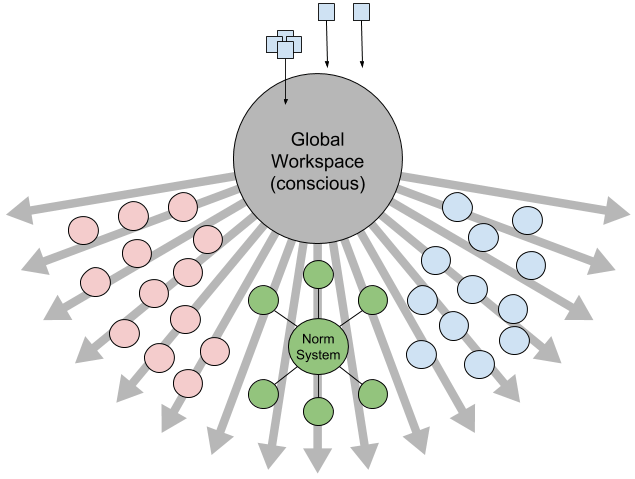
Implications for the Norm System
Recall the the moral/conventional distinction:
- Conventional judgments (should / should not) are intuitions of socially appropriate behavior, and associated with embarrassment.
- Moral judgments (good / evil) are also judgments about behavior, but more associated with anger, inflexibility, condemnation, and guilt.
Jonathan Haidt claims that these generators are responsible for moral intuitions. But the above generators also underlie the structure of our conventional norms. After all, there are plenty of mildly disrespectful behaviors that even the most conservative people would not describe as evil.
We have identified dozens of other specialized modules in the human brain. Why is e.g., feeling of knowing (recognition memory) not on our list? Because there were no biocultural pressures to integrate it with the norm acquisition and norm evaluation systems. We call our six modules social intuition generators because they have become intertwined with our normative machinery.
An Explanation of American Politics
People are genetically and environmentally disposed to respond to certain generators more strongly than others. Social matrices encode how many stimuli activate a given social intuition, and how strongly.
People with similar matrices tend to gravitate towards similar political parties. When you measure the social matrices of American citizens, you can see large differences between the social intuitions of Democrats and Republicans (Graham et al, 2009).
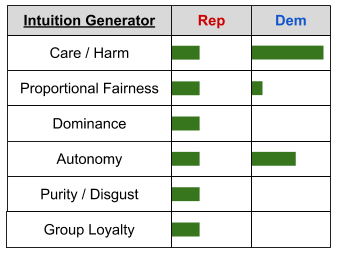
These differences in social matrices explain much of American politics.
- Why do Democrats praise entitlements, but Republicans denounce them? Because Democrats heavily emphasize Care for the poor, whereas Republicans more strongly reverberate to questions of Proportional Fairness (moral hazard).
- Why are Democrats more skeptical of patriotism than their Republican counterparts? Perhaps because they respond to Loyalty to country less.
- How can both groups claim to value Proportional Fairness? There are two competing explanations for poor outcomes: environmental (bad luck) or personal (poor character). Liberals tend to focus on the former, conservatives on the latter.
- How can both groups claim to value Autonomy? For liberals, Autonomy responds ethnic oppression: perceived injustices done in the name of one’s tribe. The foundation is expressed as group symmetry. For conservatives, Autonomy responds to government oppression: perceived injustices in the form of taxes, nanny state, and regulations. The foundation is expressed as political liberty.
Looking Forward
Moral Foundations Theory is the invention of Jonathan Haidt, who introduces the concept in his excellent 2012 book The Righteous Mind: Why Good People are Divided by Politics and Religion. You can explore your moral matrix at yourmorals.org.
This post is 90% exposition, and 10% innovation. I innovate in the preceding two sections, by a) linking the six “taste buds” to mental modules that modulate inputs to the normative system, and b) broadening its reach to conventional (non-moral) norms.
In his book, Haidt makes the case the conservatives are more ethically sophisticated, because their moral judgments respond to a larger number of taste buds. But besides appealing to the ethos of Durkheim and Burke, Haidt doesn’t investigate the normative status of the social intuition generators in sufficient detail.
Here are three questions I would like to explore, at some point:
- What is the normative status of e.g., disgust? If we could dampen or amplify disgust reactions in human beings, what would be the end result?
- Social matrices encode different modes of existence that are hard to comprehend unless they are lived. What sort of social matrices are underexplored? Does there exist entirely novel modes of existence that we simply have not yet tried out?
- What does the moral matrix of a successful metamorality look like? How do we promote positive outcomes when moral communities must live with one another?
Related Resources
- Boehm (2012). Hierarchy in the Forest: The Evolution of Egalitarian Behavior
- Haidt (2012). The Righteous Mind: Why Good People are Divided by Politics and Religion.
- Graham et al (2009). Liberals and conservatives rely on different sets of moral foundations.
- Cushman et al (2012). Simulating murder: the aversion to harmful action
- GilWhite et al (2001). Are ethnic groups biological “species” to the human brain? Essentialism in our cognition of some social categories


 Fewer Lacunae