Construal Level Theory: Musings

Table Of Contents

  • Introduction
    • Context
    • Overview of CLT
  • Insight Scratchpad
    • Mental Health
    • Skills
    • Thinking Modes
  • Application
    • Self-Diagnosis
    • Theory Integration

Introduction

Context

This weekend, I started digging into Construal Level Theory (CLT). This post is ultimately a snapshot of my learning process. It is not comprehensive, nor polished.  I have a place for it yet within the theoretical apparatus of my mind & this blog: it contains more questions than answers.

Anyways, I hope you enjoy some of the quotes at least; I found some of them to be extremely thought-provoking. (Unless noted otherwise, quotes are taken from this Psychlopedia review article).

Overview of CLT

Construal Level Theory (CLT) arises from noticing the interchangability of traits. Psychologists have begun to notice two distinct modes of human thought:

  • Near Mode: All of these bring each other more to mind: here, now, me, us; trend-deviating likely real local events; concrete, context-dependent, unstructured, detailed, goal-irrelevant incidental features; feasible safe acts; secondary local concerns; socially close folks with unstable traits.
  • Far Mode: Conversely, all these bring each other more to mind: there, then, them; trend-following unlikely hypothetical global events; abstract, schematic, context-freer, core, coarse, goal-related features; desirable risk-taking acts, central global symbolic concerns, confident predictions, polarized evaluations, socially distant people with stable traits.

In their review article, theorists Trope and Liberman summarize:

The fact that something happened long ago does not necessarily mean that it took place far away, that it occurred to a stranger, or that it is improbable. Nevertheless, as the research reviewed here demonstrates, there is marked commonality in the way people respond to the different distance dimensions. [Construal level theory] proposes that the commonality stems from the fact that responding to an event that is increasingly distant on any of those dimensions requires relying more on mental construal and less on direct experience of the event. … [We show] that (a) the various distances are cognitively related to each other, such that thinking of an event as distant on one dimension leads one to thinking about it as distant on other dimensions, (b) the various distances influence and are influenced by level of mental construal, and (c) the various distances are, to some extent, interchangeable in their effects on prediction, preference, and self-control.

Insight Scratchpad

Mental Health

After individuals experience a negative event, such as the death of a family member, they might ruminate about this episode. That is, they might, in essence, relive this event many times, as if they were experiencing the anguish and distress again. These ruminations tend to be ineffective, compromising well-being (e.g., Smith & Alloy, 2009).

In contrast, after these events, some individuals reflect more systematically and adaptively on these episodes. These reflections tend to uncover insights, ultimately facilitating recovery (e.g., Wilson & Gilbert, 2008).

When individuals distance themselves from some event, they are more inclined to reflect on this episode rather than ruminate, enhancing their capacity to recover. That is, if individuals consider this event from the perspective of someone else, as if detached from the episode themselves, reflection prevails and coping improves. In contrast, if individuals feel immersed in this event as they remember the episode, rumination prevails and coping is inhibited. Indeed a variety of experimental (e.g., Kross & Aydyk, 2008) and correlational studies (e.g., Ayduk & Kross, 2010) have substantiated this proposition.

When processing trauma, then, inducing abstract construals is desirable.

Arguably, depressed individuals tend to adopt an abstract, rather than concrete, construal. Consequently, memories of positive events are not concrete and, therefore, do not seem salient or recent. Indeed, people may feel these positive events seem distant, highlighting the difference between past enjoyment and more recent distress.

As this argument implies, memory of positive events could improve the mood of depressed individuals, provided they adopt a concrete construal. A study that was conducted by Werner-Seidler and Moulds (2012) corroborates this possibility. In this study, individuals who reported elevated levels of depression watched an upsetting film clip. Next, they were told to remember a positive event in their lives, such as an achievement. In addition, they were told to consider the causes, consequences, and meaning of this event, purportedly evoking an abstract construal, or to replay the scene in their head like a movie, purportedly evoking a concrete construal. As predicted, positive memories improved mood, but only if a concrete construal had been evoked.

In contrast, in the context of clinical depression, inducing concrete construals may be desirable.

In short, an abstract construal may diminish anxiety, but a concrete construal can diminish dejection and dysphoria

Interesting.

Skills

Action identification theory specifies the settings in which abstract and concrete construals–referred to as high and low levels–are most applicable (Vallacher, Wegner, & Somoza, 1989; Wegner & Vallacher, 1986). One of the key principles of this theory is the optimality hypothesis. According to this principle, when tasks are difficult, complex, or unfamiliar, lower level action identifications, or a concrete construal, are especially beneficial. When tasks are simple and familiar, higher level action identifications, or an abstract construal, are more beneficial.

To illustrate, when individuals develop a skill, such as golf, they should orient their attention to tangible details on how to perform some act, such as “I will ensure my front arm remains straight”. If individuals are experienced, however, they should orient their attention to intangible consequences or motivations, such as “I will outperform my friends”

Applying CLT to games. Perhaps I could use this while playing chess. 🙂

Similarly, as De Dreu, Giacomantonio, Shalvi, and Sligte (2009) showed, a more abstract or global perspective may enhance the capacity of individuals to withstand and to overcome obstacles during negotiations. If individuals need to negotiate about several issues, they are both more likely to be satisfied with the outcome of this negotiation if they delay the most contentious topics. To illustrate, when a manager and employee needs to negotiate about work conditions, such as vacation leave, start date, salary, and annual pay rise, they could begin with the issues that are vital to one person but not the other person. These issues can be more readily resolved, because the individuals can apply a technique called logrolling. That is, the individuals can sacrifice their position on the issues they regard as unimportant to gain on issues they regard as very important. Once these issues are resolved, trust improves, and a positive mood prevails. When individuals experience this positive mood, their thoughts focus on more abstract, intangible possibilities, which can enhance flexibility. Because flexibility has improved, they can subsequently resolve some of the more intractable issues.

Applying CLT to negotiation. This would seem to overlap the latitudes of acceptance construct from social judgment theory.

Thinking Modes

When individuals adopt an abstract construal, they experience a sense of self clarity (Wakslak & Trope, 2009). That is, they become less cognizant of contradictions and conflicts in their personality. Presumably, after an abstract construal is evoked, individuals orient their attention towards more enduring, unobservable traits (cf. Nussbaum, Trope, & Liberman, 2000). As a consequence, individuals become more aware of their own core, enduring qualities–shifting attention away from their peripheral, and sometimes conflicting, characteristics.

This matches my experience.

Attentional tuning theory (Friedman & Forster, 2008), which is underpinning by construal level theory, was formulated to explain the finding that an abstract construal enhances creativity thinking and a concrete construal enhances analytic thinking (e.g, Friedman & Forster, 2005; Ward, 1995).

Makes me wonder whether metaphor (engine of creative thinking) is powered by System1 processes.

Applications

Self-Diagnosis

Over time, therefore, people tend to behave politely when they feel a sense of distance. According to construal level theory, this distance coincides with an abstract construal. Therefore, politeness and an abstract construal should be associated with each other.

I tend to be very polite…

An abstract construal can also amplify the illusion of explanatory depth–the tendency of individuals to overestimate the extent to which they understand a concept (Alter, Oppenheimer, & Zemla, 2010)

I often suffer from this particular emotion.

When individuals adopt an abstract construal, they tend to be more hypocritical. That is, they might judge an offence as more acceptable if they, rather than someone else, committed this act.

I am guilty of this more often than most.

Taken together, one could make the case that I, Kevin, gravitate towards “far mode” (i.e., finding distance between my concept of self & my surroundings).

Theory Integration

To evoke a concrete construal, participants are instructed to specify an exemplar of each word, such as poodle or Ford.

An interesting link between CLT and Machery’s Heterogeneity Hypothesis.

In my deserialization series (e.g., Deserialized Cognition), I gestured towards two processing modes: authority and inference. Perhaps this could be simply hooked into CLT, with Near Mode triggering social processing, and Far Mode triggering inference processing.

Most crucially of all, I need to see how CLT can be reconciled with dual process theory (DPT).  One weakness of dual-processing theory, in my view, is in its difficulties producing an explanation for the context-dependent cognitive styles of Eastern cultures, versus the context-independence cognitive styles of Western cultures. Perhaps difficulties such as these could be dissolved by knitting the two theories together.

But how to begin stitching? If you’ll recall, dual-process theory is also grounded in, motivated by, dissociations:

CLT- Dual-Process Theory Dissociations

Notice the partial overlap: both CLT and DPT claim ownership of the “contextualized vs. abstract” dimension. But despite this partial overlap, when writing these theories back into mental architecture diagrams, the dissociations are produced by radically different things. System2 is – arguably – the product of a serialized “virtual machine” sitting on top of our inborn evolutionary-old modules. But Near Mode and Far Mode, they seem to be the product of an identity difference vector: how far a current thing is from one’s identity. (In fact, CLT might ultimately prove a staging grounds for investigations into the nature of personality). But this all makes me wonder how identity integrates into our mental architecture…

The entire process of integrating CLT and DPT is a formidable challenge… I’m unclear the extent to which the social psychological literature has already pursued this path. I also wonder whether any principles can be extracted by such integration attempts. Both CLT and DPT are – at their core – behavioral property bundlers – finding commonalities & interchangeabilities within human behaviors and descriptions. In general, do property-bundling theories produce sufficient theoretical constraint? And how does one, in principle, move from property-bundling to abducing causal mechanisms?

Takeaway

As a parting gift, a fun summary from Overcoming Bias:
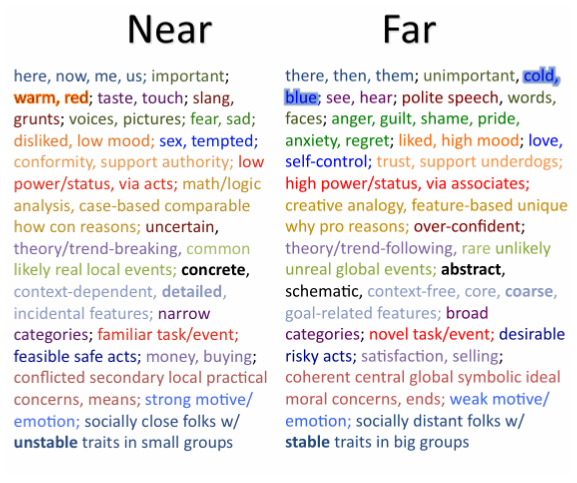
CLT- Dissociations

Movement Forecast: Effective Availabilism

Table Of Contents

  • The Availability Cascade
  • Attentional Budget Ethics
  • Effective Availabilism
  • Why Quantification Matters
  • Cascade Reform Technologies
  • Takeaways

The Availability Cascade

The following questions pop up in my Facebook feed all the time.

Why is mental illness, addiction, and suicide only talked about when somebody famous succumbs to their demons?

Why do we only talk about gun control when there is a school shooting?

What is the shape of your answer? Mine begins with a hard look at the nature of attention.

Attention is a lens by which our selves perceive the world. The experience of attention is conscious. However, the control of attention – where it lands, how long it persists – is preconscious. People rarely think to themselves: “now seems an optimal time to think about gun control”. No, the topic of gun control simply appears.

When we pay attention to attention, its flaws become visible. Let me sketch two.

  1. The preconscious control of attention is famously vulnerable to a wide suite of dysrationalia. Like transposons parasitizing your DNA, beliefs parasitize your semantic memory by latching onto your preconscious attention-control software. This is why Evans-Pritchard was so astonished in his anthropological survey of Zande mysticism. This is why your typical cult follower is pathologically unable to pay attention to a certain set of considerations. The first flaw of the attentional lens is that it is a biasing attractor.
  2. Your unconscious mind is subject to the following computational principle: what you see is all there is. This brings us the availability heuristic, the cognitive shortcut your brain uses to travel from “this was brought to mind easily” to “this must be important”. The attentional lens is that the medium distorts its contents. This is nicely summed up in the proverb, “nothing in life is as important as you think it is, while you are thinking about it.” The second flaw of the attentional lens is that bound in a positive feedback loop to memory (“that which I can recall easily, must be important, leads me to discuss more, is something I recall even more easily”).

My treatment of this positive feedback loop was at the level of individual. But that same mechanism must also promote failures at the level of social network. The second flaw writ large – the rippling eddies of attentional currents (as captured by services like Google News) – are known as availability cascades. And thus we have provided a cognitive reason why our social atmosphere disproportionately discusses gun control when school shootings appear in the news.

In electrical engineering, positive feedback typically produces runaway effects: a circuit “hits the rails” (draws maximum current from its power source). What prevents human cognition from doing likewise, from becoming so fixated on one particular memory-attention loop that it cannot escape? Why don’t we spend our days and our nights dreaming of soft drinks, fast food, pharmaceuticals? I would appeal to human boredom as a natural barrier to such a runaway effect.

Attentional Budget Ethics

We have managed to rise above the minutia, and construct a model of political discourse. Turn now to ethics. How should attention be distributed? When is the right time to discuss gun control, to study health care reform, to get clear on border control priorities?

The response profile of such a question is too diverse to treat here, but I would venture most approaches share two principles of attentional budgets:

  1. The Systemic Failure Principle. If a system performance fails to meet some arbitrary criteria of success, that would be an argument for increasing its attentional budget. For example, perhaps the skyrocketing costs of health care would seem to call for more attention than other, relatively more healthy, sectors of public life.
  2. The Low Hanging Fruit Principle. If attention is likely to produce meaningful results, that would be an argument for increasing its attentional budget. For example, perhaps not much benefit would come from a national conversation about improving our cryptographic approaches to e-commerce.

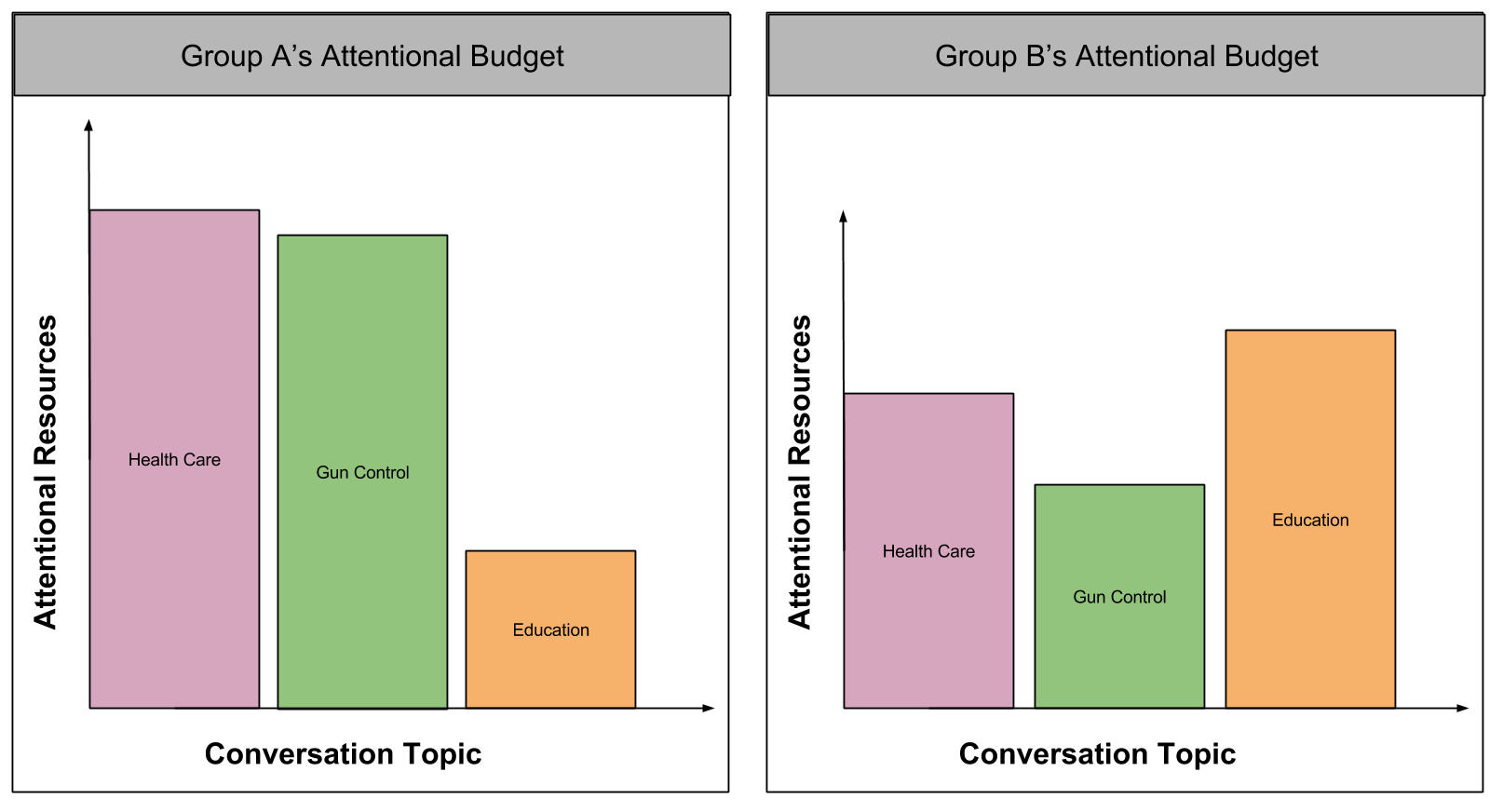
Despite how shockingly agreeable these principles are, I have a feeling that different political parties may yet disagree. In a two party system, for example, you can imagine competing attentional budgets as follows:

Attentional Budgets

Interpret “attentional resources” in a straightforward (measurement-affine) way: let it represent the number of hours devoted to public discussion.

This model of attentional budgets requires a bit more TLC. Research-guiding questions might include:

  • How ought we model overlapping topics?
  • Should budget space be afforded for future topics, topics not yet conceived?
  • Could there be circumstances to justify zero attention allocation?
  • Is it advisable to leave “attentional budget creation” topics out of the budget?
  • How might this model be extended to accomodate time-dependent, diachronic budgeting?

Effective Availibilism

Let us now pull together a vision of how to transcend the attentional cascade.

In our present condition, even very intelligent commentators must resort to the following excuse of a thought: “I have a vague sense that our society is spending too much time on X. Perhaps we shouldn’t talk about it anymore”.

In our envisioned condition, our best political minds would be able to construct the following chain of reasoning: “This year, our society has spent three times more time discussing gun control than discussing energy independence. My attentional budget prescribes this ratio to be closer to 1:1. Let us think of ways to constrain these incessant gun-control availability cascades.”

In other words, I am prophesying the emergence of an effective availabilism movement, in ways analogous to effective altruism. Effective availabilist groups would, I presume, primarily draw from neuropolitical movements more generally.

Notice how effective availabilism relies on, and comes after, of publically-available psychometric data. And this is typical: normative movements often follow innovations in descriptive technology.

Why Quantification Matters

Policy discussions influence votes which affect lives. Despite the obvious need for constructive discourse, a frustrating amount of political exchanges are content-starved. I perceive two potential solutions for this failure of our democracy:

  1. Politics is a mind-killer. By dint of our evolutionary origins, our brains do not natively excel at political reasoning. Group boundaries matter more than analyses, arguments are soldiers. But these are epistemic failure modes. Policy debates should not appear one-sided. Movements to establish the cognitive redemption of politics are already underway. See, for example, Jonathon Haidt’s http://www.civilpolitics.org/ (“educating the public on evidence-based methods for improving inter-group civility”)
  2. Greasing policy discussions with data would facilitate progress. One of my favorite illustrations of this effect is biofeedback: if you give a human being a graphical representation of her pulse, the additional data augments the brains ability to reason – biofeedback patients are even able to catch their breath faster. In the same way, improving our data streams gives hope of transcending formerly-intractable social debates.

The effective availabilism movement could, in my view, accelerate this second pathway.

Cascade Reform Technologies

It seems clear that availability cascades are susceptible to abuse. Many advertisers and political campaigns don’t execute an aggregated optimization across our national attentional profile. Instead, they simply run a maximization algorithm on their topic of interest (“think about my opponent’s scandal!”).

With modern-day technology (polls, trending Twitter tags, motive abduction, self-monitoring), noticing attentional budget failures can be tricky. With the above technology in place, even subtle attentional budget failures will be easily detectable. We have increased our supply of failures, but how might effective availabilists increase demand (open vectors of reform towards availability cascade failure modes)?

The first, obvious, pathway is to use the same tool – attentional cascades – to counterbalance. If gun control is getting too much attention, effective availabilists will strive to push social media towards a discussion of e.g., campaign finance reform. They could, further, use psychometric data to evaluate whether they have overshot (SuperPACs are now too interesting), and to adjust as necessary.

Other pathways towards reform might be empirically-precise amplification of boredom circuits. Recruit the influential to promote the message that “this topic has been talked to death” could work; as could the targeted use of satire.

Takeaways

  • Pay more attention to the quiet whispers of your mind. “Haven’t I heard about this enough” represents an undiscovered political movement.
  • Social discourse is laced with the rippling tides of availability cascades, and are at present left to their mercy.
  • As hard psychometric data makes its way towards public accessibility, a market of normative attentional budgets will arise.
  • The business of pushing current attentional profiles towards normative budgets will become the impetus of effective availabilism movements.
  • A cottage industry of cognitive technologies to achieve these ends will thereafter crystallize and mature.

Attentional Budgets Usage (1)

Fermions: Meat In Our Particle Soup

Part Of: Demystifying Physics sequence
Prerequisite Post: An Introduction To Energy
Content Summary: 2100 words, 21 min reading time.

Prerequisite Mindware

Today, we’re going to go spelunking into the fabric of the cosmos! But first, some tools to make this a safe journey.

Energy Quanta

As we saw in An Introduction to Energy,

Energy is the hypothesis of a hidden commonality behind every single physical process. There are many forms of energy: kinetic, electric, chemical, gravitational, magnetic, radiant. But these forms are expressions of a single underlying phenomena.


Consider the analogy between { electrons spinning around protons } and { planets spinning around stars }. In the case of planets, the dominant force is gravitational. In the case of the atom, the dominant force is electromagnetic.

But the analogy strength of the above is weak. In contrast to gravitational acceleration, an accelerating electric charge emits electromagnetic waves. Thus, we would expect an orbiting charge to steadily lose energy and spiral into the nucleus, colliding with it in a fraction of a second. Why have atoms not gone extinct?

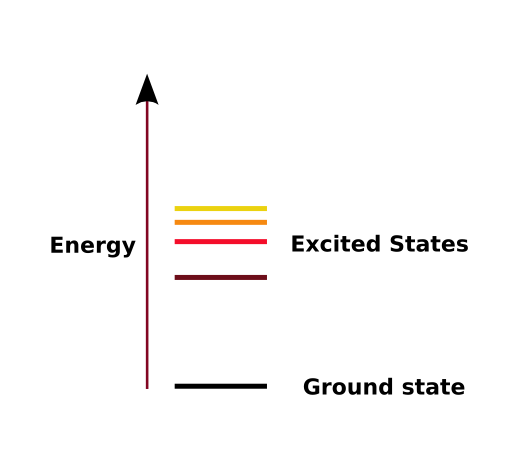
To solve this problem, physicists began to believe that in some situations, energy cannot be lost. Indeed, they abandoned the intuitive idea that energy is continuous. On this new theory, at the atomic level energy must exist in certain levels, and never in between. Further, at one particular energy level, something we will call the ground state, an electron may never lose energy.

energy_levels

Antiparticles

Let’s talk about antiparticles. It’s time to throw out your “science fiction” interpretive lens: antiparticles are very real, and well-understood. In fact, they are exactly the same as normal particles, except charge is reversed. So, for example, an antielectron has the same mass and spin as an electron, but instead carries a positive charge.

Why does the universe contain more particles than antiparticles? Good question. 😛

Meet The Fermions

Nature Up Close

Consider this thing. What would you name it?

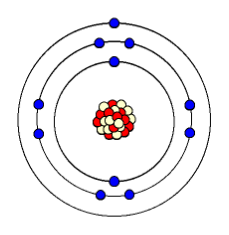
Atomic Structure

One name I wouldn’t select is “indivisible”. But that’s what the “atom” means (from the Greek “ἄτομος”). Could you have predicted the existence of this misnomer?

As I have discussed before, human vision can capture only a small subset of physical reality. Measurement technology is a suite of approaches that exploit translation proxies, the ability to translate extrasensory phenomena into a format amenable to perception. Our eyes cannot perceive atoms, but the scanning tunneling microscope translates atomic structures to scales our nervous systems are equipped to handle.

Let viable translation distance represent the difference in scale between human perceptual foci and the translation proxy target. Since translation proxies are facilitated through measurement technology, which is in turn driven by scientific advances, it follows that we ought to expect viable translation distance to increase over time.

We now possess a straightforward explanation of our misnomer. When “atom” was coined, its referent was the product of that time’s maximum viable translation distance. But technology has since moved on, and we have discovered even smaller elements. Let’s now turn to the state of the art.

Beyond The Atom

Reconsider our diagram of the atom. Do you remember the names of its constituents? That’s right: protons, neutrons, and electrons. Protons and neutrons “stick together” in the nucleus, electrons “circle around”.

Our building blocks of the universe so far: { protons, neutrons, electrons }. By combining these ingredients in all possible ways, we can reconstruct the periodic table – all of chemistry. Our building blocks are – and must be – backwards compatible. But are these particles true “indivisibles”? Can we go smaller?

Consider the behavior of the electrons orbiting the nucleus. After fixing one theoretical problem (c.f., Energy Levels section above), we now can explain why electrons orbit the nucleus: electromagnetic attraction (“opposites attract”). But here is a problem: we have no such explanation for the nucleus. If “like charges repel”, then the nucleus must be something like holding the same poles of a magnet close together: you can do it, but it takes a lot of force. What could possibly be keeping the protons in the nucleus together?

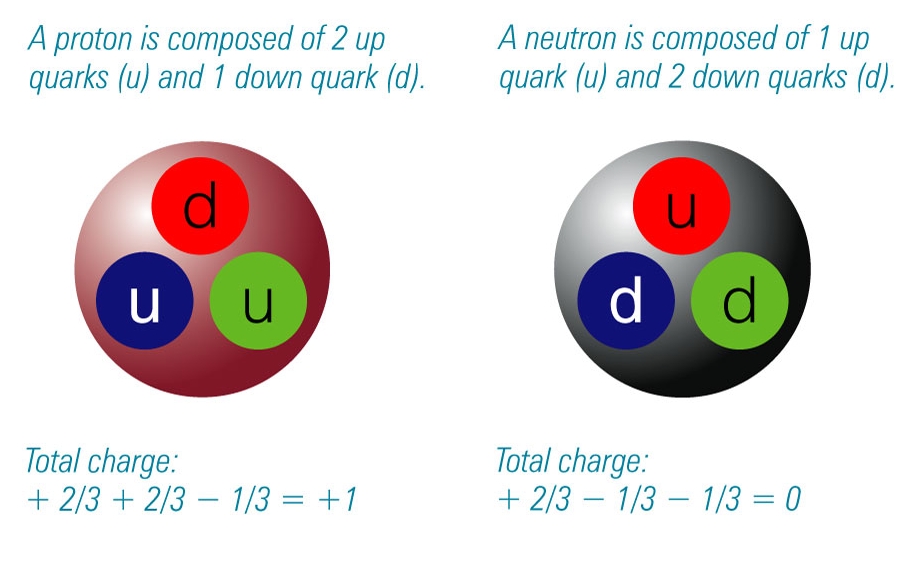
Precisely this question motivated a subsequent discovery: electrons may well be indivisible, but protons and neutrons are not. Protons and neutrons are instead composite particles made out of quarks. Quarks like to glue themselves together by a new force, known as the strong force. This new type of force not only explains why we don’t see quarks by themselves, it also explains the persistence of the nucleus.

The following diagram (source) explains how quarks comprise protons and neutrons:

atom_baryons

Okay, so our new set of building blocks are: { electron, up, down }. With a little help from some new mathematics – quantum chromodynamics – we can again reconstitute chemistry. biology, and beyond.

Please notice how some of our building blocks are more similar than others: the up and down particle comprise particles with charge divisible by three, the electron particle carries an integer charge. Let us group like particles together.

  • Call up and down particles part of the quark family.
  • Call electrons part of the lepton family.

Neutrinos

So far in this article, we’ve gestured towards gravitation and electromagnetism. We’ve also introduced the strong force. Now is the time to discuss Nature’s last muscle group, the weak force.

A simple way to bind the weak force to your experience: consider what you know about radioactive material. The types of atoms that are generated in, to pick one source, nuclear power do not behave like other atoms. They emit radiation, they decay. Ever heard of the “half-life” of a material? That term defines how long is takes for half of an unstable radioactive material to decay into a more stable form. For example, { magnesium-23 → sodium-23 + antielectron }.

Conservation of energy dictates that such decay reactions must preserve energy. However, when you actually calculate the energetic content of decay process given above, you find a mismatch. And so, scientists were confronted with the following dilemma: either reject conservation of energy, or posit the existence of an unknown particle to “balances the books”. Which would you chose?

The scientific community began to speculated that a fourth type of fermion existed, even with an absence of physical evidence. And they found it 26 years later, in 1956.

Why did it take relatively longer to discover this fourth particle? Well, these hypothesized neutrinos do not carry an electric charge or a color charge. As such, they only interact with other particles via the weak force (which has a very short range) and the atomic force (which is 10^36 times less powerful than electromagnetic force). Due to these factors, neutrinos such as those generated by the Sun pass through the Earth undetected. In fact, in the time it takes you to read this sentence, hundreds of billions of neutrinos have passed through every cubic centimeter of your body without incident. Such weak interactivity explains the measurement technology lag.

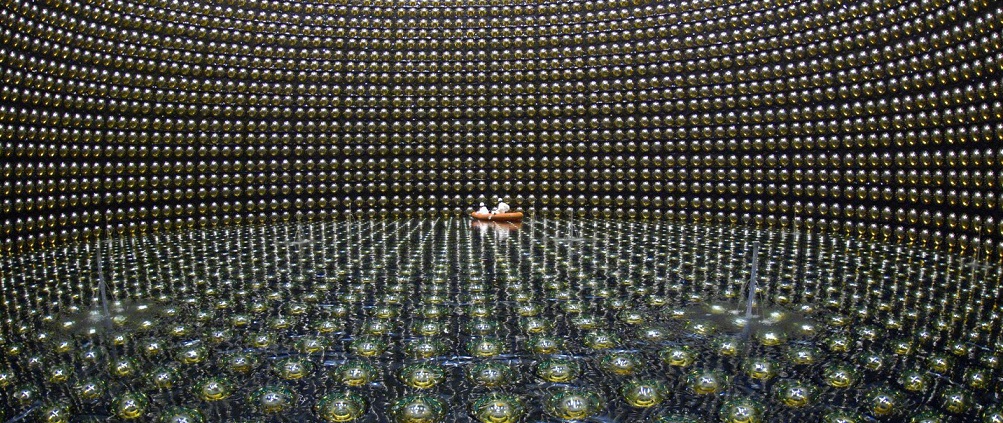
Are you sufficiently creeped out by how many particles pass through you undetected? 🙂 If not, consider neutrino detectors. Because of their weak interactivity, our neutrino detectors must be large, and buried deep inside the earth (to shield from “noise” – more common particle interactions). Here we see a typical detector, with scientists inspecting their instruments in the center, for contrast:

neutrino_detector

The Legos Of Nature

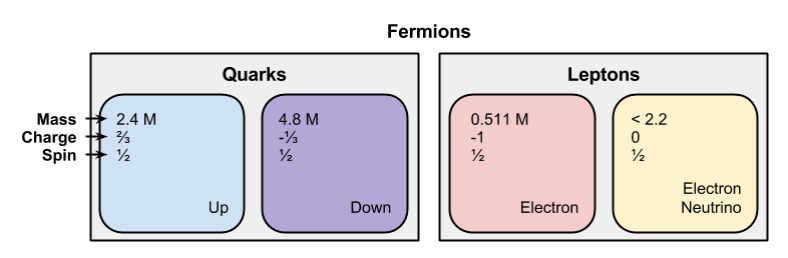
Here, then, is our picture of reality:

Fermions- One Generation

Notice that all fermions have spin ½; we’ll return to this fact later.

A Generational Divide

Conservation of energy is a thing, but conservation of particles is not. Just as particles spontaneously “jump” energy levels, sometimes particles morph into different types of particles, in a way akin to chemical reactions. What would happen if we were to pump a very large amount of energy into the system, say by striking an up quark with a high-energy photon? Must the output energy be expressed as hundreds of up quarks? Or does nature have a way to “more efficiently” spend its energy budget?

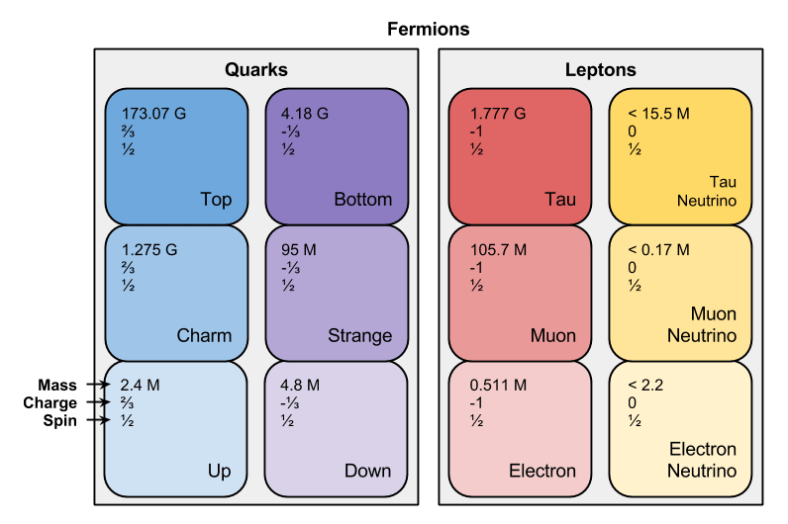
It turns out that you can: there exist particles identical to these four fermions with one exception: they are more massive. And we can pull this magic trick once more, and find fermions even heavier than these fermions. To date, physicists have discovered three generations of fermions:

Fermions- Three Generations


The latter generation took lots of time to “fill in” because you only see them in high-energy situations. Physicists had to close the translation distance gap, by building bigger and bigger particle accelerators. The fermion with the highest mass – the Top quark – was only discovered in 1995. Will there be a fourth generation, will we discover some upper bound on fermion generations?

Good question.

Even though we know of three generations, in practice only the first generation “matters much”. Why? Because the higher-energy particles that comprise the second and third generations tend to be unstable: give them time (fractions of a second, usually), and they will spontaneously decay – via the weak force – back into first generation forms. This is the only reason why we don’t find atomic nuclei orbited by tau particles.

Towards A Mathematical Lens

General & Individual Descriptors

The first phase of my lens-dependent theorybuilding triad I call conceptiation: the art of carving concepts out of a rich dataset. Such carving must be heavily dependent on descriptive dimensions: quantifiable ways that an entity may differ from one another.

For perceptual intake, the number of irreducible dimensions may be very large. However, for particles, this set is surprisingly small. There is something distressingly accurate in the phrase “all particles are the same”.

Each type of fermion is associated with one unique value for the following properties (particle-generic properties):

  • mass (m)
  • electric charge (e)
  • spin (s)

Fermions may differ according to their quantum numbers (particle-specific properties). For an electron, these numbers are:

  • principal. This corresponds to the energy level of the electron (c.f., energy level discussion)
  • azimuthal. This corresponds to the orbital version of angular momentum (e.g., the Earth rotating around the Sun). These numbers correspond to the orbitals of quantum chemistry (0, 1, 2, 3, 4, …) ⇔ (s, p, d, f, g, …); which helps explain the orbital organization of the periodic table.
  • magnetic. This corresponds to the orientation of the orbital.
  • spin projection. This corresponds to the “spin” version of angular momentum (e.g., the Earth rotating around its axis). Not to be confused with spin, this value can vary across electrons.

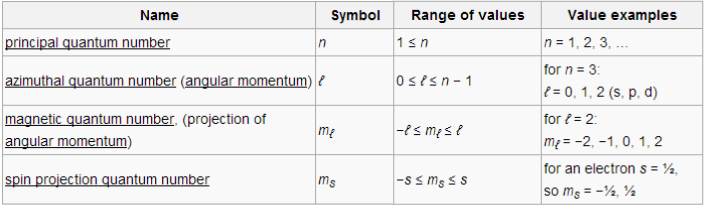
Quantum numbers are not independent; their ranges hinge on one another in the following way:

Quantum Numbers

Statistical Basis

With our fourth building block in place, we are in a position to answer the question: what does the particulate basis of matter have in common?

All elementary particles of matter we have seen have spin ½. By the Spin-statistics Theorem, we must associate all such particles with Fermi-Dirac statistics. Let us name all particles under this statistics – all particles we have seen so far – “fermions”. It turns out that this statistical approach generates a very interesting property known as the Pauli Exclusion Principle. The Pauli Exclusion Principle states, roughly, that two particles cannot share the same quantum state.

Let’s take an example: consider a hydrogen atom with two electrons. Give this atom enough time, and both electrons will be on its ground state, n=1. What happens if the hydrogen picks up an extra electron, in some chemical process? Can this third electron also enter the ground state?

No, it cannot. Consider the quantum numbers for our first two electrons: { n=1, l=0, m_l=0, m_s=1/2 } and { n=1, l=0, m_l=0, m_s=-1/2 }. Given the range constraints given above, there are no other unique descriptors for an electron with n=1. Since we cannot have two electrons with the same quantum numbers, the third electron must come to rest at the next highest energy level, n=2.

The Pauli Exclusion Principle has several interesting philosophical implications:

  • Philosophically, this means that if two things have the same description, then they cannot be two things. This has interesting parallels to the axiom of choice in ZFC, which accommodates “duplicate” entries in a set by conjuring some arbitrary way to choose between them.
  • Practically, the Pauli Exclusion Principle is the only thing keeping your feet from sinking into the floor right now. If that isn’t a compelling demonstration of why math matters, then I don’t know what is.

Composite Fermions

In this post, we have motivated the fermion particulate class by appealing to discoveries of elementary particles. But then, when we stepped back, we discovered that the most fundamental attribute of this class of particles was its subjugation to Fermi-Dirac statistics.

Can composite particles have spin-½ as well as these elementary particles? Yes. While all fermions considered in this post are elementary particles, that does not preclude composite particles from membership.

What Fermions Mean

In this post, we have done nothing less than describe the basis of matter.

But are fermions the final resolution of nature? Our measurement technology continues to march on. Will our ability to “zoom in” fail to produce newer, deeper levels of reality?

Good questions.

Knowledge: An Empirical Sketch

Table Of Contents

  • Introduction
    • All The World Is Particle Soup
    • Soup Texture
  • Perceptual Tunnels
    • On Resolution
    • Sampling
    • Light Cones, Transduction Artifacts, Translation Proxies
  • The Lens-dependent Theorybuilding Triad
    • Step One: Conceptiation
    • Step Two: Graphicalization
    • Step Three: Annotation
    • Putting It All Together: The Triad
  • Conclusion
    • Going Meta
    • Takeaways

Introduction

All The World Is Particle Soup

Scientific realism holds that the entities scientists refer to are real things. Electrons are not figments of our imagination, they possess an existence independent of your mind. What does it mean for us to view particle physics with such a lens?

Here’s what it means: every single thing you see, smell, touch… every vacation, every distant star, every family member… it is all made of particles.

This is an account of how the nervous system (a collection of particles) came to understand the universe (a larger collection of particles). How could Particle Soup ever come to understand itself?

Soup Texture

Look at your hand. How many types of particles do you think you are staring at? A particle physicist might answer: nine. You have four first-generation fermions (roughly, particles that comprise matter) and five bosons (roughly, particles to carry force). Sure, you may get lucky and find a couple exotic particles within your hand, but such a nuance would not detract from the morale to the story: in your hand, the domain (number of types) of particles is very small.

Look at your hand. How large a quantity of particles do you think you are staring at? The object of your gaze is a collection of about 700,000,000,000,000,000,000,000,000 (7.0 * 10^26) particles. Make a habit about thinking in this way, and you’ll find a new appreciation for the Matrix Trilogy. 🙂 In your hand, the cardinality (number of tokens) of particles is very large.

These observations generalize. There aren’t many kinds of sand in God’s Sandbox, but there is a lot of it, with different consistencies across space.

Perceptual Tunnels

On Resolution

Consider the following image. What do you see?

Lincoln Resolution

Your eyes filter images at particular frequencies. At this default human frequency, your “primitives” are the pixelated squares. However, imagine being able to perceive this same image at a lower resolution (sound complicated? move your face away from the screen :P). If you do this, the pixels fade, and a face emerges.

Here, we learn that different resolution lens may complement one another, despite their imaging the same underlying reality. In much the same way, we can enrich our cognitive toolkit by examining the same particle soup with different “lens settings”.

Sampling

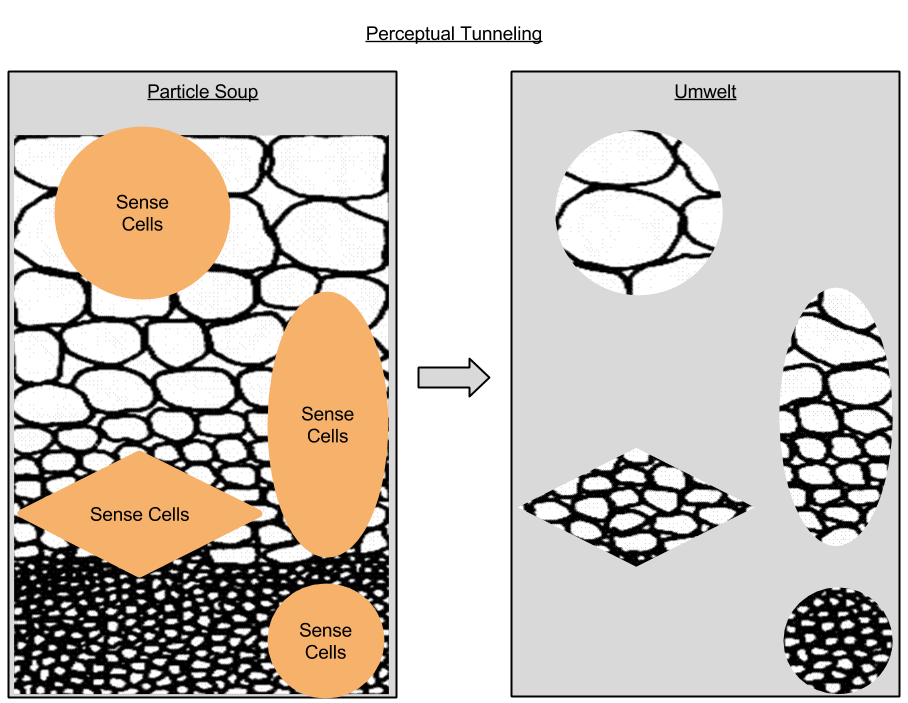
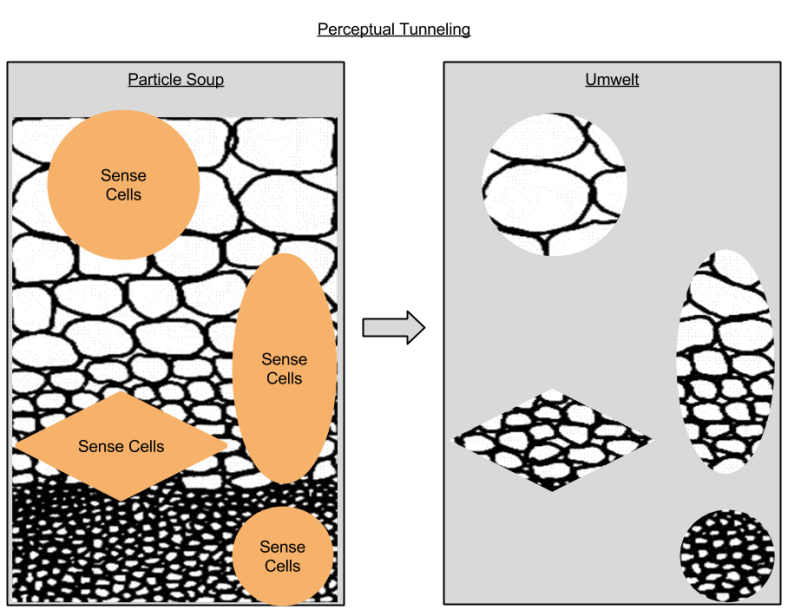
By default, the brain does not really collect useful information. It is only by way of sensory transductor cells – specialized cells that translate particle soup into Mentalese – that the brain gains access to some small slice of physical reality. With increasing quantity and type of these sensory organs, the perceptual tunnel burrowed into the soup becomes wide enough to support a lifeform.

Another term for the perceptual tunnel is the umwelt. Different biota experience different umwelts; for example, honeybees are able to perceive the Earth’s magnetic field as directly as we humans perceive the sunrise.

Perceptual tunneling may occur at different resolutions. For example, your proprioceptive cells create signals only on the event of coordinated effort of trillions and trillions of particles (e.g., the wind pushes against your arm). In contrast, your vision cells create signals at very fine resolutions (e.g., if a single photon strikes your photoreceptor, it will fire).

Perceptual Tunneling

Light Cones, Transduction Artifacts, Translation Proxies

Transduction is a physically-embedded computational process. As such, it is subject to several pervasive imperfections. Let me briefly point towards three.

First, nature precludes the brain from the ability to sample from the entirety of the particle soup. Because your nervous system is embedded within a particular spatial volume, it is subject to one particular light cone. Since particles cannot move faster than the speed of light, you cannot perceive any non-local particles. Speaking more generally: all information outside of your light cone is closed to direct experience.

Second, the nervous system is an imperfect medium. It has difficulty, for example, representing negative numbers (ever try to get a neuron firing -10 times per second?). Another such transduction artifact is our penchant for representing information in a comparative, rather than absolute, format. Think of all those times you have driven on the highway with the radio on: when you turn onto a sidestreet, the music feels louder. This experience has nothing at all to do with an increased sound wave amplitude: it is an artifact of a comparison (music minus background noise). Practically all sensory information is stained by this compressive technique.

Third, perceptual data may not represent the actual slice of the particle soup we want. To take one colorful example, suppose we ask a person whether they perceived a dim flashing light, and they say “yes”. Such self-reporting, of course, represents sensory input (in this case, audio vibrations). But this kind of sensory information is a kind of translation proxy to a different collection of particles we are interested in observing (e.g., the activity of your visual cortex).

This last point underscores an oft-neglected aspect of perception: it is an active process. Our bodies don’t just sample particles, they move particles around. Despite the static nature of our umwelt, our species has managed to learn ever more intricate scientific theories in virtue of sophisticated measurement technology; and measurement devices are nothing more than mechanized translation proxies.

The Lens-dependent Theorybuilding Triad

Step One: Conceptiation

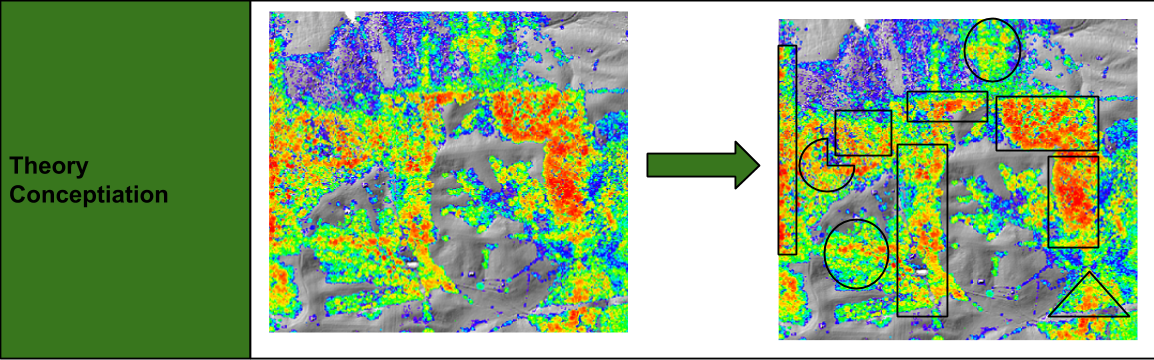
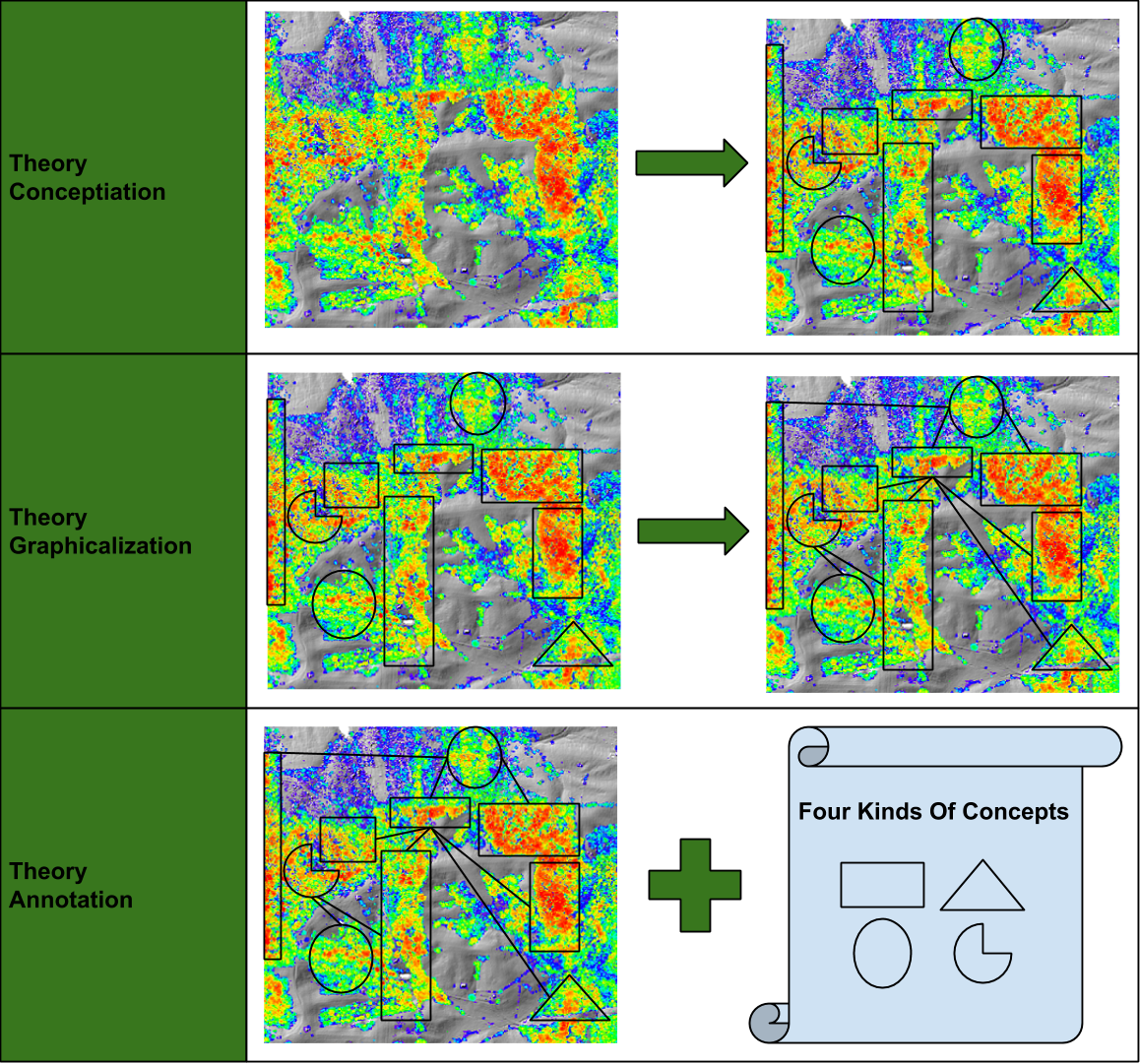
Plato once describes concept acquisition as “carving nature at its joints”. I will call this process (constructing Mentalese from the Soup) theory conceptiation.

TheoryBuilding- Conceptiation

If you meditate on this diagram for a while, you will notice that theory conceptiation is a form of compression. Acccording to Kolmogorov information theory, the efficacy of compression hinges on how many patterns exist within your data. This is why you’ll find leading researchers claiming that:

Compression and Artificial Intelligence are equivalent problems

A caveat: concepts are also not carved solely from perception; as one’s bag of concepts expands, such pre-existent mindware exerts an influence on the further carving up of percepts. This is what the postmoderns attribute to hermeneutics, this is the root of memetic theory, this is what is meant by the nature vs. nurture dialogue.

Step Two: Graphicalization

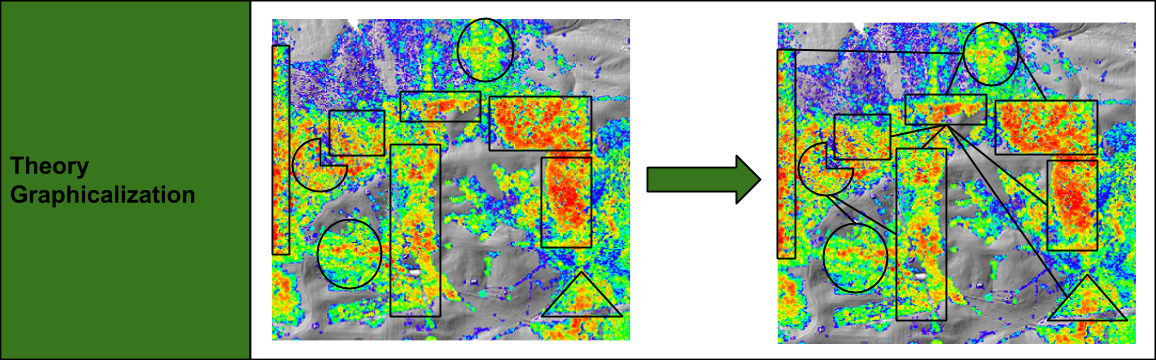
Once the particle soup is compressed into a set of concepts, relations between these concepts are established. Call this process theory graphicalization.

TheoryBuilding- Graphicalization

If I were ask you to complete the word “s**p”, would you choose “soap” or “soup”?  How would your answer change if we were to have a conversation about food network television?

Even if I never once mention the word “soup”, you become significantly more likely to auto-complete that alternative after our conversation. Such priming is explained through concept graphs: our conversation about the food network activates food-proximate nodes like “soup” much more strongly than graphically distant nodes like “soap”.

Step Three: Annotation

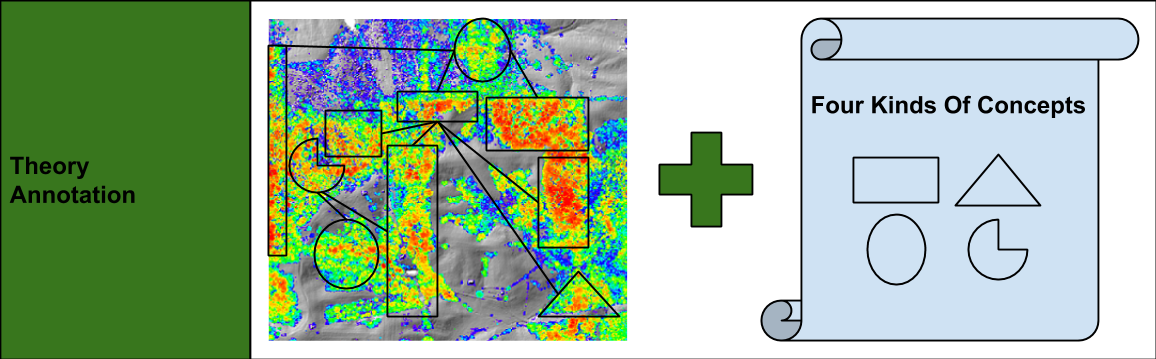
Once the graph structure is known, metagraph information (e.g., “this graph skeleton occurs frequently”) is appended. Such metagraph information is not bound to graphs. Call this process theory annotation.

TheoryBuilding- Annotation

We can express a common complaint about metaphysics thusly: theoretical annotation is invariant to changes in conceptiation & graphicalization results. In my view (as hinted at by my discussion of normative therapy) theoretical annotation is fundamentally an accretive process – it is logically possible to generate an infinite annotative tree; this is not seen in practice because of the computational principle of cognitive speed limit (or, to make a cute analogy, the cognition cone).

Putting It All Together: The Triad

Call the cumulative process of conceptiation, graphicalization, and annotation the lens-dependent theorybuilding triad.

TheoryBuilding- Lens-Dependent Triad

Conclusion

Going Meta

One funny thing about theorybuilding is how amenable it is to recursion. Can we explain this article in terms of Kevin engaging in theorybuilding? Of course! For example, consider the On Resolution section above. Out of all possible adjectives used to describe theorybuilding, I deliberately chose to focus my attention on spatial resolution. What phase of the triad does that sound like to you?  Right: theory conceptiation.

Takeaways

This article does not represent serious research. In fact, its core model – the lens-dependent theorybuilding triad – cites almost no empirical results. It is a toy model designed to get us thinking about how a cognitive process can construct a representation of reality. Here is an executive summary of this toy model:

  1. Perception tunneling is how organisms begin to understand the particle soup of the universe.
    1. Tunneling only occurs by virtue of sensory organs, which transduce some subset of data (sampling) into Mentalese.
    2. Tunneling is a local effect, it discolors its target, and its sometimes merely represents data located elsewhere.
  2. The Lens-Dependent Theorybuilding Triad takes the perception tunnel as input, and builds models of the world. There are three phases:
    1. During conceptiation, perception contents are carved into isolable concepts.
    2. During graphicalization, concept interrelationships are inferred.
    3. During annotation, abstracted properties and metadata are attached to the conceptual graph.

[Sequence] Demystifying Physics

Perceptual Tunneling

Introductions

Natural History

Miscellaneous Topics

Relevance To Perception

Organisms like you are immersed in a sea of particles – particle soup, if you will. Your ability to know – your epistemology – must somehow reside in connections between your mental representations, and the soup.

An Introduction To Electromagnetic Spectra

Part Of: Demystifying Physics sequence
Content Summary: 1200 words, 12 min read

Motivations

Consider the following puzzle. Can you tell me the answer?

We see an object O. Under white light, O appears blue. How would O appear, if it is placed under a red light?

As with many things in human discourse, your simple vocabulary (color) is masking a more rich reality (quantum electrodynamics). These simplifications generate the correct answers most of the time, and make our mental lives less cluttered. But sometimes, they block us from reaching insights that would otherwise reward us. Let me “pull back the curtain” a bit, and show you what I mean.

The Humble Photon

In the beginning was the photon. But what is a photon?

Photons are just one type of particle, in this particle zoo we call the universe. Photons have no mass and no charge. This is not to say that all photons are the same, however: they are differentiated by how much energy they possess.

Do you remember that famous equation of Einstein’s, E = mc^2? It is justly famous for demonstrating mass-energy interchangeability. If you are set up a situation to facilitate a “trade”, you can purchase energy by selling mass (and vice versa). Not only that, but you can purchase a LOT of energy with very little mass (the ratio is about 90,000,000,000,000,000 to 1). This kind of lopsided interchangeability helps us understand why things like nuclear weapons are theoretically possible. (In nuclear weapons, a small amount of uranium mass is translated into considerable energy). Anyways, given E = mc^2, can you find the problem with my statement above?

Well, if photons have zero mass, then plugging in m=0 to E = mc^2 tells us that all photons have the same energy: zero! This falsifies my claim that photons are differentiated by energy.

Fortunately, I have a retort: E = mc^2 is not true; it is only an approximation. The actual law of nature goes like this (p stands for momentum):

E = \sqrt{\left( (mc^2)^2 + (pc)^2 \right) }

Since m=0 for photons, we can eliminate the left-hand side of the equation. This leaves E = pc (“energy equals momentum times speed-of-light”). We also know that that p = \frac{ \hslash }{ \lambda } (“momentum equals Planck’s constant divided by wavelength”). Putting these together yields the cumulative value for energy of a photon:
E = \frac{\hslash c}{\lambda}

Since h and c are just constants, the relation becomes very simple: energy is inversely proportional to wavelength. Rather than identifying a photon by its energy, then, let’s identify it by its wavelength. We will do this because wavelength is easier to measure (in my language, we have selected a measurement-affine independent variable).

Meet The Spectrum

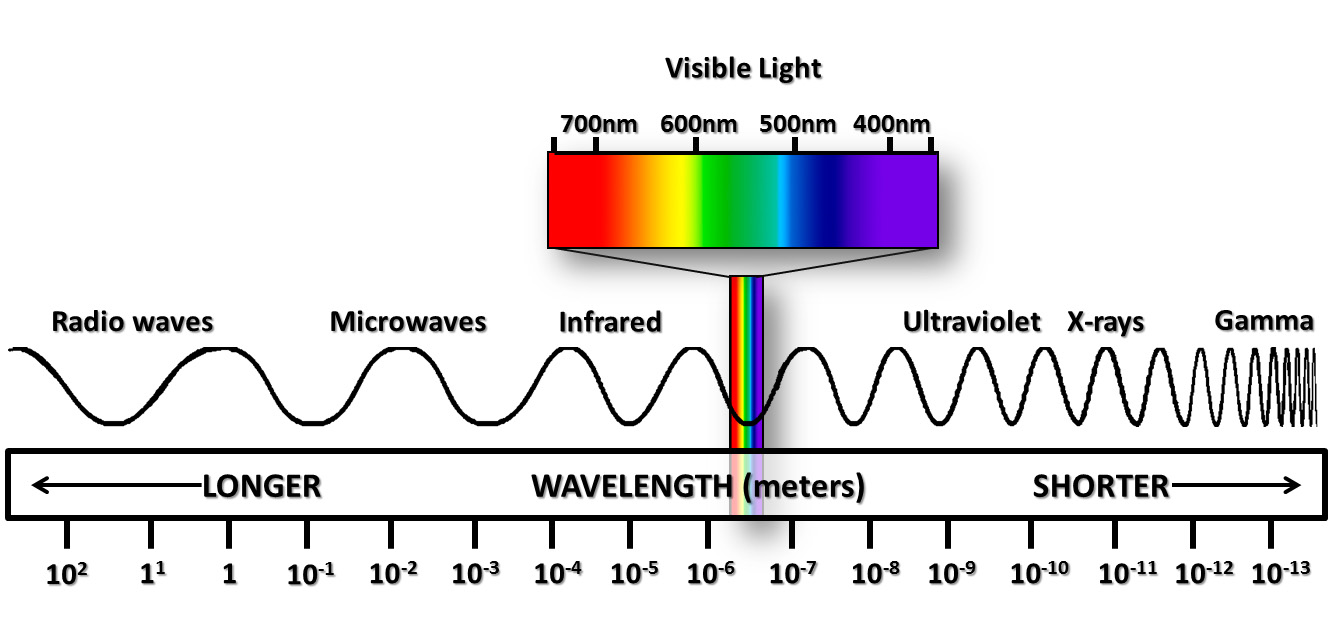
So we can describe one photon by its wavelength. How about billions? In such a case, it would be useful to draw a map, on which we can locate photon distributions.  Such a photon map is called an electromagnetic spectrum. It looks like this:

spectrum

Pay no attention to the colorful thing in the middle called “visible light”. There is no such distinction in the laws of nature, it is just there to make you comfortable.

Model Building

We see an object O.

Let’s start by constructing a physical model of our problem. How does seeing even work?

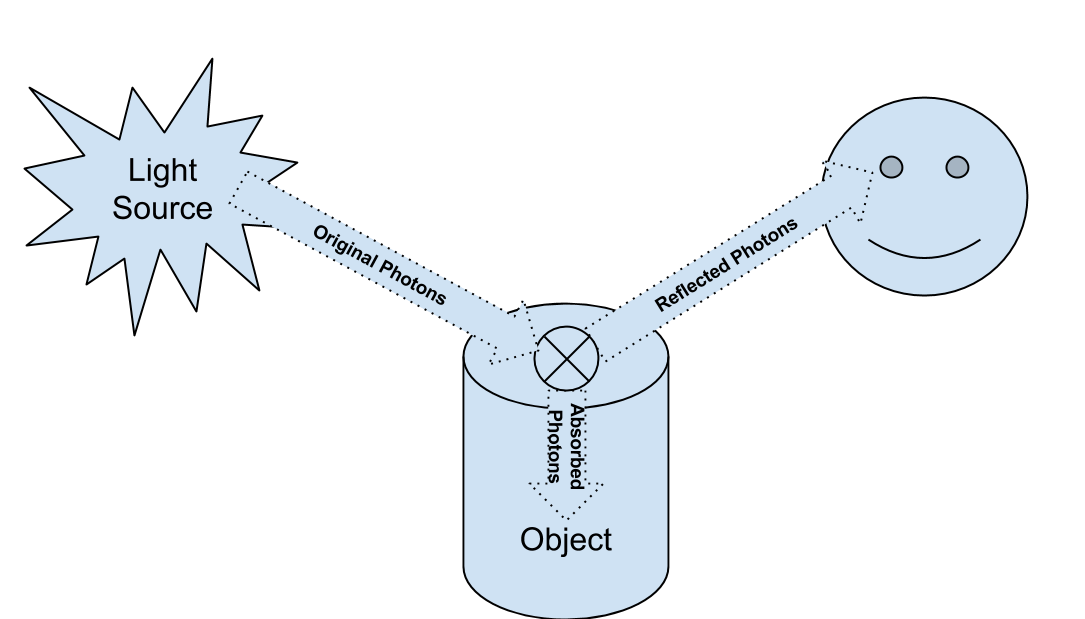
Once upon a time, the emission theory of vision was in vogue. Plato, and many other renowned philosophers, believed that perception occurs in virtue of light emitted from our eyes. This theory has since been proven wrong. The intromission theory of vision has been vindicated: we see in virtue of the fact that light (barrages of photons) emitted by some light source, arrives at our retinae. The process goes like this:

Spectrum Puzzle Physical Setup

If you understood the above diagram, you’re apparently doing better than half of all American college students… who still affirm emission theory… moving on.

Casting The Puzzle To Spectra

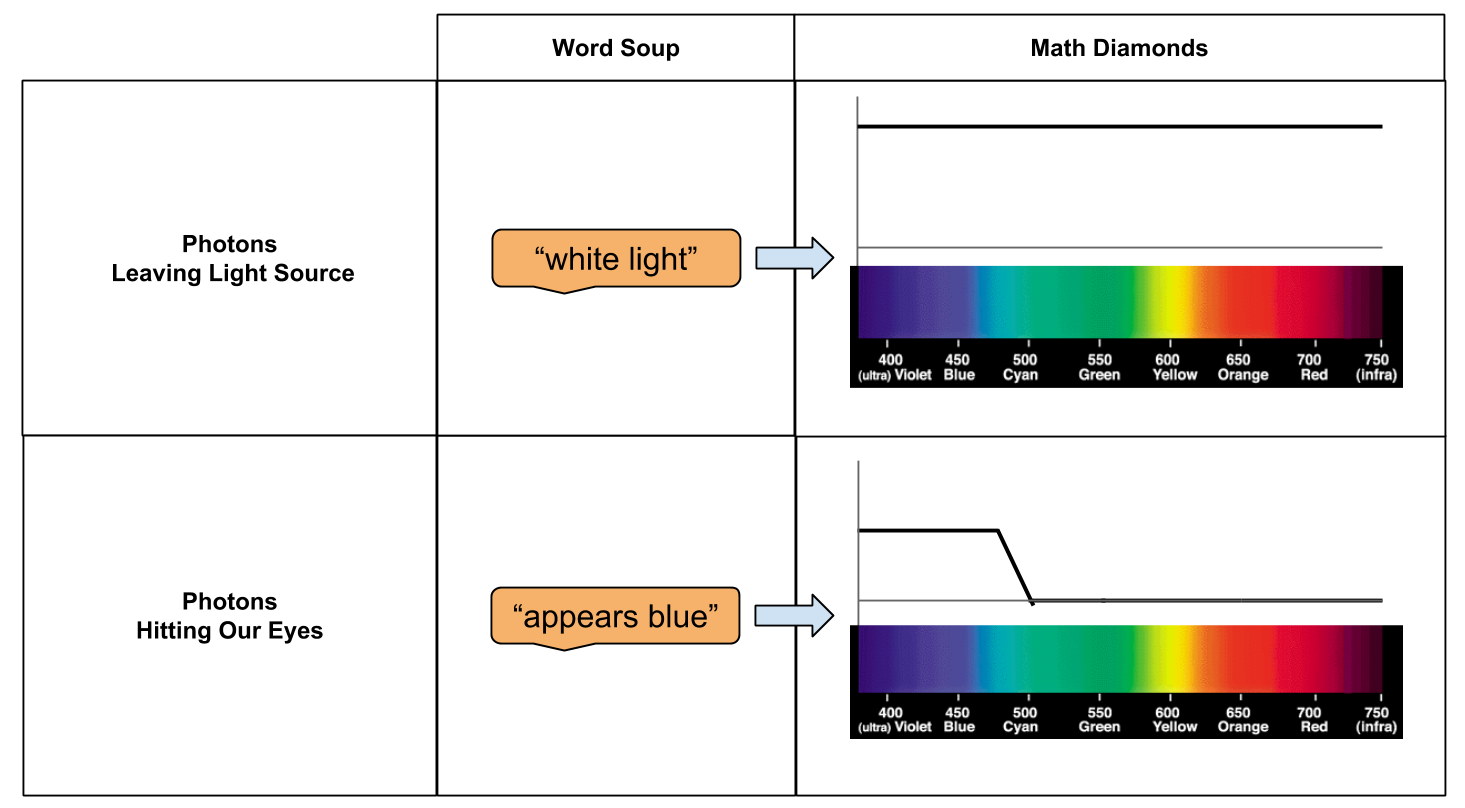
Under white light, O appears blue.

White is associated with the activation of all of the spectra (this is why prisms work). Blue is associated with high-energy light (this is why flames are more blue at the base). We are ready to cast our first sentence. To the spectrum-ifier!

Spectrum Puzzle Setup

Building A Prediction Machine

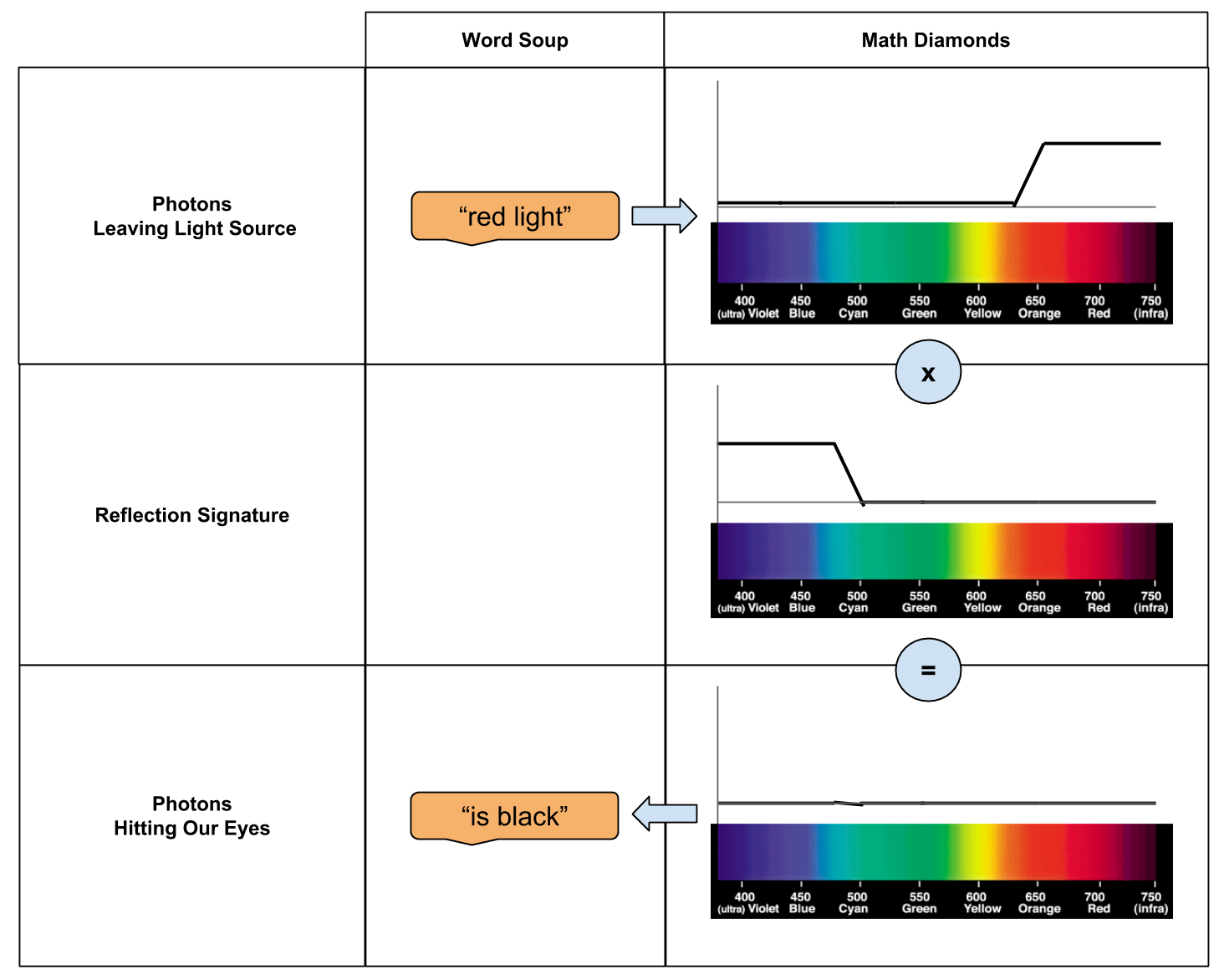
Here comes the key to solving the puzzle. We are given two data points: photon behavior at the light source, and photon behavior at the eye. What third location do we know is relevant, based on our intromission theory discussion above? Right: what is photon behavior at the object?

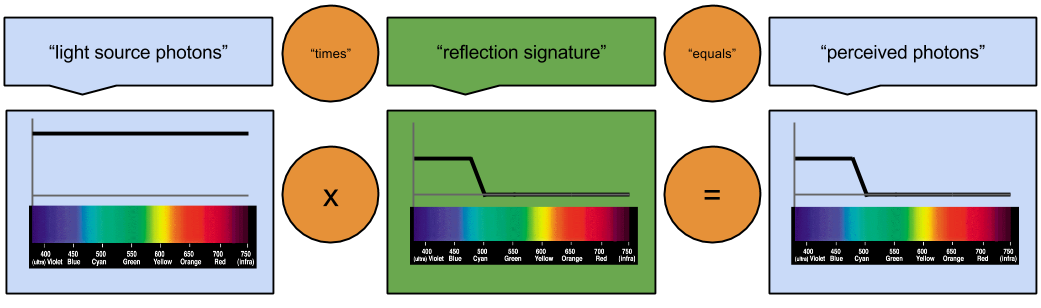
It is not enough to describe the object’s response to photons of energy X. We ought to make our description of the object’s response independent from details about the light source. If we could find the reflection spectrum (“reflection signature“) of the object, this would do the trick: we could anticipate its response to any wavelength. But how do we infer such a thing?

We know that light-source photons must interact with the reflection signature to produce the observed photon response. Some light-source photons may be always absorbed, others may be always reflected. What sort of mathematical operation might support such a desire? Multiplication should work. 🙂 Pure reflection can be represented as multiply-by-one, pure absorption can be represented as multiply-by-zero.

At this point, in a math class, you’d do that work. Here, I’ll just give you the answer.

Spectrum Puzzle Object Characteristics

For all that “math talk”, this doesn’t feel very intimidating anymore, does it? The reflection signature is high for low-wavelength photons, and low for high-wavelength light. For a very generous light source, we would expect to see the signature in the perception.

Another neat thing about this signature: it is rooted in properties of the object atomic structure! Once we know it, you can play with your light source all day: the reflection signature won’t change. Further, if you combine this mathematical object with the light source spectrum, you produce a prediction machine – a device capable of anticipating futures.  Let’s see our prediction machine in action.

And The Answer Is…

How would O appear, if it is placed under a red light?

We have all of the tools we need:

  • We know how to cast “red light” into an emissions spectra.
  • We have already built a reflection signature, which is unique to the object O.
  • We know how to multiply spectra.
  • We have an intuition of how to translate spectra into color.

The solution, then, takes a clockwise path:

Spectrum Puzzle Solution

The puzzle, again:

We see an object O. Under white light, O appears blue. How would O appear, if it is placed under a red light?

Our answer:

O would appear black.

Takeaways

At the beginning of this article, your response to this question was most likely “I’d have to try it to find out”.

To move beyond this, I installed three requisite ideas:

  1. A cursory sketch of the nature of photons (massless bosons),
  2. Intromission theory (photons enter the retinae),
  3. The language of spectra (map of possible photon wavelengths)

With these mindware applets installed, we learned how to:

  1. Crystallize the problem by casting English descriptions into spectra.
  2. Discover a hidden variable (object spectrum) and solve for it.
  3. Build a prediction machine, that we might predict phenomena never before seen.

With these competencies, we were able to solve our puzzle.

Deserialization: Hazards & Control

Part Of: [Deserialized Cognition] sequence
Followup To: [Deserialized Cognition]

Preliminaries

Two major differences exist between conceptiation and deserialization:

  1. Deserialization Delay: A time barrier exists between concept birth & use.
  2. Deserialization Reuse: The brain is able to “get more” out of its concepts.

Inference Deserialization: Obsolescence Hazard

Let’s consider the deserialization delay within inference cognition modes:

Deserialization- Inference Cognition

If you think of an idea, and a couple hours later deserialize & leverage it, risk will (presumably) be minimal. But what about ideas conceived decades ago?

Your inference engines change over time. Here’s a fun example: Santa Claus. It is easy to imagine even a very bright child believing in Santa, given a sufficiently persuasive parent. The cognitive sophistication to reject Santa Claus only comes with time. However, even after this ability is acquired, this belief may be loaded from semantic memory for months before it is actively re-evaluated.

The problem is that every time your inference engines are upgraded (“versioned”), their past creations are not tagged as obsolete. What’s worse, you are often even ignorant of upgrades to the engine itself – you typically fail to notice (c.f., Curse Of Knowledge).

Potential Research Vector: The fact that deserialization decouples your beliefs from your belief-engines has interesting implications for psychotherapy, and the mind-hacking industries of the future. I can imagine moral fictionalism (moral talk is untrue, but useful to talk about) leveraging such a finding, for example.

Social Deserialization: Epistemic Bypass Hazard

Let’s now consider deserialization reuse within social cognition modes:

Deserialization- Social Cognition

Let me zoom into how social conceptiation is actually implemented in your brains. Do people believe every claim they hear?

The answer turns out to be… yes. Of course, you may disbelieve a claim; but to do so requires a later, optional process to analyze, and make an erasure decision about, the original claim. If you interrupt a person immediately after exposure to a social claim, you interrupt this posterior process and thereby increase acceptance irrespective of the content of the claim!

Social conceptiation, therefore, is less epistemically robust than inference conceptiation. Deserialization simply compounds this problem, by allowing the reuse of concepts that fail to be truth-tracking.

Potential Research Vector: Memetic theory postulates that, in virtue of your belief generation systems having a shape: that certain properties of the belief themselves influences cognition. I imagine that this distinction between concept acquisition modes would have nteresting implications for memetic theory.

How To Select Away From Hazardous Deserialization

Unfortunately, from the subjective/phenomenological perspective, there is precious little you can do to feel the difference between hazardous and truth-bearing deserializations. The brain simply fails to tag its beliefs in any way that would be helpful.

Before proceeding, I want to underscore one point: the process of selecting away from hazards cannot be usefully divided into a noticing step and a selection step. If you notice hazard, you don’t need “tips” on how to select away from it: your brain is already hardwired with an action-guiding desire for truth-tracking beliefs. No, these steps remain together; your challenge is “merely” to learn how to raise hazardous patterns to your attention.

Let’s get specific. When I say “raise X to your attention”, what I mean is “when X is perceived, your analytic system (System 2) overrides your autonomic system (System 1) response”. If this does not make sense to you, I’d recommend reading about dual process theory.

How does one encourage a domain-general stance favorable to such overrides? It turns out that there exists an observable personality trait – the need for cognition – which facilitates an increased override rate. Three suggestions that may help:

  1. Reward yourself when you feel curiosity.
  2. Inculcate an attitude of distrust when you notice yourself experiencing familiarity.
  3. Take advantage of your social mirroring circuit by surrounding yourself with others who possess high needs for cognition.

How can you encourage a domain-specific stance favorable to such overrides? In other words: how can you trigger overrides in hazardous conditions, in conditions where obsolescence or epistemic bypassing has occured? So far, two approachs seem promising to me:

  1. Keep track of areas where you have been learning rapidly. Be more skeptical about deserializing concepts close to this domain.
  2. Train yourself to be skeptical of memes originating outside of yourself: whenever possible, try to reproduce the underlying logic yourself.

Of course, these suggestions won’t work exceptionally well, for the same reason self-help books aren’t particularly useful. In my language, your mind has a kind of volition resistance that tends to render such mind hacks temporary and/or ineffectual (“people don’t change”). But I’ll leave a discussion for why this might be so, and what can be done, for another day…

Takeaways

In this post, we explored how the brain recycles concepts in order to save time, via the deserialization technique discussed earlier. Such recycling brings with it two risks:

  1. Obsolescence: The concepts you resurrect may be inconsistent with your present beliefs.
  2. Epistemic Bypass: The concepts you resurrect may not have been evaluated at all.

We then identified two ways this mindware might enrich our lives:

  1. Getting precise about how concepts & conceptiation diverge will give us more control over our mental lives.
  2. Getting precise about how deserialization complements epistemic overrides will allow us to expand memetic accounts of culture.

Finally, we explored several ways in which we might encourage our minds to override hazardous deserialization patterns.

Deserialized Cognition

Part Of: [Deserialized Cognition] sequence
Followup To: [Why Serialization?]

You’ve heard the phrase “pre-conceived notion” before. Ever wonder what it means? Let’s figure it out!

Cognitive Style: Conceptiation

Your mind is capable of generating concepts. Let us name this active process conceptiation.

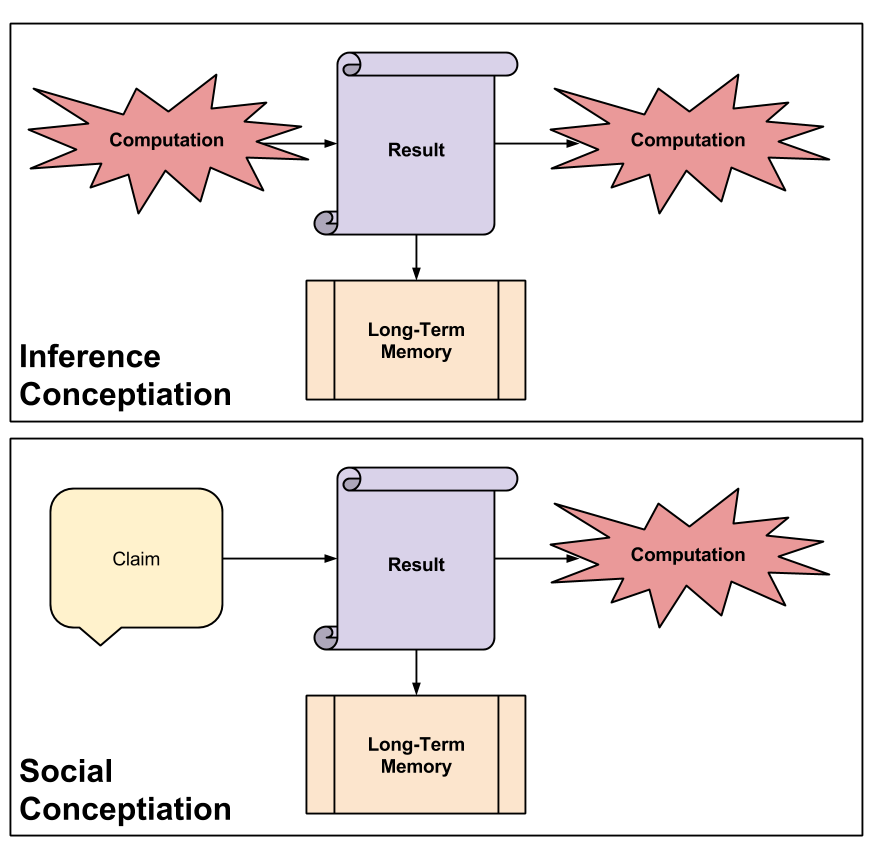
How does this process work in practice? There are only two ways concepts are created: from oneself (inference conceptiation), or from others (social conceptiation):

Deserialization- Conceptiation

Inference Conceptiation attempts to get at self-motivated, non-social cognition. You process information, you form a conclusion (a result), you save this result to memory, and then you pass it along to other cognitive process. Examples:

  • A scientist trying to make progress in string theory
  • An artist teaching herself to speak Spanish

Social Conceptiation summarizes the thought process of someone immersed in a more social setting. Examples:

  • An engineer picking up an proverb (e.g., “no analogy is perfect”) from Facebook, without thinking about it much.
  • A socialite half-listening to some guy at a dinner party describing nuanced work tasks.

During both types of conceptiation, concepts are saved to your long-term memory. Call this serialization.

Cognitive Style: Deserialization

You are a lazy thinker.  Don’t take it personally, though – so is everyone else. How can we explain our inner cognitive miser? It turns out that there are at least two biological reasons for this failing:

  • Brains are slow because they rely on chemical synapses; they run at 100Hz (vs the 2 billion Hz of computers)
  • Brains are metabolically expensive, burning 800% more energy than other organs (20% of total organismic load)

Serialization techniques (discussed previously) allow our brains to be lazy. Not all concepts need to be created from scratch; if, at some point in the past, you have acquired the requisite mindware, you can always resurrect it from long-term memory, in virtue of your built-in deserialization mechanism:

Deserialization- Deserialization

Two Inputs

As mentioned, deserialization (loading) only works if the requisite concepts have been serialized (saved) at some point in the past. Since serialization comes in two flavors, we can now refer to two different kinds of deserialization:

Deserialization- Deserialization Modes (1)

Call the former inference deserialization, and the latter social deserialization.

Application: “I Love You”

Imagine you were raised to believe in the importance of regular expressions of affection to your significant other (SO). So, you say “I love you” to him/her every day. At first, you are eager to tell them the reasons behind your feelings, but after a while, novelty becomes increasingly effortful. Eventually, you settle into a simple “I love you” before falling asleep. Fast forward two years, and your SO says “I don’t feel like you are being affectionate enough”. How can we explain this?

We are now equipped to describe the “I love you” pattern as an instance of deserialized cognition, no? This form of cognition (more specifically, a behavioral pattern) was established previously, and no longer requires active conceptiation to perform. Why should your SO wish for you to employ active processing, especially if such processing yields content very similar to your habituated behavior?

Why would your SO wish you reject serialized cognition? Here’s one path an explanation may take: such an override goes against the instinct of the cognitive miser. Costly signaling is a staple concept in ethology: effort filters between those who truly hold the recipient in high regard and those who only wish to appear that way.

Speaking more generally, it seems to me that our itch for originality come from precisely this will to demonstrate rejection of deserialized cognition.

Takeaways

In this post, we explored how the brain uses concepts via two distinct mechanisms:

  1. In conceptiation, the brain actively constructs & uses novel concepts.
  2. In deserialization, the brain simply reuses pre-existing concepts.

The brain also employs two different ways to create concepts:

  1. Some concepts are constructed by one’s own mind.
  2. Concepts constructed in a social setting are constructed externally, but are (optionally) evaluated by the self.

Putting these together, we are now equipped to refer to four different types of cognition.

Deserialization- Cognition Taxonomy (2)

This new vocabulary opens many doors to explanation, including the question “why do people value originality?”

Credit: Some of the ideas of this post come from previous speculations about cached thoughts. However, compared to deserialization, caching has a weaker analogy strength: concept reuse has precious little to do with enforcing consistency within a memory hierarchy.

Until next time!

Why Serialization?

Part Of: [Deserialized Cognition] sequence

Introduction

Nietzsche once said:

My time has not yet come; some men are born posthumously.

Well, this post is “born posthumously” too: its purpose will become apparent by its successor. Today, we will be taking a rather brisk stroll through computer science, to introduce serialization. We will be guided by the following concept graph:

Concept Map To Serialization

On a personal note, I’m trying to make these posts shorter, based on feedback I’ve received recently. 🙂

Let’s begin.

Object-Oriented Programming (OOP)

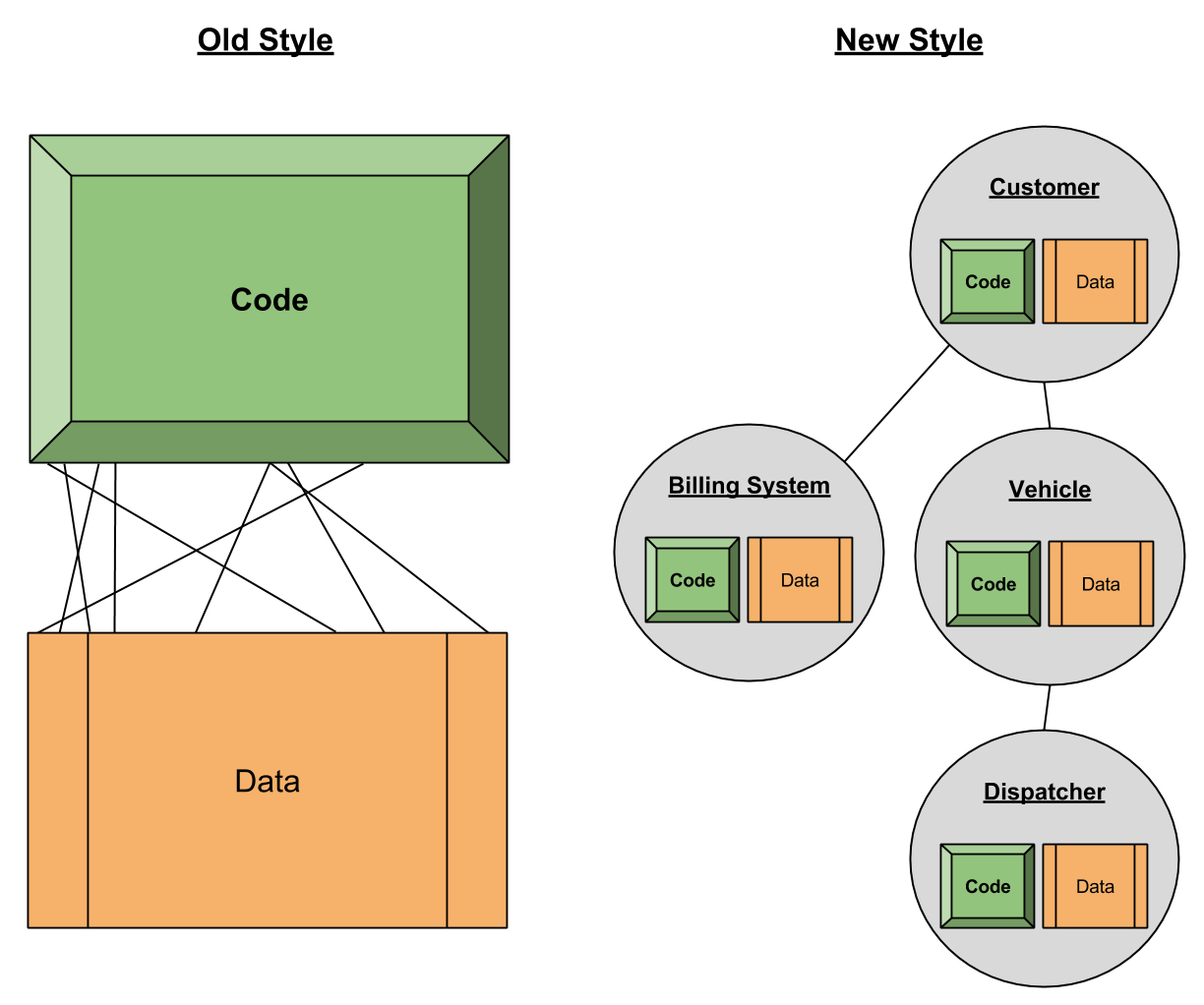
In the long long ago, most software was cleanly divided between data structures and the code that manipulated them. Nowadays, software tends to bundle these two computational elements into smaller packages called objects. This new practice is typically labelled object-oriented programming (OOP).

OOP- Comparison to imperative style (1)

The new style, OOP, has three basic principles:

  1. Encapsulation. Functions and data that pertain to the same logical unit should be kept together.
  2. Inheritance. Objects may be arranged hierarchically; they may inherit information in more basic objects.
  3. Polymorphism. The same inter-object interface can be satisfied by more than one object.

Of these three principles, the first is most paradigmatic: programming is now conceived as a conversation between multiple actors. The other two simply elaborate the rules of this new playground.

None of this is particularly novel to software engineers. In fact, the ability to conjure up conversational ecosystems – e.g., the taxi company OOP system above – is a skill expected in practically all software engineering interviews.

CogSci Connection: Some argue that conversational ecosystems is not an arbitrary invention, but necessary to mitigate complexity.

State Transitions

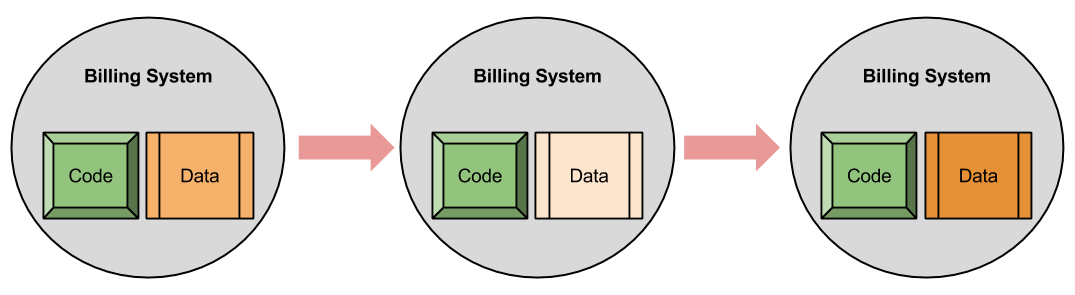
Definition: Let state represent a complete description of the current situation. If I were to give you full knowledge of the state of an object, you could (in principle) reconstitute it.

During a program’s lifecycle, the state of an object may change over time. Suppose you are submitting data to the taxi software from the above illustration. When you give your address to the billing system, that object updates its state. Object state transitions, then, look something like this:

OOP- Object State Transitions

Memory Hierarchy

Ultimately, of course, both code and data are 1s and 0s. And information has to be physically embedded somewhere. You can do this in switches, gears, vacuum tubes, DNA, and entangled quantum particles: there is nothing sacred about the medium. Computer engineers tend to favor magnetic disks and silicon chips, for economic reasons. Now, regardless of the medium, what properties do we want out of an information vehicle? Here’s a tentative list:

  • Error resistant.
  • Inexpensive.
  • Non-volatile (preserve state even if power is lost).
  • Fast.

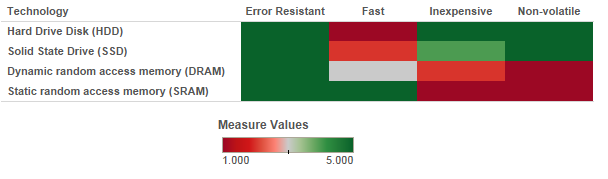
Engineers, never with a deficit of creativity, have invented dozens of such information vehicle technologies. Let’s evaluate four separate candidates, courtesy of Tableau. 🙂

memory technology comparison

Are any of these technologies dominant (superior to all other candidates, in every dimension)?

No. We are forced to make tradeoffs. Which technology do you choose? Or, to put it more realistically, what would you predict computer manufacturers have built, guided by our collective preferences?

The universe called. It says my question is misleading. Economic pressures have caused manufacturers to choose… several different vehicles. And no, I don’t mean embedding different programs into different mediums. Rather, we embed our programs into multiple vehicles at the same time. The memory hierarchy is a case study in redundancy.

CogSci Connection: I cannot answer why economics has gravitated towards this highly counter-intuitive solution? But, it is important to realize that the brain does the same thing! It houses a hierarchy of trace memory, working memory, and long-term memory. Why is duplication required here, as well? So many unanswered questions…

Serialization

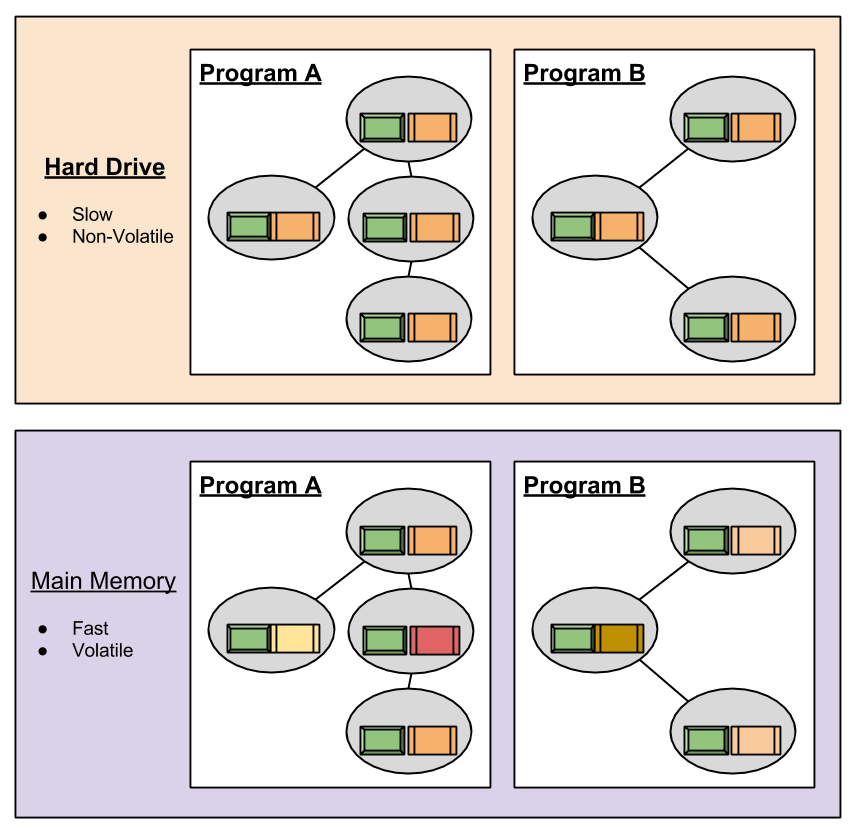
It is time to combine OOP and the memory hierarchy. We now imagine multiple programs, duplicated across several vehicles, living in your computer:

OOP- Memory Hierarchy

In the above illustration, we have two programs being duplicated in two different information vehicles (main memory and hard drive). The main memory is faster, so state transitions (changes made by the user, etc) land there first. This is represented by the mutating color within the objects of main memory. But what happens if someone trips on your power cord, unplugging your CPU before main memory can be copied to the hard drive? All changes to the objects are lost! How do we fix this?

One solution is serialization (known in some circles as marshalling). If we simply write down the entire state of an object, we would be able to re-create it later. Many serialization formats (competing techniques for how best to record state) exist. Here is an example in the JavaScript Object Notation (.json) format:

{“menu”: {
“id”: “file”,
“value”: “File”,
“popup”: {
“menuitem”: [
{“value”: “New”, “onclick”: “CreateNewDoc()”},
{“value”: “Open”, “onclick”: “OpenDoc()”},
{“value”: “Close”, “onclick”: “CloseDoc()”}
]
}
}}

Applications

So far, we’ve motivated serialization by appealing to a computer losing power. Why else would we use this technique?

Let’s return to our taxi software example. If the software becomes very popular, perhaps too many people will want to use it at the same time. In such a scenario, it is typical for engineers to load balance: distribute the same software on multiple different CPUs. How could you copy the same objects across different computers? By serialization!

CogSci Connection: Let’s pretend for a moment that computers are people, and objects are concepts. … Notice anything similar to interpersonal communication? 🙂

Conclusion

In this post, we’ve been introduced to object-oriented programming, and how it changed software to becoming more like a conversation between agents. We also learned the surprising fact about memory: that duplicate hierarchies are economically superior to single solutions. Finally, we connected these ideas in our model of serialization: how the entire state of an object can be transcribed to enable future “resurrections”.

Along the way, we noted three parallels between computer science and psychology:

  1. It is possible that object-oriented programming was first discovered by natural selection, as it invented nervous systems.
  2. For mysterious reasons, your brain also implements a duplication-heavy memory hierarchy.
  3. Inter-process serialization closely resembles inter-personal communication.

Policy Proposal: Metrication

Table Of Contents

  • Back To Basics
  • Meet The English System
  • A Cognition-Friendly Design
  • Global Trends
  • Policy Proposal
  • What Use Are Policy Proposals?
  • Bonus Proposal!

Hm. So, I enjoy discussing this topic. Maybe if I write about it, my Will To Rant will weaken! (Family & friends will be thanking me in no time. 😉 )

Back To Basics

Do you remember how long one meter is? Extend your arms to approximate its length. Now say “meter” about eighteen times, until you achieve semantic satiation. Okay good, I’ve confused you. Your familiarity high was stunting your ability to learn.

Why must a meter be that long? What forbids it from being defined differently?

Nothing. All measurement conventions are arbitrary. Thus, it is possible for every person to use different measurement rules.

But that isn’t how society operates. Why? How do we explain measurement convergence?

It is a cultural technology: it moves attention away from the communicative vehicle and to its content.

Does the above remind you of anything? It should. If I swap out the nouns, I’d be talking about language. The analogy strength is considerable. (Have you yet figured out the mechanism that underwrites analogy strength?)

The funny thing about language is that globalization is murdering it. Of the 6500 languages alive today, fewer than half will survive to 2100 ACE. If you combine this fact to our analogy, you are mentally equipped to forge a prediction:

  • We expect the number of measurement systems to be decreasing.

Meet The English System

In fact, only two comprehensive measurement systems remain. Here is a snapshot of one of them, the English system:

english_system


Chances are that you live in the US, and chances are you’ve wrestled with the question “how many ounces in a quart” once in your life.

Let’s be explicit about why we don’t like the above:

  • There is no discernible pattern between the equivalency values (e.g., 2, 1760, 2240, 43,560…) or words (e.g., “cup”, “pint”, “quart”, “gallon”)

Do you agree? Is this is the reason why you winced at the above table?

Even if we agree, we aren’t done. We still need to explain where our complaint comes from. And that explanation is, of course, cognitive:

  • Patterns facilitate memorization, improving performance of long-term memory.
  • Patterns allow for compression, reducing the load on working memory.

A Cognition-Friendly Design

If you were to design a solution to the above problems from scratch, how would you do it?

I doubt I would have been able to invent this technology independently: it is intimidatingly brilliant. Time to meet the quantitative prefix. The basic idea is: why don’t we link equivalency values to the grammar, and infuse mathematical meaning into our prefixes?

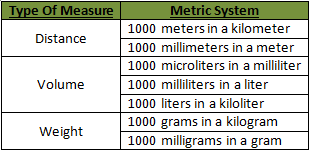
The metric prefix is a kind of quantitative prefix. It encodes scale, in increments of 10^3 (i.e., 1000), by the following:

metric_prefixes


You can allow your sense of familiarity back in the room. You have, of course, used quantitative prefixes all your life. Do you recognize the words “milli-meter”, “kilo-gram”, “giga-byte”? Well, now you have another tool under your belt: you can now precisely understand words you’ve become accustomed to, and rapidly absorb the meaning of new combinations. Two examples:

  1. If someone were to ask you “what does a micro-gram mean?” you could answer “a millionth of a gram!”
  2. If someone were to ask you “how many bytes in 4 gigabytes?” you could answer “4,000,000,000”! *

(* Unless the person who said gigabyte ACTUALLY meant 4 gibibytes, which is NOT the same thing, and a totally separate rant. 🙂 )

metric_system

Notice that, with this technology, we have the same root word, and only need to modify the prefix to expand our vocabulary. More pleasant, no?

Global Trends

Recall our prediction, that the number of measurement systems would decrease over time. And it has. All countries marked in green use the Metric system:

Global Metrication Status

Notice any outliers? 🙂

It’s not like the United States hasn’t tried. In 1975, Congress passed the Metric Conversion Act… but its efforts were largely disbanded in 1982. You can read more here if you like.

Policy Proposal

  • Proposal: The United States should pursue metrication.

Some drawbacks: Such legislation will cost money, and be inconvenient in the short term.

Some benefits: Improved international relations, promotion of less fuzzy thinking, working memory generally freed up for other tasks.

To me, I’m more worried about the possibility of systemic failure: perhaps any political action that incur short-term-cost in exchange for long-term gain are generally considered hazardous. Perhaps, for example, we could introduce a legislation timers so that the fallout from “eat your vegetables” bills don’t fall on their signatories.

Yes, I’m aware the above example is completely broken. But it is meant to signal the kind of thinking we need: infrastructure refactoring.

What Use Are Policy Proposals?

A large amount of ink has been spilled on the metric system. Many of these contributions dive to a depth greater than mine. I do not expect my career to involve the comprehensive analysis of policy ramifications, the meticulous construction of actionable proposals. I am a voice in the wind. Why do I bother?

I will be collecting policy proposals on this blog for several reasons. Beyond my philosophy of politics, I write because it may bring value to the world, and it helps organize my mental life. I also would like to ultimately find collaborators, like-minded individuals interested in researching with me. But I also write because I hope my unconventional emphases will someday unlock relatively-novel ideas that are of good quality. Here’s an example of an idea that may come from my cognitive emphasis above (no promises on quality though :P):

The above solution of quantitative prefix was ultimately a marriage of mathematical reasoning and grammatical systems. I am unable to technically specify the full cognitive algorithm for why this combination works (yet, darn it!). But it opens the door to brainstorming: how else could we leverage language to crystallize and augment our rational capacities? And then you start casting around for ideas.

Bonus Proposal!

A stream-of-consciousness illustration of the kind of transhumanist creativity I am encouraging.

For me, I recall reading speculations that perhaps one reason Chinese kids tend to score highly in math is because the digits are easier to pronounce. I then search for “chinese digits pronunciation” and find this paper. An excerpt:

These data offer support for the hypothesis that differences in digit memory between Chinese and English speakers are derived, in part, from differences in the time required to pronounce number words in the two languages.

I then wonder if a numeric system could be engineered to supplant our “one”, “two”, “three”, etc with a system more like Chinese, to enhance students’ cognitive capacities. But not exactly Chinese numerals – that phonetic system carries other disadvantages. I envision a new numerical phonetics that, engineered with state-of-the-art computational models of working memory, brings empirically-demonstrable cognitive advantages over its “natural” competitors.

See you next time.