Part Of: [Advanced Inference In Graphical Models] sequence
I made this infographic while studying the relationship between chordal graphs and perfect elimination orderings.
Results I found particularly useful have their edges bolded. Enjoy!
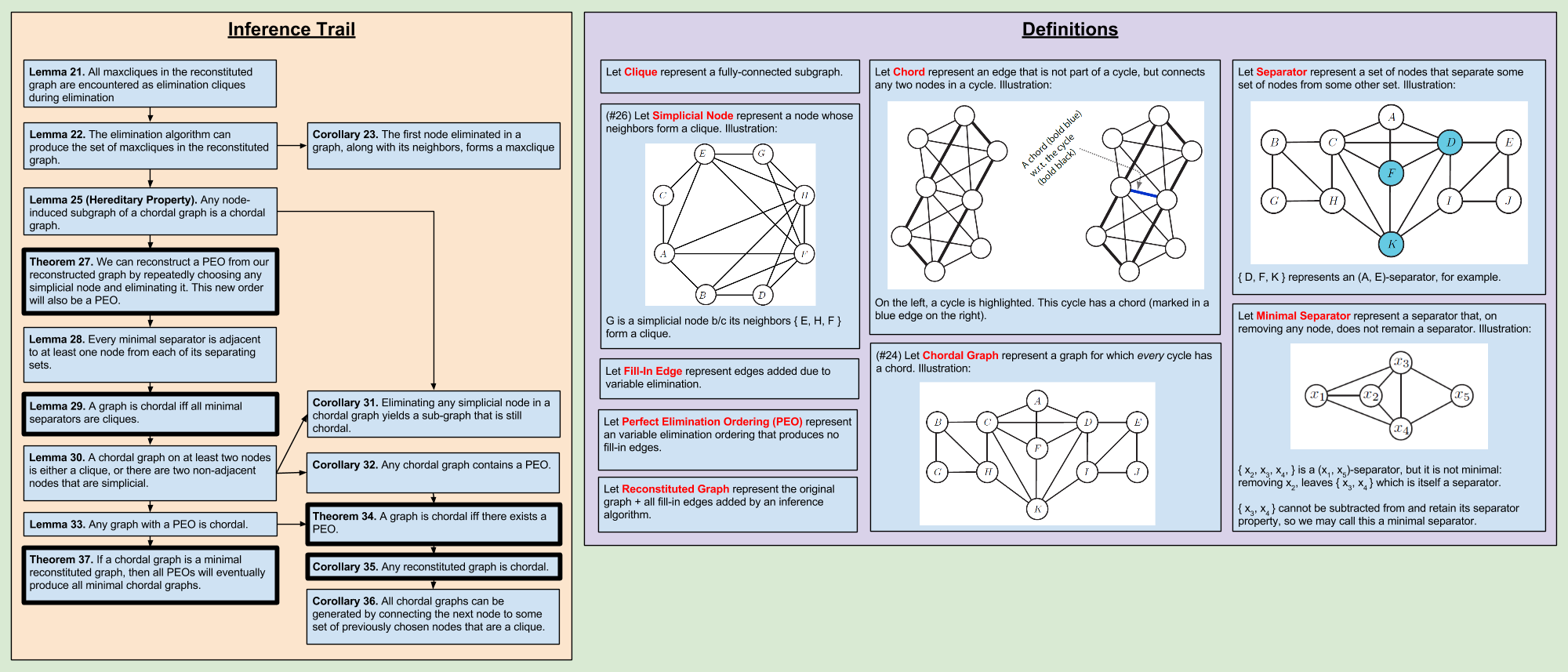
Part Of: [Advanced Inference In Graphical Models] sequence
I made this infographic while studying the relationship between chordal graphs and perfect elimination orderings.
Results I found particularly useful have their edges bolded. Enjoy!
Part Of: [Advanced Inference In Graphical Models] sequence
Followup To: [Murderous Cliques]
Table Of Contents
Context
Our takeaways from last time:
We can make our conclusion more specific.
Let perfect elimination ordering refer to exact inference algorithms that do not at any step introduce fill-in edges; F = {}.
In order to accomplish such an ordering, we should eliminate nodes that match either one of two elimination principles:
In either case, fill-in edges will not be added because the clique requirement is already satisfied.
Forests & Trees
So far in this sequence, we have considered a wide variety of different graph types. Today, let us consider a special type of graph: the forest, and the tree.
Informally, a forest is a graph that has no cycles. A tree is a connected forest, a forest in which two nodes are connected by precisely one path.
Below is one forest comprising four trees:

Theorem 2 (Trees, Berge). Let T = (V, E) be an undirected graph with |V| = n > 2. Then each of the following properties are equivalent and each can be used to define a tree.
Perfect Elimination
Do all graphs support a perfect elimination ordering (PEO)? Consider the following:

In the left image, a PEO does not exist: it doesn’t matter which node you chose, its two neighbors are not already-connected. The right image, in contrast, does contain a PEO (as was shown last time).
Notice how the left 4-cycle is not a tree, whereas the right chain is. Might other types of trees (besides chains) also support perfect elimination orderings? The answer turns out to be yes:
Therefore, any leaf-first ordering on a tree will yield a perfect elimination order, and operate in O(N*r^2) time.
Two important facts to remember:
Murderous Messages
Time to view leaf-first ordering in action. Consider a tree T with |V| = 15. Suppose that, after building this tree with statistical data, a scientist submits a query as to the relationship between two variables.
We know how to perform this inference: eliminate all variables not involved in the query itself. To perform such elimination perfectly, we perform leaf-first ordering:

In the right image, we “rooted” T on the query variables, and eliminated the irrelevant nodes starting from the “lowest” ones.
Pay attention to the way information flows with the above ordering. It is as if the query variables act as a collecting magnet, sucking information from the rest of the graph towards its nodes. On a Bayesian interpretation of this algorithm, we can meaningfully state that this leaf-first ordering is a collection of evidence. Let us call such transmission of evidence message passing.
We can then re-interpret leaf-first ordering in the following protocol:
Message Passing Protocol (MPP): A message may be sent from node i to a neighbor node j only after node i has received a message from all of its other neighbors.
We motivated the MPP based on trees, and elimination principle #1. But we will later MPP in the context of chordal graphs, which guarantee principle #2.
Two things to bear in mind as we close:
Takeaways
 Fewer Lacunae