The Domestication of Sapiens

Part Of: Anthropogeny sequence
Followup To: An Introduction to Domestication
Content Summary: 2000 words, 20 min read

Two Forms of Aggression

Aggression is not a natural kind. Rather, as described in e.g., Siegel & Victoroff (2009), there are two kinds of aggression.

  1. Reactive aggression is based on the RAGE subsystem. It is the biological basis of resource competition. 
  2. Proactive aggression is based on the SEEKING subsystem. It is the biological basis of predation, and sexual selection-driven infanticide.

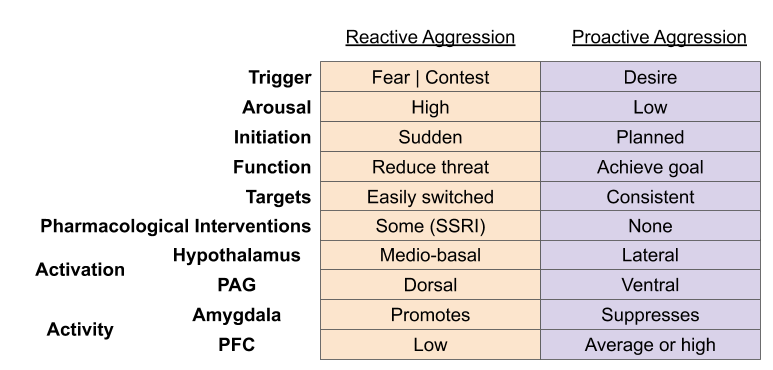
These two systems have different behavioral signatures. Reactive aggression is associated with high arousal, sudden initiation, and functions to remove a threatening stimulus. As observers of a bar fight can tell you, you don’t want to get close to an enraged person at the wrong time – the aggressive behavior can easily switch its target. In contrast, proactive aggression is associated with low arousal, planned initiation, and functions to achieve some sort of goal. 

These systems also feature different physiological signatures. Reactive aggression is caused by activation of the mediobasal hypothalamic nuclei, and dorsal nuclei of the periaqueductal gray (PAG). Amygdala activity promotes these behaviors, and are accompanied by low levels of prefrontal control. In contrast, proactive aggression is caused by activation of the lateral hypothalamic nucleus, and ventral regions of the PAG; amygdala activity suppresses its expression, and it is accompanied by significant cortical activity. 
Of course, these two systems can interact.

  • When a beta chimpanzee challenges an alpha, he may convert predatory aggression (plotting a coup) to an escalating sequence of reactive violence.
  • When a human being suffers intense personal injury and is unable to immediately retaliate, he may convert that reactive rage into the more proactive and delayed phenomena known as vengeance

The distinction also prominently appears in human legal codes: we tend to punish proactive aggression (premeditated murder) more virulent than reactive aggressive (bar fight). 

Anyone looking at homicide data will tell you that being male, and being young, render a person much more likely to kill. Violence-generating mechanisms differ by sex, because each sex is subject to diverging selective pressures.
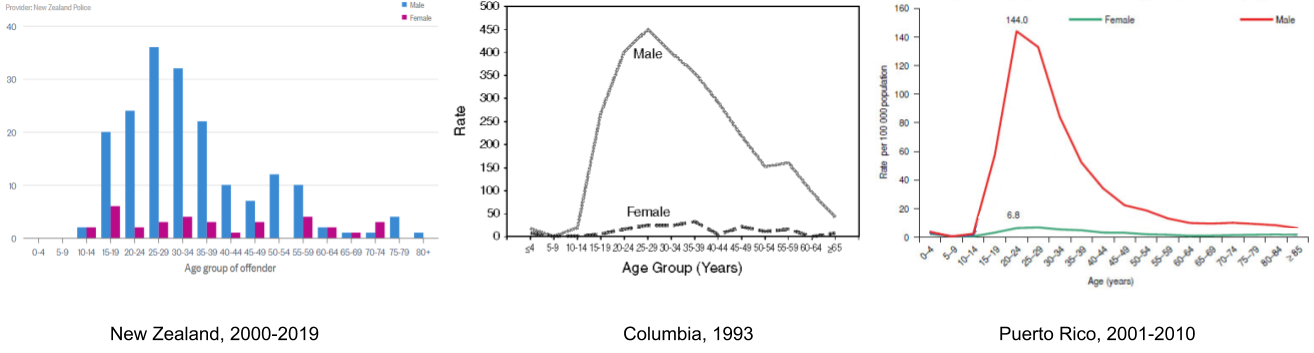
Of course, homicide can be produced by two kinds of aggression. It would be more useful to policy makers to analyze rates of reactive versus proactive aggression separately. Given its more cognitive basis, I suspect proactive violence is more amenable to cultural interventions; whereas reactive violence might be best treated with therapy and pharmaceuticals to strengthen one’s self-control.

And indeed, just these kinds of considerations are now being employed by social scientists seeking to better understand and mitigate phenomena such as domestic violence, and delinquency in children.

From a historical perspective, our species spent most of its history as foragers (i.e.,, hunter-gatherers), with statecraft a consequence of the agricultural revolution. There is a keen interest in understanding the natural tendency of forager populations, since these are more representative of the “original social contract”. The Rousseau paradigm sees foraging humans as a naturally benign and unaggressive species. This position considers violence to be promoted by the state. The Hobbes paradigm rejects the idea of the noble savage and holds violence in the evolutionary path. In this view, the state is an instrument to restrain violence.  

The Evolution of War

Comparative biology data can resolve the Rousseau-Hobbes debate. 

First, consider how chimpanzees use gangs of allied individuals to achieve political ends through aggressive means. These coalitions are very rare in the animal kingdom. They are only known to occur among social carnivores and primates. These acts of coalition-based aggression are proactive in nature. 

Second, it is important to understand how chimpanzees express xenophobia. Chimp troops don’t wander haphazardly; they instead inhabit clearly demarcated territories. The troops of neighboring communities are treated with hostility, so much so that up to 75% of the time is spent in the central 35% of the range. Another expression of chimp territoriality is border patrols, conducted by groups of male chimps moving stealthily to enforce their territory’s boundaries. 

Third, these factors coalesce in the phenomenon of chimpanzee commando raids, with large groups of males penetrating deep into enemy territory, stalking and killing members of competing troops. Why small-scale raids instead of large-scale brawls? Well, warfare is only adaptive when the potential benefits outweigh the risk of personal injury. Thus, these raids are governed by the logic of a local imbalance of power. Raids preferentially occur when the attacking party has gathered significantly more fighting power than the defender (Wrangham 1999).

Killing doesn’t directly increase one’s biological fitness. Why then has such behavior been selected? Because successful raids promote the possibility of territorial expansion (Mitani et al 2010), plausibly by weakening the other groups’ overall fighting power. In turn, territory size directly correlates with resource and mate availability.
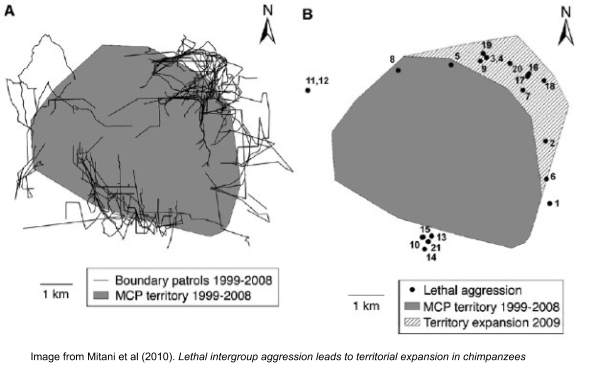
Here is Wrangham (1999) explaining parallels with human warfare:

It is clear that intergroup aggression has occurred among many, possibly all, hunter-gatherer populations and follows a rather uniform pattern. From the most northern to the most southern latitudes, the most common pattern of intergroup aggression was for a party of men from one group to launch a surprise attack in circumstances in which the attackers were unlikely to be harmed. Attacks were sometimes unsuccessful but were, at other times, responsible for the deaths of one or many victims. Women and girls were sometimes captured.

Chimpanzees and hunter gatherers, we conclude, share a tendency to respond aggressively in encounters with members of other social groups; to avoid intensely aggressive confrontations in battle line (typically, by retreating); and to seek, or take advantage of, opportunities to use imbalances of power for males to kill members of neighboring groups.

Indeed, even the rate at which foraging humans and chimpanzees engage in between-group violence is quite similar:
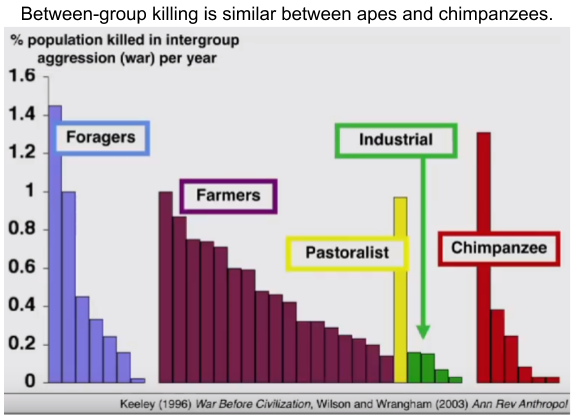
These data suggest a common mechanism. It is not that humans evolved a unique thirst for warfare. Rather, this instinct long predates our species.

The Domestication of Bonobos

It is hard to imagine species with more dramatically different social lives than bonobos and chimps. They are renowned for their ultra-sexualtity: sexual acts are used in lieu of grooming, as the primary vehicle to strengthen relationships. They also exhibit startlingly low rates of violence:

  1. Killing of any kind (including coalition-based acts of violence) is literally unheard of. 
  2. Rape and infanticide have also never occurred.
  3. Commando raids do not occur; bonobos do not even express hostility to neighboring troop “outgroups”. 

The bonobos and chimp lineages diverged very recently (less than 1 mya); yet they lead entirely different social lives. How is this possible?

A clue comes from observations of unusually strong female coalitions in bonobos. Every time a male tries to coerce a female for food or sex, that female’s coalition vigorously rebuff the coalition. These female coalitions in effect give non-aggressive males an advantage. Over the generations, this selective pressure will yield decreasing levels of (proactive) aggression in the bonobo species. 

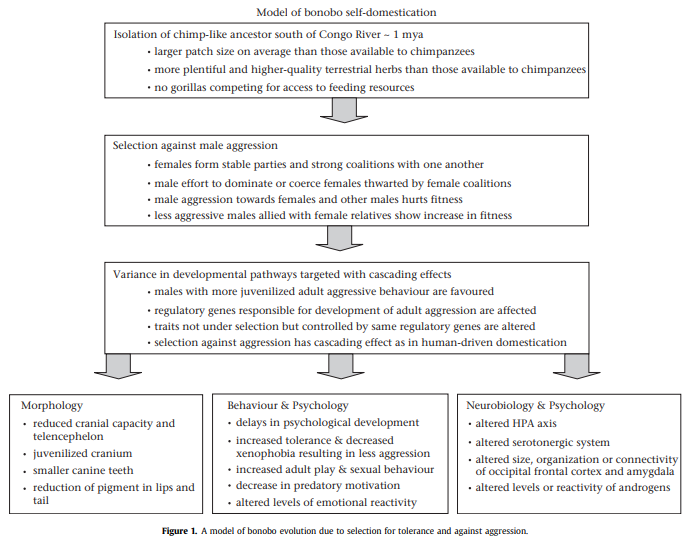
As we learned in An Introduction to Domestication: when aggression is downregulated in a species, a whole complex of unintended byproducts occur. And we see precisely this domestication syndrome in bonobos. Bonobos have smaller crania, reduced pigmentation, increased sexual behaviors, and a general uptick in childlike mannerisms. Bonobos domesticated themselves! Here is the model from Hare et al (2012):
The Puzzle of Humanity

Chimpanzees and humans have comparably high rates of proactive (predatory) violence, and this proclivity underlies a shared love of warfare. In contrast, bonobos exhibit near-zero rates of proactive aggression.

Let’s turn our attention back to reactive violence. Bonobos exhibit moderate forms of reactive aggression; primarily expressed by female coalitions to curtail male domination behaviors. In contrast, chimps are notoriously short-tempered; reacting violently to even trivial “provocations”. How do rates of human reactive aggression compare in practice?

Even in comparatively violent forager groups, the difference is remarkably large. Humans experience reactive violence at rates two orders of magnitude less than our chimpanzee cousins. 
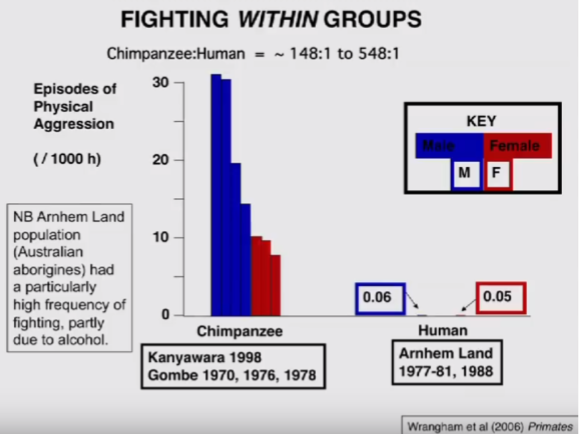
With these data, the following picture has emerged:
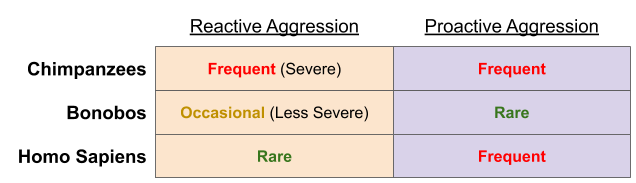
Let’s assume chimpanzee aggression behaviors are representative of the LCA. Bonobos became docile by a process of self-domestication. Why are humans less reactively violent? Did we self-domesticate too?

Another Case of Self-Domestication

The surprising answer is yes. A host of anatomical changes in H. Sapiens around 300 ka all support the self-domestication hypothesis (Leach 2003, Cieri et al 2014).

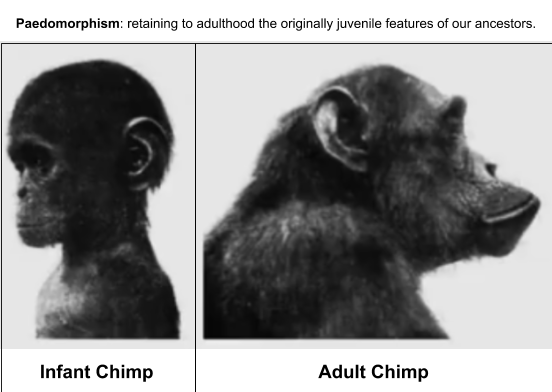
One symptom of domestication is paedomorphism: childlike features that extend into adulthood. Our adult cranium (especially the smooth, round skull) resembles the skull of chimpanzee children (in contrast with a chimpanzee adult’s prognathic face):
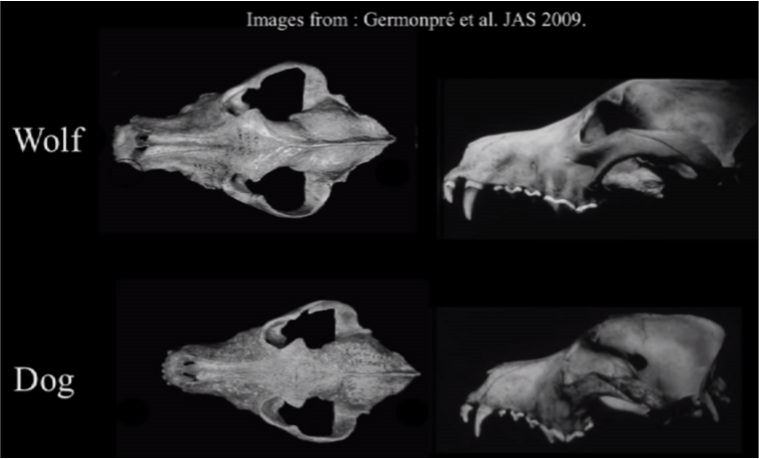
In domestication (among others), we see a reduction in face size, and a feminization of the skull:
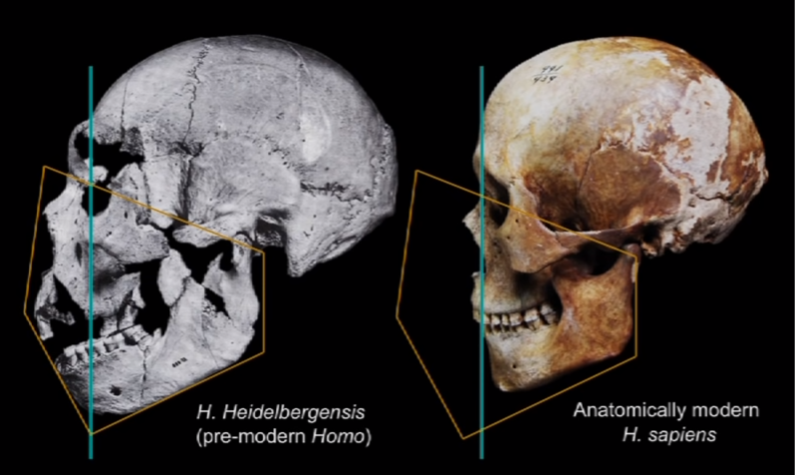
These changes look a lot like the change between our mid-Pleistocene ancestor and anatomically modern H. Sapiens:
Other “domestication signatures” in modern humans include:

  • Brain volume reduction (in last 30,000 years)
  • Smaller teeth, small face-body ratio
  • Reduced sexual dimorphism (differences between male vs female skeletons)
  • More childlike features in adults (longer juvenile period, extended learning, adult play)
  • Increased fertility rate (incl. hidden estrus)
  • Increased rates of lifelong homosexuality

This anatomical evidence of self-domestication nicely explains with our species’ unique relationship with violence. 

Significance of Self-Domestication

Consider again that the domestication syndrome appears between 400 and 100 kya. The Heidelbergs were more violent than Sapiens. 
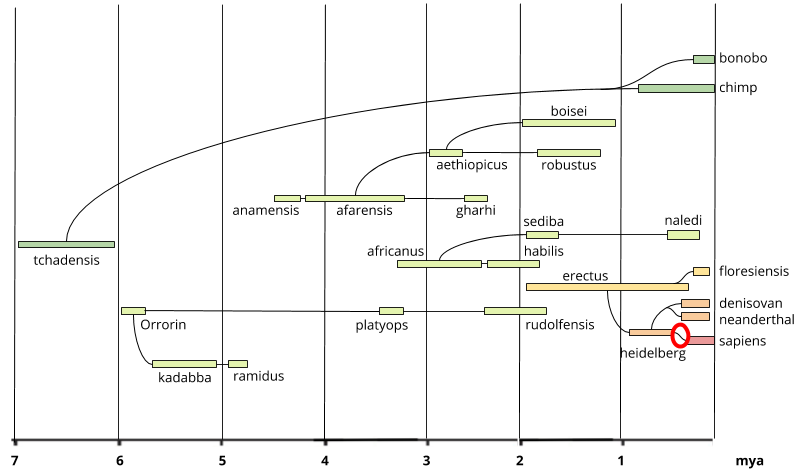
Most primates don’t get enraged by acts of violence that don’t involve them personally. But humans do experience moral outrage at such acts, to the point of being willing to engage in so-called altruistic punishment (risking personal injury to punish a third-party offense).  

Moral instincts are one of the couple dozen traits that are uniquely human. Evolutionary anthropology must explain when and why these uniquely human faculties were forged. Being willing to punish acts of reactive violence surely played a role in the self-domestication process. We can safely conclude that morality as a cognitive adaptation evolved late. Heidelbergs were amoral; Sapiens were increasingly subject to the moral sentiments.

I’ll speak towards why morality evolved another time. For now, let’s turn our attention from the causes, to the effects of self-domestication. For it turns out that these data give us unique insights into what made our species ecologically dominant. Heidelbergs did not conquer the globe – Sapiens did. But how could a reduction in intra-group violence create the necessary conditions for our species’ success?

Our species was not successful because of its pacifism. Rather, the cultural intelligence hypothesis holds that our species’ unique gifts for coordinating with others to transmit cultural knowledge created the conditions for cultural ratcheting. Rather than inheriting only our genetic legacy, we also inherit cultural knowledge which (together with our innate endowments) give us increasing powers to control our environment.

Importantly, the ability for our cultural knowledge (or “super mind”) to accumulate information is not guaranteed. If a particular community of humans is too few in number, or too antagonistic towards one another, its net cultural know-how will not grow across the generations. 
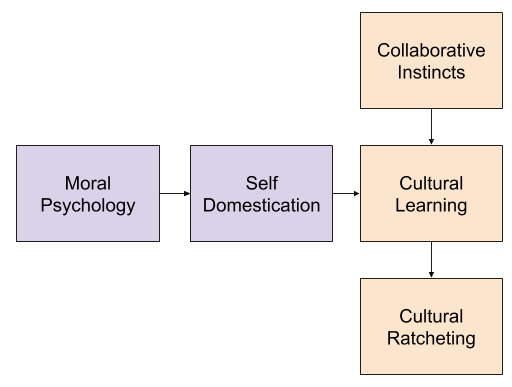
In this model, our cultural instincts evolved earlier in our lineage. But the advent of morality, and its concomitant reduction in reactive violence, was the event that unleashed the astonishing generative potential of human culture.

Until next time. 

Inspiring Materials

Some of these views are articulated in more detail in Wrangham (2019a). For video lecture on this topic, please see:

Works Cited

  • Cieri et al (2014). Craniofacial Feminization, Social Tolerance, and the Origins of Behavioral Modernity
  • Hare et al (2012). The self-domestication hypothesis: evolution of bonobo psychology is due to selection against aggression
  • Leach (2003). Human Domestication Reconsidered.
  • Marean (2015). An Evolutionary Anthropological Perspective on Modern Human Origins
  • Mitani et al (2010). Lethal intergroup aggression leads to territorial expansion in chimpanzees
  • Siegel & Victoroff (2009). Understanding human aggression: New insights from neuroscience 
  • Wrangham (1999). Evolution of Coalitionary Killing 
  • Wrangham (2003). Intergroup Relations in Chimpanzees
  • Wrangham (2018). Two types of aggression in human evolution
  • Wrangham (2019a). The Goodness Paradox: The Strange Relationship Between Virtue and Violence
  • Wrangham (2019b). Hypotheses for the Evolution of Reduced Reactive Aggression in the Context of Human Self-Domestication
Strangers To Ourselves

Part Of: Sociality sequence
Followup To: Intro to Confabulation
Content Summary: 2000 words, 20 min read

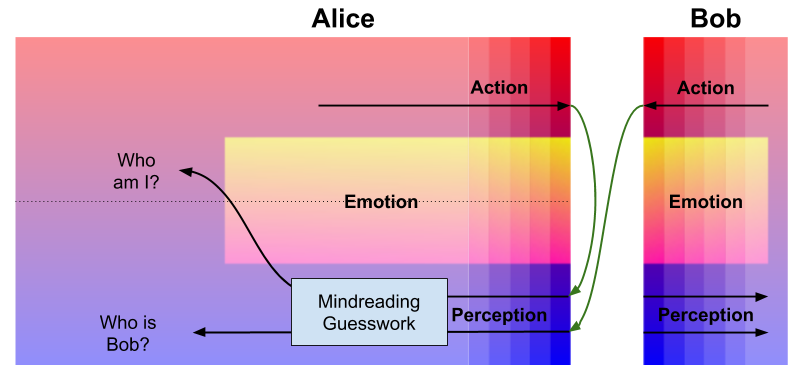
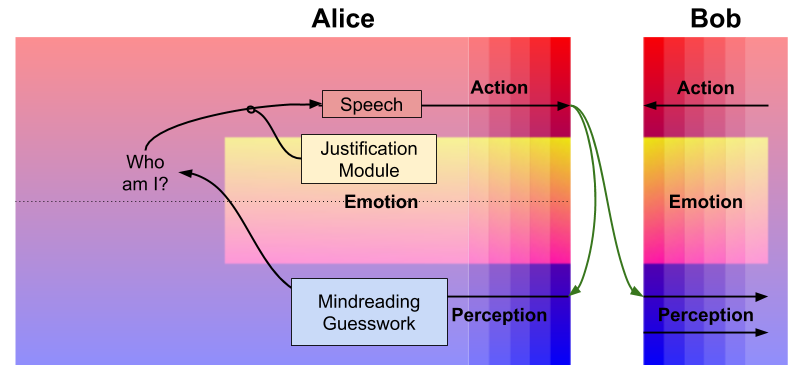
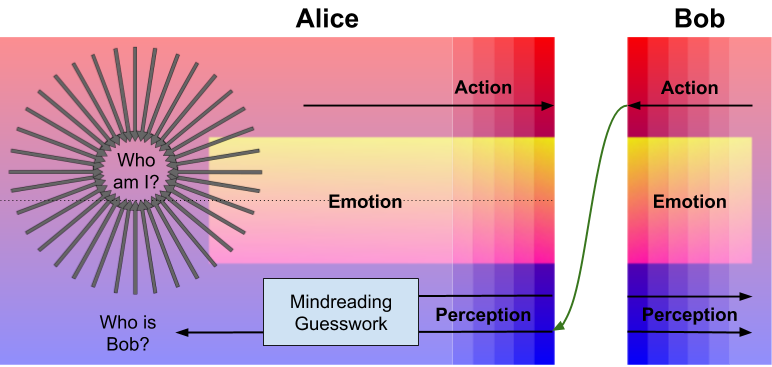
We do not have direct access to our mental lives. Rather, self-perception is performed by other-directed faculties (i.e., mindreading) being “turned inwards”. We guess our intentions, in exactly the same way we guess at the intentions of others.

Self-Knowledge vs Other-Knowledge

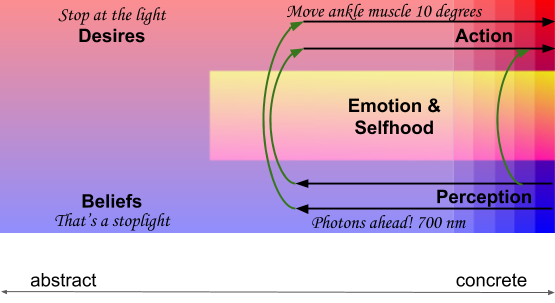
The brain is organized into perception-action cycles, with decisions mediating these streams.  We can represent this thesis as a simple cartoon, which also captures the abstraction hierarchy (concrete vs abstract decisions) and the two loop hypothesis (world vs body).

Agent files are the mental records we maintain about our relationships with people. Mindreading denotes the coalition of processes that attempt to reverse engineer the mental state of other people: their goals, their idiosyncratic mental states, and even their personality. Folk psychology contrasts this interpretive method of understanding other people with our ability to understand ourselves. 

We have powerful intuitions that self-understanding is fundamentally different than other-understanding. The Cartesian doctrine of introspection holds that our mental states and mechanisms are transparent; that is, directly accessible to us. It doesn’t matter which mental system generates the attitude, or why it does so – we can directly perceive all of this. 

Our Unconscious Selves

Cartesian thinking has fallen out of favor. Why? Because we discovered that most mental activity happens outside of conscious awareness.

A simple example should illustrate. When we speak, the musculature in our vocal tracts contort in highly specific ways. Do you have any idea which muscles move, and in which direction, to speak? No – you are merely conscious of the high-level desire. The way that those instructions are cached out at the more detailed motor commands is opaque to you. 

The first movement against transparency was Freud, who championed that a repression hypothesis: that unconscious beliefs are too depraved to be admitted to consciousness. But, after a brief detour through radical behaviorism, modern cognitive psychology tends to avow a plumbing hypothesis: that unconscious states are too complex (or not sufficiently useful) to merit admission to consciousness.

The distinction between unconscious and conscious processes can feel abstract, until you grapple with the limited capacity of consciousness. Why is it possible to read one, but not two books simultaneously? Why is it possible for most of us to remember a new phone number, but not the first twenty digits of pi, after the first 15 minutes of exposure? 

The ISA Theory

The Interpretive Sensory-Access (ISA) theory holds that our conscious selves are completely ignorant of our own mental lives save for the mindreading faculty. That is, the very same faculty used in our social interactions also constructs models of ourselves. 

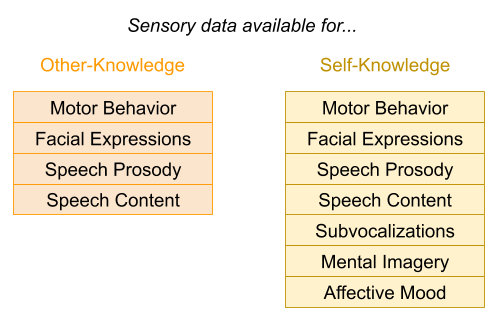
It is important to realize that the range of perceptual data available for self-interpretation is larger than that available for people outside of ourselves. For both types of mindreading, we have perceptual data on various behaviors. In the case of self-mindreading, we also have access to our subvocalizations (inner speech) and the low-capacity contents of the global broadcast, more generally. 

Perhaps our mindreading faculties are more accurate, given they have more data on which to construct a self-narrative. 

The ISA theory explains the behavior-identity bootstrap; i.e., why the “fake it until you make it” proverb is apt. By acting in accordance with a novel role (e.g., helping the homeless more often), we gradually begin to become that person (e.g., resonating to the needs of others more powerfully in general). 

Theses, Predictions, Evidence

The ISA theory can be distilled into four theses:

  1. There is a single mental faculty underlying our attributions if propositional attitudes, whether to ourselves or to others
  2. That faculty has only sensory access to its domain
  3. Its access to our attitudes is interpretive rather than transparent
  4. The mental faculty in question evolved to sustain and facilitate other-directed forms of social cognition. 

The ISA theory is testable. It generates the following predictions:

  1. No non-sensory awareness of our inner lives
  2. There should be no substantive differences in the development of a child’s capacities for first-person and third-person understanding. 
  3. There should be no dissociation between a person’s ability to attribute mental states to themselves and to others. 
  4. Humans should lack any form of deep and sophisticated metacognitive competence. 
  5. People should confabulate promiscuously. 
  6. Any non-human animal capable of mindreading should be capable of turning its mindreading abilities on itself. 

These predictions are largely borne out in experimental data:

  1. Introspection-sampling studies suggest that some people believe themselves to experience non-sensory attitudes. These data is hard for ISA theory to accommodate. But it is also hard for introspection-based theories to reconcile with – if we had transparent access to our attitudes, why do some people only experience them with a sensory overlay?
  2. Wellman et al (2001) conducted a meta-analysis of well over 100 pairs of experiments in which children had been asked, both to ascribe a false belief to another persons and to attribute a previous false belief to themselves. They were able to find no significant difference in performance, even at the youngest ages tested. 
  3. Other theorists (e.g., Nichols & Stich 2003) claim that autism exemplifies deficits in other-k but not in self-k, and schizophrenia is an impairment of self-k but not other-k. But on inspection, these claims have weak if nonexistent empirical support. These syndromes injure both forms of knowledge.
  4. Transparent self-knowledge should entail robust metacognitive competencies. But we do not.  For example, the correlation between people’s judgments of learning and later recall are not very strong (Dunlosky & Metcalfe (2009)). 
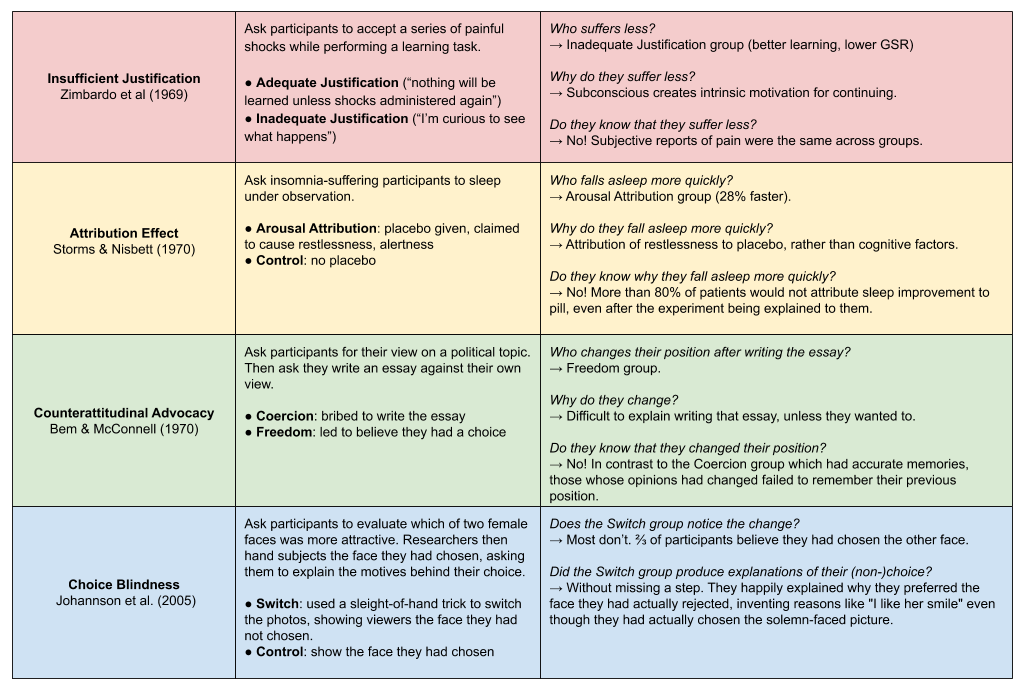
  5. The philosophical doctrine of first-person authority holds that we cannot hold false beliefs about our mental lives. The robust phenomena of confabulation discredits this hypothesis (Nisbett & Wilson (1977)). We are allergic to admitting “I don’t know why I did that”; rather, we invent stories about ourselves without realizing their contrived nature. I discuss this form of “sincere dishonesty” at length here.
  6. Primates are capable of desire mindreading, and their behavior is consistent with their possessing some rudimentary forms of self-knowledge.

The ISA theory thus receives ample empirical confirmation.

Competitors to ISA Theory

There are many competitors to the ISA account. For the below, we will use attitude to denote non-perceptual mental representations such as desires, goals, reasons and decisions. 

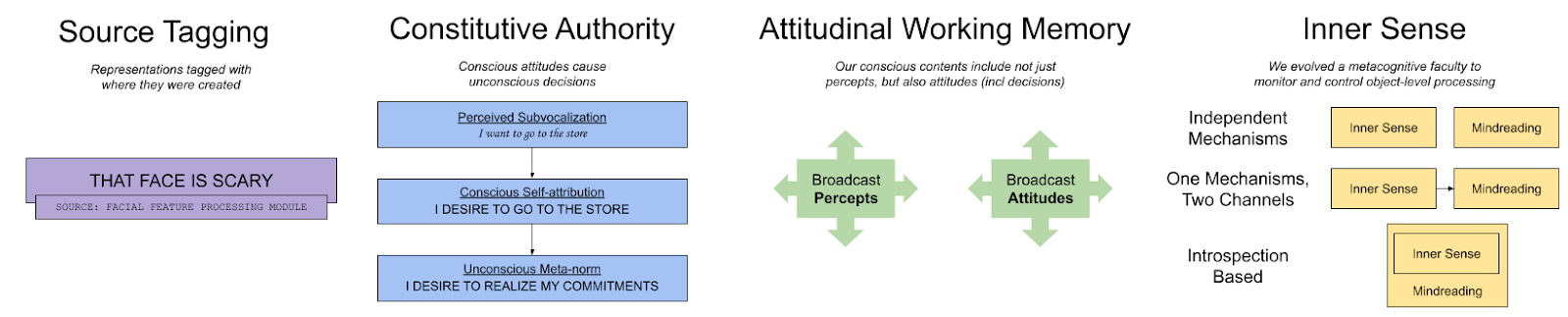
  1. Source tagging theories (e.g., Rey 2013) hold that, whenever the brain generates a new attitude, the generating system(s) add a tag indicating their source. Whenever that representation is globally broadcast, our conscious selves can inspect the tag to view its origin. 
  2. Attitudinal working memory theories (e.g., Fodor 1983, Evans 1982) hold that, in addition to a perception-based working memory system, there is a separate faculty to broadcast conscious attitudes and decisions. 
  3. Constitutive authority theories (e.g., Wilson 2002, Wegner 2002, Frankish 2009) admit that conscious events (e.g., suppose we say I want to go to the store) do not directly cause action. However, we do attribute these utterances to ourselves, and the subconscious metanorm I DESIRE TO REALIZE MY COMMITMENTS works to translate these conscious self-attributions to unconscious action programs. 
  4. Inner sense theories hold that, as animal brains increased in complexity, there was increasing need for cognitive monitoring and control. To perform that adaptive function, the faculty of inner sense evolved to generate metarepresentations: representations of object-level computational state. There are three important flavors of this theory:

But there are data speaking against these theories

  1. Contra source tagging, the source monitoring literature shows that people simply don’t have transparent access to the sources of their memory images. For example, Henkel et al (2000) required subjects to either see, hear, imagine as seen, or imagine as heard, a number of familiar events, such as a basketball bouncing. But people frequently misremembered which of these four mediums had produced their memory, when asked later. 
  2. The capacity limits of sensory-based working memory explains nearly the entire phenomena of fluid g, also known as IQ (Colom et al 2004). If attitudinal working memory evolved alongside this system, it is hard to explain why it doesn’t contribute to fluid intelligence scores. 

More tellingly, however, each of the above theories fails to explain confabulation data. Most inner sense theories today (e.g., Goldman 2006) adopt a dual-method stance: when confabulating, people are using mindreading; else people are using transparent inner sense. But as an auxiliary hypothesis, dual-method theories fail to explain the patterning of when a person will make correct versus incorrect self-attributions. 

Biased ISA Theory

The ISA theory holds self-knowledge to be grounded in sparse but unbiased perceptual knowledge. But this does not seem to be the whole story. For we know that we are prone to overestimate the good qualities of the Self and Us, but underestimate the bad qualities of the Other and Them. 

For example, the fundamental attribution error describes the tendency to explain our own failings as contingent on the situation, but the failings of others to immutable character flaws. More generally, the argumentative theory of reasoning posits a justification faculty which subconsciously makes our reasons rosier, and our folk sociology faculty demonizes members of the outgroup. 

In social psychology, there is a distinction between dispositional beliefs (avowals that are generated live) and standing beliefs (those actively represented in long-term memory). The relationship between the content of what one says and the content of the underlying attitude may be quite complex. It is unclear whether these parochial biases act upon standing or dispositional beliefs. 

Explaining Transparency

The following section is borrowed from Carruthers (2020). 

In general, our judgments of others’ opinions come in two phases:

  1. First pass representation of the attitude expressed, relying on syntax, prosody, and the salient feature of conversational context.
  2. Lie Detection. Whenever the degree of support for the initial interpretation is lower than normal, or there is a competing interpretation in play that has at least some degree of support, or the potential costs of a misunderstanding are higher than normal, a signal would be sent to executive systems to slow down and issue inquiries more widely before a conclusion is reached. 

Why do our self-attributions feel transparent? Plausibly, because, the attribution of self-attitudes only undergo the first stage (not subject to disambiguation and lie detection systems). This architecture would likely generate the following inference rules:

  1. One believes one is in mental state M → one is in mental state M.
  2. One believes one isn’t in mental state M → one isn’t in mental state M.

The first will issue in intuitions of infallible knowledge, and the second in the intuition that mental states are always self-presenting to their possessors.

For example, consider the following two sentences

  1. John thinks he has just decided to go to the party, but really he hasn’t. 
  2. John thinks he doesn’t intend to go to the party, but really he does.

These sentences are hard to parse, precisely because the mindreading inference rules render them strikingly counterintuitive.

These intuitions may be merely tacit initially, but will rapidly transition into explicit transparency beliefs in cultures that articulate them. Such beliefs might be expected to exert a deep “attractor effect” on cultural evolution, being sustained and transmitted both because of their apparent naturalness. And indeed, transparency doctrines have been found in traditions from Aristotle, to the Mayans, to pre-Buddhist China.

Until next time. 

Inspiring Materials

These views are more completely articulated in Carruthers (2011). For a lecture on this topic, please see:

Works Cited

  • Carruthers (2011). The Opacity of Mind
  • Carruthers (2020). How mindreading might mislead cognitive science
  • Colom et al (2004). Working memory is (almost) perfectly predicted by g
  • Evans (1982). The Varieties of Reference
  • Henkel et al (2000). Cross-modal source monitoring confusions between perceived and imagined events
  • Fodor (1983). The Modularity of Mind
  • Goldman (2006). Simulating Minds. 
  • Frankish (2009). How we know our conscious minds. 
  • Nichols & Stitch (2003). Mindreading: An Integrated Account of Pretence, Self-Awareness, and Understanding Other Minds
  • Nisbett & Wilson (1977). Telling more than we can know: verbal reports on mental processes.
  • Rey (2013). We aren’t all self-blind: A defense of modest introspectionism
  • Wilson (2002). Strangers to ourselves
  • Wegner (2002). The illusion of conscious will