Feature Binding: The Language of Consciousness

Part Of: Object sequence
Content Summary: 400 words, 4 min read

Binding Via Phase Locking

As we have seen, objects are distributed networks: their resident features are computed in myriad locations across cortex.
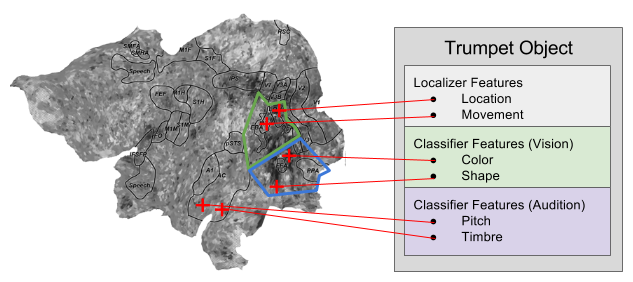
Objects- Distributed Object Networks (2)

The binding problem is: how do these distributed networks cohere?  How does geographic division become logical unity?

Object binding seems to be accomplished via phase locking. By some unknown mechanism, firing patterns from disparate features synchronize, such that they all strike consumer processes simultaneously. By this temporal mechanism, objects increase their “firing power” while not needing to amplify their component signals.

Phase locking can be observed in the electrical rhythm of the brain, as measured by the electroencephalogram  (EEG). Phase locking is only observed during the wakeful state, disappearing with the onset of Slow Wave Sleep (SWS).
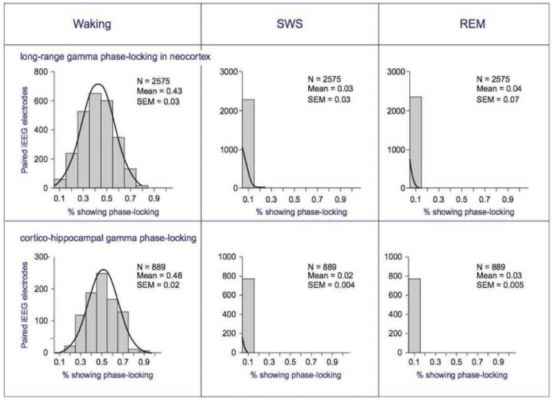
Objects- Phase Locking & Wakefulness

We hypothesize that phase locking is necessary for object creation; that it is the solution to the binding problem. But phase locking only occurs during wakefulness. This suggests that object creation and consciousness are closely interrelated processes.

Let us conjecture that objects are the language of consciousness. They are the Song of Cortex.

This hypothesis provides explanatory firepower. We may now dissolve two Gordian knots.

The Unconscious Dorsal Stream

Remember blindsight? We explored blindsight in The Three Stream Hypothesis: blindsight patients have visual information accessible to the Dorsal Stream, but not the Lateral nor Ventral Stream.

But why should the Dorsal Stream be uniquely non-conscious?  This is one of GWTs big open questions, as acknowledges by Baars in Global Workspace Dynamics, 2013. But we have made two conceptual moves that Baars has not:

  1. Objects are the language of consciousness
  2. Objects are created across by a ventral Classifer and a lateral Localizer engine (see Dual Engine Hypothesis, here).

The Dorsal Stream is unconscious because it does not participate in object construction.

Chunking

In the working memory literature, chunking refers to the ability to retain more information via drawing creative boundaries around information. Suppose I were to verbally recite the following phone numbers:

  • “2-0-6-5-5-5-1-2-2-0”
  • “206-555-220”

Both sounds encode the same information, but you could remember the latter more easily.  Why?

It is widely acknowledged that the contents of working memory are available to consciousness. If working memory is the Global Workspace, then we would expect that chunks are objects. And indeed, our conjecture does successfully explain chunking:

In the above example, we retain the chunked version better because it requires the activation of only three objects (206, 555, 1220), rather than ten, single-digit objects.

Takeaways

  • Evidence of phase locking suggests that objects are the language of consciousness:
  • Objects are created by two engines: a Localizer and a Classifier. The Dorsal stream contains neither engine, and is thus non-conscious.
  • Objects explain working memory results such as chunking.

[Sequence] Object Files: The Seat Of Knowledge

Part of: Demystifying Consciousness sequence

Suggested Prereading:

Core Sequence:

Salience Maps: The Auction For Awareness

Part Of: Attention sequence
Followup To: How Meat Decides
Content Summary: 900 words, 4 minute read

Salience as Unit of Bidding

Recall our Attention as Gatekeeper metaphor:

Our perceptual systems process myriad sensory events, these must bid for entry into the capacity-limited Global Workspace.

Attention, then, is a kind of auction. The unit of bidding is salience. Let me explain.

Salience Maps

Imagine a landscape with money on the ground. This is rather unexpected: not many experiences of natural scenes include such images. Salience and consciousness are related: the bag of money is one of the first things to enter awareness.

Attention- Salience Maps

The salience map hypothesis is that the brain constructs a topographic map to compute salience distributions.

The salience map hypothesis is meant literally: if you were standing over an exposed brain, and could transduce electrical activity into light, you would physically see the salience map tattooed onto the cortical surface.

Notice how this salience map contains a peak of activity at the location of the money. The money stimulus has evoked the strongest bid.

The Computation of Salience

Your visual system receives information from the retina into what is called a primary visual area, V1. From there, information is carried along several diverging cortical streams. Think: carrier pigeons dispatched to the four corners of the globe.

One pathway, the ventral stream (the soft underbelly of the brain) is responsible for extracting features (e.g., color, shape, texture) from retinal imagery.  Features are used in object recognition: if an unknown object has the shape shape as your pre-existing Trumpet memory, then you will identify it as a trumpet!

Another thing that features do, however, is generate salience bids. Psychophysics has revealed a wide swathe of visual properties that induce salience. Here are some examples:

  • Motion: objects moving quickly or erratically
  • Contrast: significantly brighter or darker than background
  • Novelty: violates contextual expectations; occur with low-probability.

We should expect salience to be grounded in biological fitness: that information with high survival value would select for high salience.  This is in fact the case. The above salience-triggers are precisely the sorts of things we would expect e.g., predators to produce.

Premotor Theory of Attention

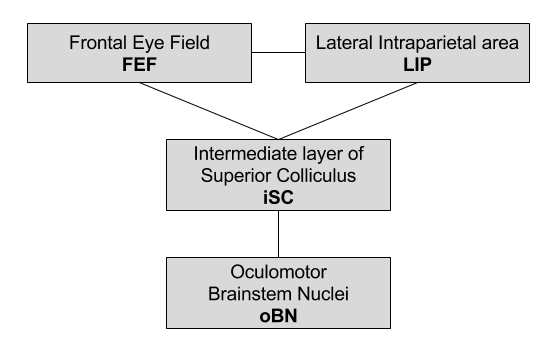
The following circuitry are associated with eye movement:

Attention- Original Network

Call this the saccade circuit. The foveal spotlight moves via the following mechanism:

Signals from FEF & LIP travel to iSC, which engages the (tremendously complicated) oBN network responsible for generating eye movement.

However, in the 1990s, researchers began to notice that the saccade circuit is also involved in attention! Three streams of evidence have since confirmed this suspicion:

  1. Human imaging studies (e.g., Corbetta et al 1998) discovered eye movements and visuospatial attention both activate identical regions within the saccade circuit.
  2. Primate electrophysiology studies (e.g., Moore and Armstrong 2003) showed that microstimulation of FEF enhanced visual responses in V4 neurons that represented the same spatial location.
  3. Human TMS studies (e.g., Ruff et al 2006) blasted FEF with a magnetic pulse, and observed attention-like effects within early visual cortex (e.g., V1).

Taken together, these data motivate the Premotor Theory of Attention, which holds that visuospatial attention constitutes preparation for a saccade event.

Given the weight of evidence supporting it, the premotor theory is now the consensus view among neuroscientists. Of course, the theory is only a starting point. Much contemporary attention research elaborates on this basic mechanism.

Via Premotor Theory, we have successfully discovered a selection mechanism within the cortex. This adds some meat to our attention as gatekeeper metaphor:

Attention- Circuit

A Dual Map Hypothesis of Spatial Attention

So far, we have seen three trends in the literature:

  1. Neuroeconomics argues that saccadic choice is implemented via Winner-Take-All (WTA) on utility maps.
  2. Salience maps are increasingly viewed as indispensable to exogenous attention, and suspected to reside in posterior parietal cortex (Gottlieb et al 1998).
  3. Premotor Theory suggests that saccadic choice and attentional choice utilize the same circuit.

Let me throw my hat into the ring, and present a novel hypothesis to weld these themes together.

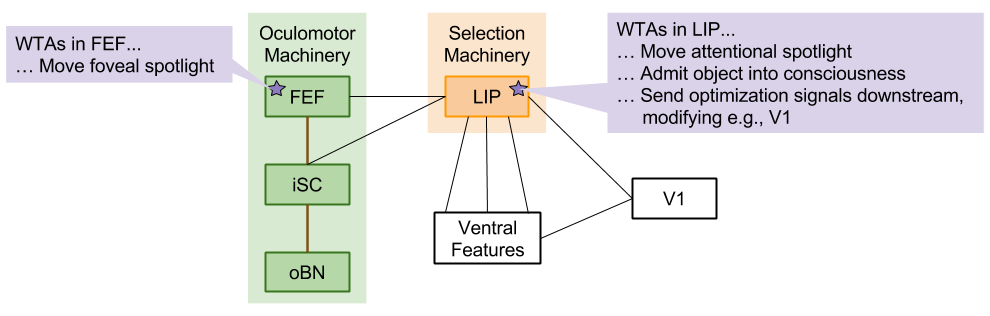
  • Conjecture 1: FEF contains a saccade utility map, and LIP contains a salience map.
  • Conjecture 2: Corticocortical pathways between FEF and LIP synchronize these maps (“high saliency is high saccade utility”)
  • Conjecture 3: WTAs in FEF induce saccades. They represent decisions to relocate the foveal spotlight.
  • Conjecture 4: WTAs in LIP represent decisions related to the attentional spotlight.  They initiate bind & broadcast operations necessary to admit an object into the Global Workspace, and send optimization signals downstream, modifying processing as far as V1.

Call this the Dual Map Hypothesis.

Attention- Dual Choice Conjecture

Recall that “large” simulations of FEF induces both saccades & attentional signals, whereas “moderate” stimulations only affects attention. Is this incompatible with my Dual Map Hypothesis?

No. This result is, in fact, predicted by our theory, given the following conditions:

  • The electrical impulse travels across the FEF-LIP bridge, affecting both topographic maps
  • The resolution threshold of FEF is considerably higher than that of LIP.
    • This isn’t terribly difficult to suppose. Saccadic decisions are more metabolically and temporally expensive, after all.
Attention- Dual Choice Conjecture Example (1)

Until next time.

References

  • Ruff et al (2006). Concurrent TMS-fMRI and Psychophysics Reveal Frontal Influences on Human Retinotopic Visual Cortex
  • Moore & Armstrong (2003). Selective gating of visual signals by microstimulation of frontal cortex
  • Corbetta et al (1998) A Common Network of Functional Areas for Attention and Eye Movements
  • Gottlieb et al (1998). The representation of visual salience in monkey parietal cortex

Winner-Take-All: How Meat Decides

Part Of: Attention sequence
Followup To: Attention As Gatekeeper

Part Of: Neuroeconomics sequence
Followup To: Because vs As-If

Topographic Maps

Recall that cerebral cortex is like a sheet: stretched flat, it covers an area of 2.5 square feet.

Mental modules are clusters of functionally-homogenous cortex. If the cortex is a map, modules are the borders of its nation-states. For example, the Fusiform Face Area (FFA) is a well-known example of a specialized module: it performs face recognition.

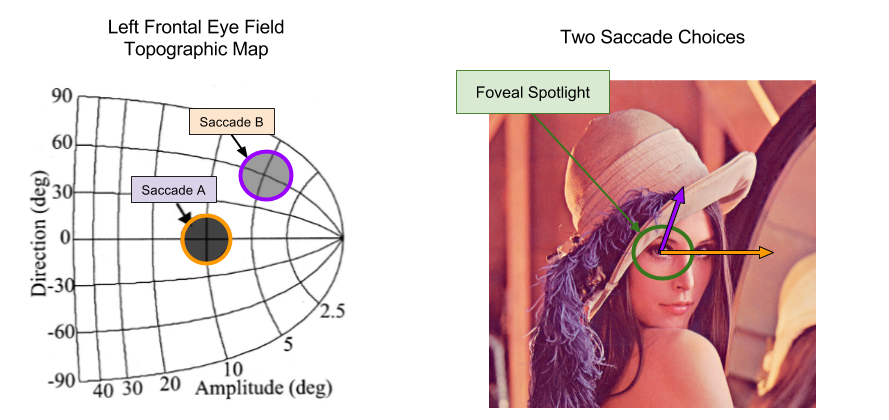
Mental modules often contain topographic maps. Let’s imagine viewing the FEF topographic map from above, and seeing two hills of activity (electrical storms). These represent different choices:

Attention- Topographic Maps (4)

Our topographic map encodes different saccade vectors. Specifically,

  • Saccade A represents looking at the mirror: moving the foveal spotlight horizontally (0°) a moderate distance (10°).
  • Saccade B represents looking at Lena’s hat:  moving the foveal spotlight up-right (60°) a small distance (5°).

The closer the two hills of activity, the more similar the saccade vectors. More concisely, in topographic maps, proximity encodes similarity.

The Machinery of Choice

These two peaks of activity (electrical storms) encode two choices under consideration. The brain is considering whether to look at the hat, or the mirror. How does the brain select the best option? 

Topographic maps implement choice via removing all unchosen options from the topographic map. It preserves the winner via a Winner-Take-All (WTA) process, sometimes called exponentiation.

When a topographic map “makes a choice”, its activity peaks transmit inhibitory neurochemicals (e.g., GABA) to one another. The process is not unlike arm wrestling. The option with most vibrant activity is almost always selected. Muscles matter. 🙂

So in the above, since Choice A is the more intense electrical storm, the person chose to look at the mirror.

A Universal Process

Human beings perform more complex behaviors than shifting their gaze. However, WTA has been shown to underlie nearly all of them.

Sometimes, topographic maps comfortably share space without engaging in WTA. How does the brain decide to decide? The resolution threshold is the point of no return: if an electrical storm becomes more intense than that value, it is off to the races. And, of course, the brain has several mechanisms for dynamically altering this threshold.

Wrapping Up

  • Economists like to talk about utility maximization.
  • Mathematicians like to talk about the argmax operator.  
  • Cognitive psychologists like to talk about decision making.

WTA is the unifying thread. It allows meat to make decisions.

References

This writeup was, of course, heavily simplified. For technical details, see:

  • Cisek (2006). Integrated Neural Processes for Defining Potential Actions and Deciding between Them: A Computational Model
  • Glimcher (2010). Foundations of Neuroeconomics


Attention as Gatekeeper

Part Of: Attention sequence
Followup To: An Introduction to the Attentional Spotlight
Content Summary: 600 words, 6 min read

Global Workspace Theory

The weakest noticeable sound is defined at 0 decibels. Imagine putting somebody into a scanner, and having them listen to two sounds:

  1. A trumpet playing at -5 dB
  2. A trumpet playing at 5 dB

The acoustic difference between the two waveforms are not very different. How similar are the patterns of brain activation?

Attention- GWT

Here we see that subliminal auditory stimuli only activate early perceptual areas. Consciousness brings with it a huge increase in neural activation! Why should this be?

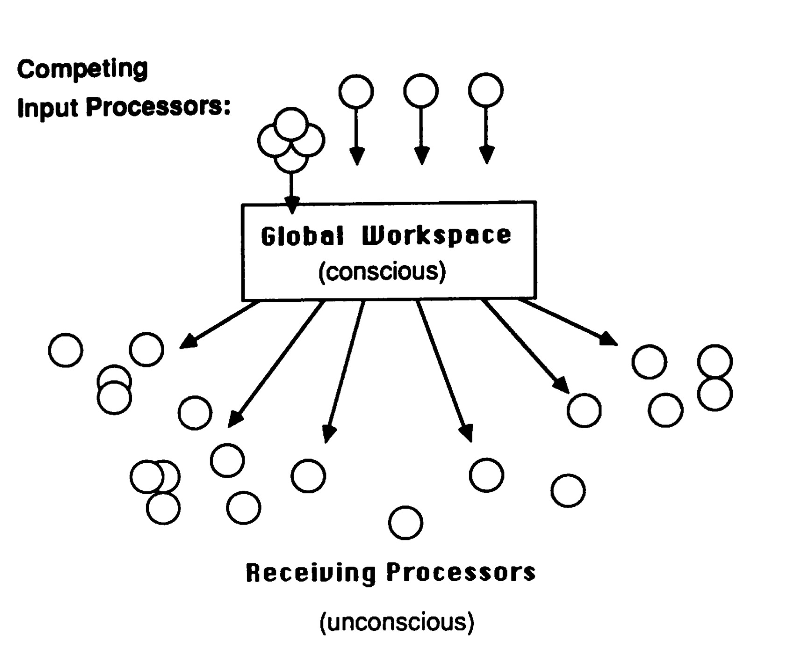
Global Workspace Theory (GWT) posits that consciousness is involved in two mental operations:

  • Binding: perceptual features, distributed across the brain, are bound together into discrete objects
  • Broadcasting: these object networks are broadcast to the rest of cortex, allowing consumer systems to use & modify them.

Attention- GWT Architecture
Three properties of consciousness have long baffled philosophers:

  • Consciousness is small: we can only retain a few (less than 7) objects in our head at one time.
  • Consciousness is serial: we can’t read two books at the same time.
  • Consciousness is flexible: unlike state of the art AI software, human reasoning can effortlessly enter new domains.  

GWT explains these facts. Consciousness is…

  • … small because it is hard to keep global object networks distinct from one another.
  • … serial because it is a singleton: massively parallel modules engage the same centralized resource.
  • … flexible because any consumer system can augment the processing of any perceptual object.

The Role of Attention

Attention is a gatekeeper. Our perceptual systems process myriad sensory events, these must bid for entry into the Global Workspace. The brain contains circuitry that implements this selective process, choosing which perceptual objects to bind & broadcast.  

Attention- Gatekeeper Role

Let’s see if we can use this metaphor to make sense of the sprawling literature on attention.

Consolidating Taxonomies

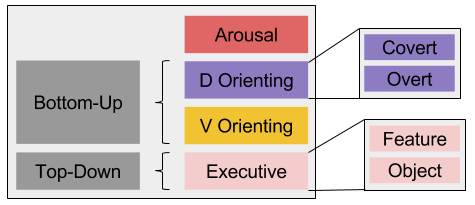
There are three taxonomies of attention that you’ll find in the literature:

  1. Covert vs overt attention. As discussed in Attentional Spotlight, we can differentiate attending to objects in the periphery, versus saccading to attended targets.
  2. Bottom-up vs top-down attention.  Distinguishes unplanned attention (e.g., to loud noises) vs goal-based attention (e.g., “count the number of times the soccer ball is passed”).
  3. Feature vs spatial attention. Distinguishes attending to a feature (“look for all red things”) vs an object (“look for a red triangle”)

In an influential paper, Peterson & Posner (1990) present three attentional networks: functionally independent brain systems which do attention. These are:

  1. Alerting. This network is tightly linked to wakefulness. Startling events induces strong alerting, lounging on a couch less so.
  2. Orienting. These two networks (one dorsal, the other located more ventral) orients the organism to process incoming stimuli.
  3. Executive. This network supports complex task execution, and goal-oriented attention.

Peterson & Posner’s framework allows us to simplify the conceptual landscape:

Attention- Taxonomy Reduction

The Orienting network produces Bottom-Up (“externally-driven”) attention. Its dorsal arm contains mechanisms for covert and overt orienting.

The Executive network produces Top-Down (“internally-generated”) attention. Feature and Object attention are both a form of search template, and as such are constructed here.

An Attentional Organ

In my next post, I’m going to argue that the Dorsal Orienting network is the attentional gateway, full stop. It alone performs selection: a single gateway through which percepts pass into conscious awareness.

On this model, the arousal, ventral orienting, and executive networks play auxiliary roles, modulating our brain’s attentional gateway.

Attention- Architecture Overview

Until next time.

References

  • Peterson & Posner (1990). The attention system of the human brain

Logic Structure: Connectives in IPL

Part Of: Logic sequence
Content Summary: 700 words, 7 min read

Organizational Principles Of Logic

The ingredients of any system of logic are:

  • A proposition is an atomic statement that can acquire a truth value. For example, “Socrates is a man”.
  • A connective takes atomic propositions, and melds them into a more complex, composite proposition. For example, AND is a connective.

Propositions, in both atomic and composite form, represent containers for truth valuations. A judgment is a filled container: a proposition assigned a specific truth value (true or false).

But logical systems are not static entities. The heart of any logic is its dynamics: rules which permute its resident propositions.

The IPL System

Once upon a time, logicians tired of the tedious algebraic format of their logical systems. Natural deduction was invented as a graphical alternative to such systems.

In this post, I use the natural deduction format to present one particular system of logic, Intuitionistic Propositional Logic (IPL).

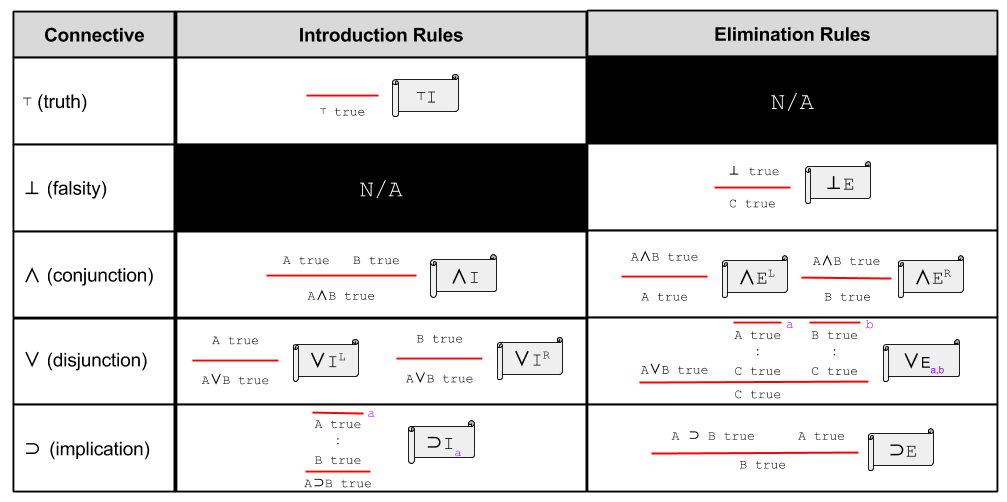
IPL permits the following connectives:

  • ∧ (conjunction, “AND”)
  • ⊃ (implication)
  • ∨ (disjunction, “OR”)
  • ⊤ (truth)
  • ⊥ (falsity)

Rules can be categorized as follows:

  1. Introduction rules show how connectives are injected into the system.
  2. Elimination rules describe how connectives are removed from the system.

Ready to take a look under the hood?

Conjunction () Rules

The ∧ (AND) connective features three rules. In the following visuals, premises (knowledge before rule application) are on top, conclusions (knowledge after rule application) below.

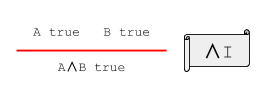
Our first rule is AND-Introduction (∧I). It permits us to glue facts together.

IPL- Conjunction Introduction

In English: “Before we applied the ∧I rule, suppose we know two facts: A, and B. Afterwards, we know one additional fact: A∧B.”

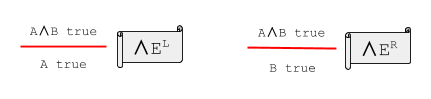
Next, we have Left-AND-Elimination (∧EL) and Right-AND-Elimination (∧ER). Together, these rules “remove the glue”.

IPL- Conjunction Elimination

The left rule means: “If we use A∧B, we can use A by itself.”

Implication () Rules

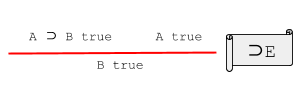
IMPLICATION-Elimination (⊃E) proceeds fairly intuitively:

IPL- Implication Elimination

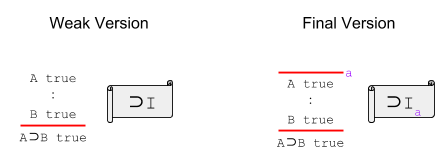
IMPLICATION-Introduction (⊃I) is where things get tricky. Consider the weaker version of this rule, on the left.

IPL- Implication Introduction

The ellipsis “..” means that other rules may be injected, the intermediate proof can be hundreds of lines long, if need be. So this weak rule seems intuitive:

If you know A, and from this information can eventually prove B, then you may conclude ‘A implies B’.

However, this version is too simplistic: it allows implications only to be introduced when the antecedent was already assumed. The real rule is more powerful:

If you assume A, and from this information can eventually prove B, then you may conclude ‘A implies B’.

Get the difference? Before, our assumptions were unchanged.  But now we expand our assumption set, and denote the location of our assumption-expansion with a line, and name it (in this case, “a”.)

Disjunction (∨) Rules

OR statements only require only one of its terms to be true. If you have evidence for one statement, it doesn’t matter whether the others are true or false.

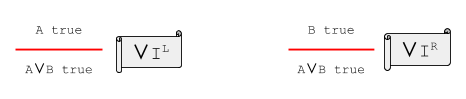
This intuition is cashed out in the Left-OR-Introduction (∨IL) and Right-OR-Introduction (∨IR) rules.

IPL- Disjunction Introduction

The left rule means: “If we use A, we can use A∨B.” 

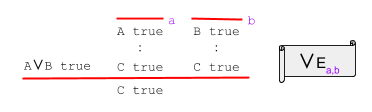
Of all the rules in Intuitionistic Propositional Logic, OR-Elimination (∨E) requires the most time to comprehend. 

IPL- Disjunction Elimination

Notice that the last two inputs fit the criteria for implication, and could simplify to A⊃C and B⊃C.

Here is one way to interpret the above rule:

Suppose we know that A∨B.

If it is true that “A implies C” and “B implies C”, then we know C is true.

We know this because at least one component of A∨B must be true!

Truth () and Falsity () Rules

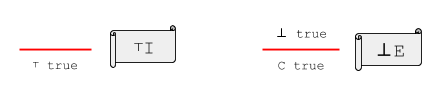
IPL includes two rules regarding Truth and Falsity.

IPL- Truth and Falsity (1)

The TRUTH-Introduction (⊤I) rule simply means that the system admits trivial truths.  There is no TRUTH-Elimination rule.

The FALSITY-Elimination (⊥E) rule reflects the Principle Of Explosion: “from contradiction, anything follows.”

Notice that the IPL System connective for complement (¬). However, Falsity allows the system to express negation regardless: ¬A = A ⊃ ⊥.

Takeaways

In this post, we learned the ten rules which define Intuitionistic Propositional Logic (IPL):

IPL- All Rules (1)

Next time, we’ll use IPL to solve a real problem. 🙂