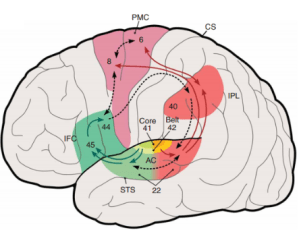
Part Of: [Mental Architecture v1.5] sequence
An summary image like this is, of course, highly tentative & deserves a writeup summary & a summary of extant comparative anatomy data. Maybe in v1.6!
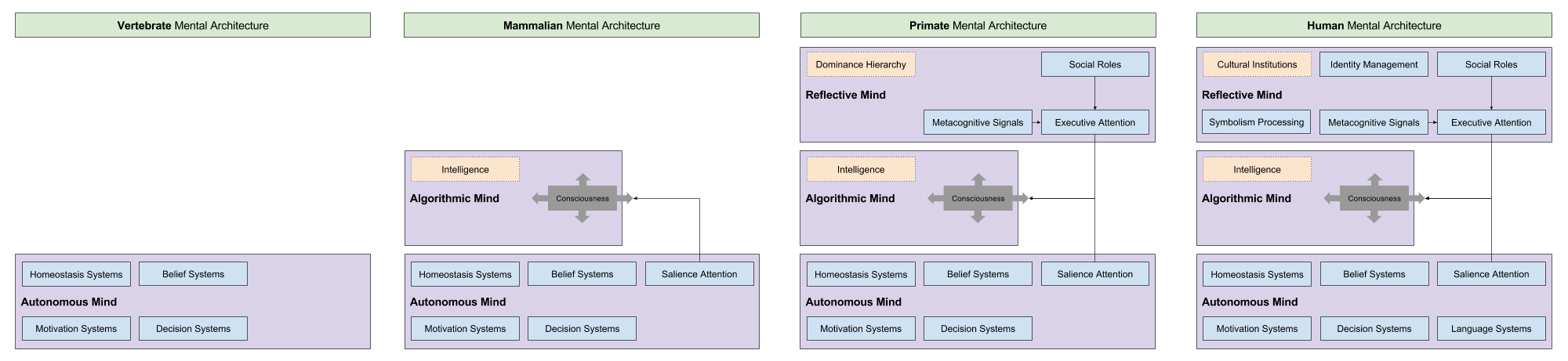
Part Of: [Mental Architecture v1.5] sequence
An summary image like this is, of course, highly tentative & deserves a writeup summary & a summary of extant comparative anatomy data. Maybe in v1.6!
Part Of: Neuroanatomy sequence
Followup To: The Thalamocortical Plasma Globe
Content Summary: 1100 words, 11 min read
Cortical Area & The Obstetric Dilemma
Last time, we learned that the brain is organized like a plasma globe: a sphere within a sphere. Today, we’ll be exploring a technique for reasoning about the cerebral cortex, or “outer sphere”. A few things you should know about this organ:
Does your neocortex have the most neurons? No, that title goes to the cerebellum, whose 100 billion neurons coordinates complex movements. But your brain must do a lot more than motor fine-tuning. Your brain perceives its environment, identifies objects, sets goals, makes decisions, feels emotions, and experiences consciousness. Where does your brain perform these tasks? Primarily in the neocortex! Loosely speaking, the outer sphere does much of the “heavy lifting” for your brain.
Why is the human brain so wrinkled? After all, not all species have brains with this shape:

Consider the following evolutionary pressures, together known as the obstetric dilemma.
As any microchip designer can tell you, wrinkles are a way to increase surface area, while holding volume constant!
Flattening The Lobes
And now, a short story. Cognitive neuroscience is rife with Latin terms for cortical areas. There are hundreds of them: “anterior cingulate cortex”, “fusiform gyrus”, “temporo-parietal junction”, etc. Over the past few years, as I consumed more of the field, I had slowly acclimated to hypotheses regarding the functions and interrelations for such areas. But given my lack of robust anatomical intuitions, these Latin names were just linguistic markers; I lacked an appreciation for geography.
While 3D models of different locations were mildly helpful, the pieces really fell into place when I discovered cortical flat maps.
While the neocortex is like a sheet, in some ways it is more accurate to imagine two sheets. Most people know that the brain has two hemispheres, but fewer know that these hemisphere’s are not (directly) connected? The two halves of your brain do talk to one another, but via a subterranean tunnel known as the corpus callosum.
Okay, here it is: a flat map of the human brain.

The brain is often divided into four to six different sections, or lobes. My map colors each lobe, illustrating the relationships between 3D brain and 2D map.
Here are my five lobes:
Flat maps are an underappreciated resource. But I’ll return to this point some other day. In the meantime, I should mention that these flat maps are imprecise elaborations of the flat maps created by the Gallant Lab. That is, my creations strike me a bit like this:

I am planning to ultimately construct more precise flat maps using tools like Freesurfer. But in the meantime, I’ll stick with my quick-and-easy 16th century cartographic approach. 🙂
Primary vs Association Cortex
Let’s turn now to perception. In Tunneling Into The Soup, we discussed how sense organs (e.g., the rods and cones in your eye) translate the physical reality outside your body into neuron-compatible signals that your brain consumes. To make this intuitively compelling, I employed the following metaphor:
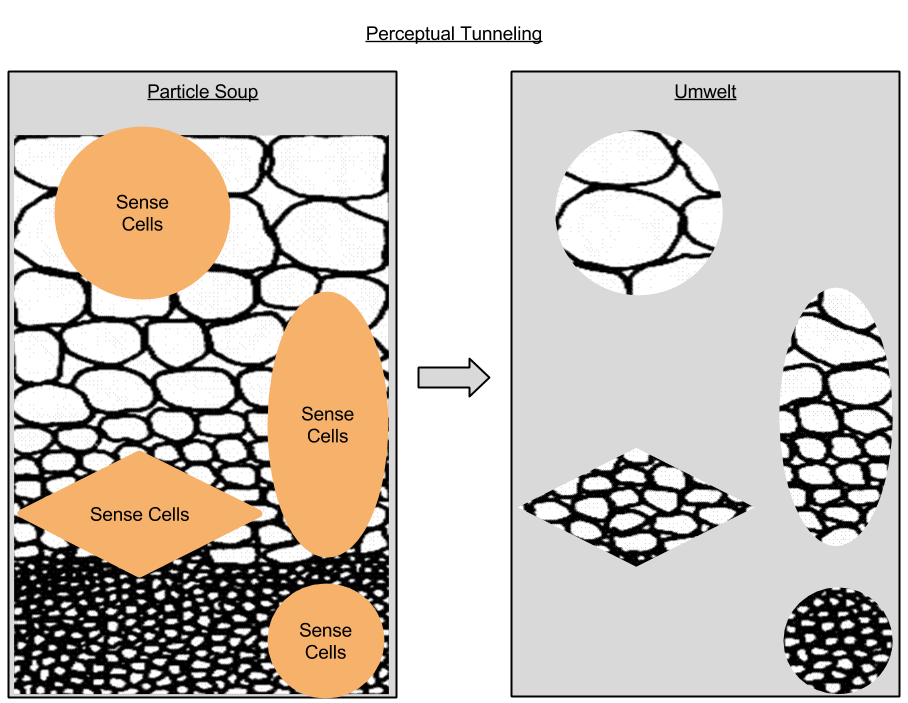
Your eye transmits data to your brain via information highways known as the optic nerves. The traffic of these highways – sense data – captures only a subset of physical reality; call this subset an umwelt. Such highways drain their contents onto landing sites on the cortex known as primary areas.
Aristotle is wrong: you have more than five senses. Balance and body alignment are senses in just the same way as sight, hearing, touch, taste, and smell. I am currently aware of nine different types of sense, or sensory modalities. But of these, three sense modalities are particularly important (and consume more space!) in the human brain. They are:
These three primary areas of your cortex are marked in dark green:
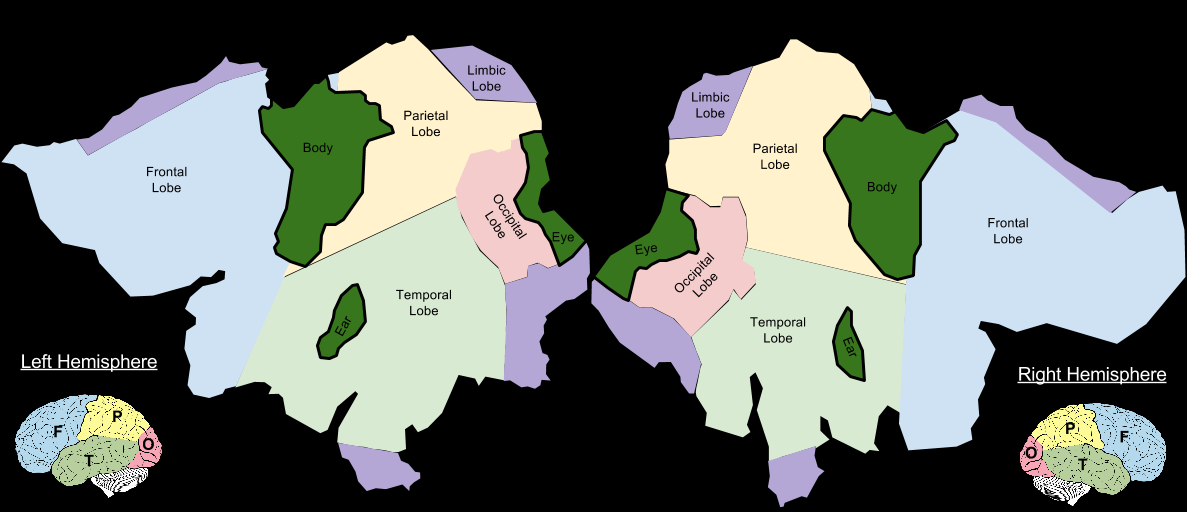
Non-primary areas of the cortex (areas that are not dumping grounds) are called association areas. Association cortex is associated with two distinct functions:
Evolutionary Considerations
How does the human brain compare to that of other species? Consider again the mouse brain. It is obviously smaller than the human variety, but is the ratio of primary-vs-association cortex preserved?
It turns out that the answer is no. Because primary sensory processing is more immediately useful to survival, the neocortex of the mouse is actually dominated (>50%) by primary areas.
This biological fact reminds me of the (amusing) Expanding Earth conspiracy theory. In contrast to plate tectonics, the Expanding Earth claim is that continent size has remained constant, whereas the oceans have been expanding. Despite being complete bunk, it does provide a colorful metaphor to our genetic distinctions from the mouse. Our species has invested more heavily in association cortex (oceans) than primary cortex (continents).

Have humans invested equally in every part of the association cortex? No: the hominid line shows pronounced (6x) gains in the prefrontal cortex, and comparatively restrained growth elsewhere. We thus have reason to believe that most uniquely human behaviors must be supported by the prefrontal cortex. To be continued.
Takeaways
Part Of: [Cognitive Architecture] sequence
Followup To: [Mental Architecture v1.4]
Let’s review our theoretical trajectory.
The Autonomic Mind: Belief, Motivation, and Decision Making
Our first architectures (1.0 → 1.2) explored the autonomic mind, which comprises our most fundamental mental capacities.
The Algorithmic Mind: Attention, Consciousness, and Intelligence
Subsequent architectures (1.3 → 1.4) complemented this understanding with the algorithmic mind, by weaving together three theories:
There is a close link between intelligence and consciousness, as evidenced by working memory’s strong correlation with both. Generally fluid intelligence (IQ) is essentially a measure of the precision of your attentional streams.
The Reflective Mind: Metacognition, Control, and Culture
The novel innovation of this architecture (1.5) could be entitled Prefrontal Cortex: The Final Frontier. It integrates two theories into the base corpus:
These five theories together constitute the foundation stones of my mental architecture. Let me call this synthesis the Attention-Modulated Tripartite Mind theory.
Putting Clothes On My Theory
A theory is a house, and the above merely represents its foundation. On this base, I will add details: the following posts are planned:
Part Of: Neuroanatomy sequence
Content Summary: 400 words, 4 min read
Today, we embark on a (very) brief tour inside your head!
How Neurons Work
What is a brain? A brain is a collection of 120 billion neurons.
What is a neuron? A neuron is simply a cell. Since you are a eukaryote, all cells in your body – neuron cells, skin cells, etc – have a lot in common, including:
In addition to these shared features, specialized tendrils (dendrites and axons) set neurons apart, giving them their web-like shape.

Neurons are useless individually. But when chained together, they may transmit pulses of electrochemical energy known as spike trains. input dendrites receive such signals and – sometimes! – fire, pushing the outgoing signal through the output axon. The output tendrils of a neuron connect with the input tendrils of other neurons; these connections are called synapses.
In this way, neurons mediate a relationship between input and output signals. What other kinds of things do this? Mathematical devices known as functions, and electrical devices known as transistors.
Gray Matter vs White Matter
Let’s zoom out to consider the entire brain. A brain has two symmetric halves (the hemispheres) connected by a bridge (the corpus callosum). Here’s what it looks like from the inside:

Certain parts of the brain are gray, and others are white. Why? What happens when you put these under a microscope?
If white matter doesn’t process information, why is there so much of it?
The Neural Plasma Globe
To answer this question, we turn to the gray matter. Where does it live? In only two places: the wrinkly surface of the brain (the cerebral cortex), and in an evolutionarily ancient part of the brain (the thalamus, and neighboring midbrain structures). Think: spheres within spheres.
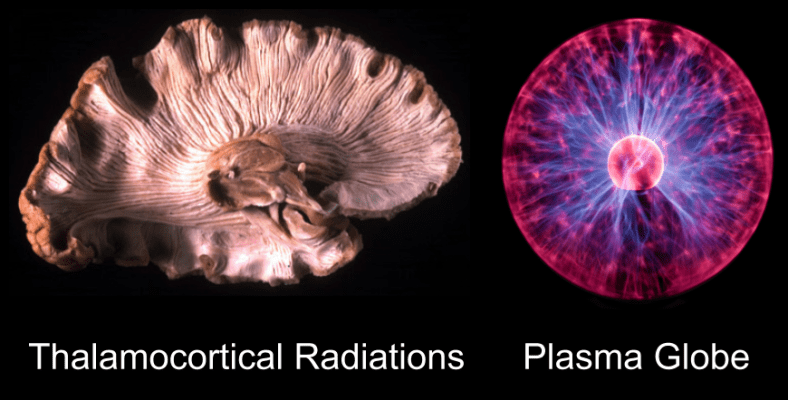
We can see now why there is so much white matter. White matter comprises information highways which transport information to and from different areas of the cerebral cortex. Some of these highways directly connect cortical regions, but much travels through the thalamic “central hub”. We will call such highways thalamocortical radiations.
With tractography (a sister technology to the MRI scan), we can now directly visualize such radiations. There is something almost poetic about these highways… you could say that the brain is like a plasma globe.
Next time, we’ll explore some implications of this metaphor.
Part Of: [Mental Architecture] project
Followup To: [Mental Architecture v1.3]
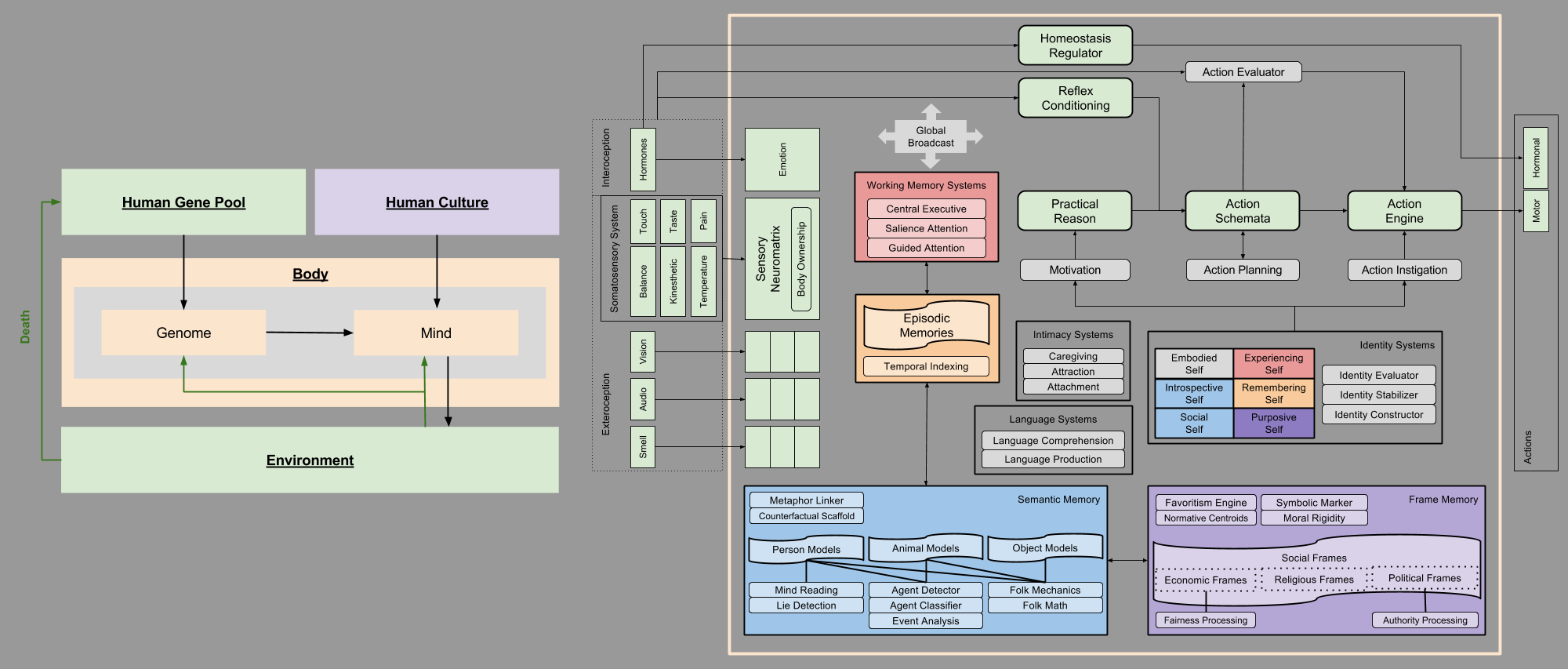
Less of a jump than v1.3, but still a worthwhile place to “save my work”. Significant new features include:
Consolidation Of Working Memory
Adopts the Alternative View, contra the “Standard Model”, as put forward by Postle (2006) Working Memory As An Emergent Property of the Mind and Brain. Abolishes the Visuo-spatial Sketchpad and the Phonological Loop and replaces it w/ the contents of perceptual memory (and semantic memory, etc).
Improved Sensory Specificity
Reintroduces some of the sensory details already present in Mental Architecture v1.0, and adds a few organizing distinctions (e.g., exteroceptive vs interoceptive)
A Home For Emotional Processing
For months, my Emotion Generator module has lacked a comfortable home. Now, following Damasio’s gesture at homeostasis, I finally have a home for the “big six” emotions (Anger, Disgust, Fear, Joy, Sadness, Surprise). Specifically, I conjecture that these emotions are produced in topographic map located in the middle of a processing stream, whose data flows from interoceptive (e.g., hormonal) sense organs.
Explicit Brain Architecture
Administrivia
Module Changelog
Open Tasks
Open Questions
Frustratingly Unaddressed Human Explananda
Part Of: Attention sequence
Content Summary: 800 words, 8 min read
No one denies attention is intimately related to consciousness. But how much do you know about attention? Does it feel like a synonym for consciousness?
Today, we will be learning about some interesting software suspended above your perceptual systems: the attentional spotlight.
Foveal Vision and Saccades
To understand visual attention, I first need to tell you about vision.
Your eyes contain rods & cones. Rods detect light intensity, cones detect light color.
Rods and cones are not distributed evenly. Cones live right behind your pupils, rods live everywhere else.
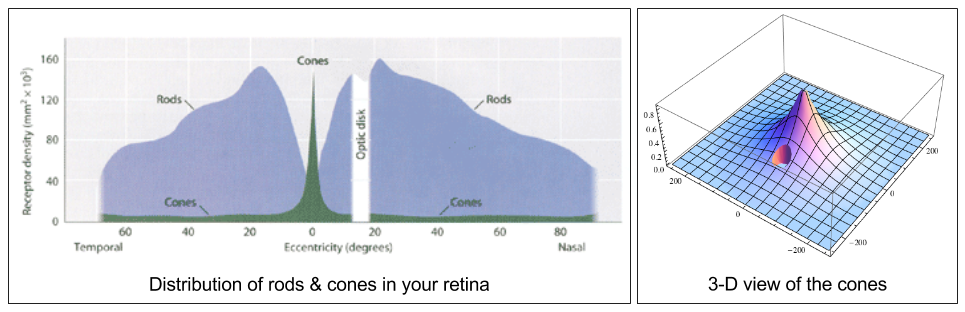
As this graph makes clear, there are two different types of vision:
Why is there a hole in the above pictures? This blind spot is due to your optic nerve intruding on your retina. Natural selection can sometimes design itself into a corner. Animals inhabiting different evolutionary lineages, such as octopi, do not suffer this problem.
Foveal vision is very narrow. In order to get more detail, your eyes have to move. Specifically, your foveal spotlight needs to travel from point to point, slowly adding detail to your understanding of a scene.
Such eye movements are known as saccades. Saccades usually operate subconsciously. With modern imaging technology, we can graph precisely how your eyes move over an image. Consider, for example, a saccade trace over the following portrait:
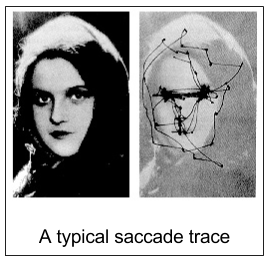
Why are saccades drawn to the eyes? Let me answer that question a bit later.
Let’s return to the question of (foveal) color vision. I’ve shown you two distinct features in this system:
Crucially, neither the spotlight nor the blind spot enter conscious awareness:

This is a bit unsettling. We literally see less than we think. Somewhere between perception and the Mental Movie, our brains inject an illusion of transparency. Such “false wholeness” effects should give us pause.
Overt vs Covert Attention
We can now explain visual attention! 🙂 Suppose I give you the above picture and say, “pay attention to the shape of her nose”. How do you respond?
Your eyes would most likely trace a saccade until your foveal spotlight was centered above her nose. A detailed image of her nose would then probably appear in your Mental Movie. Are we done? Is this an adequate description of the biology of attention?
Before declaring victory, consider sound. Imagine deciding to pay attention to the cello section of an orchestra. Is there an acoustic equivalent of a saccade, through which your body can amplify this particular frequency? Absolutely not. (Tilting your head won’t work, because that addresses your ability to detect directional sound).
Another counterexample comes from proprioception, the sense of the orientation of your limbs (as reported by nerves in your muscles). Here too, there is no way your body to “zoom in” on any limb. Yet it is possible to hold specific body parts in the center of your conscious experience.
Thus, attention doesn’t require assistance from mechanisms like saccades. The attentional spotlight is thoroughly independent. We can call unassisted cases of attention (e.g., sound) covert attention, and “enhanced” versions of attention (e.g., vision) overt attention.
This approach is confirmed by a careful study of visual experience. The foveal spotlight and the attentional spotlight can come apart. While these two spotlights often converge, sometimes they attentional spotlight will broadcast the contents of peripheral vision (as any driver can attest). Inattentional blindness is another striking example of the two spotlights diverging: even surprising stuff – like a gorilla – can escape detection, despite their placement within the foveal spotlight.

We can now improve our understanding of overt attention. In vision, overt attention moves the foveal spotlight (“green flashlight”) so that it follows the attentional spotlight (“orange flashlight”). In this ways, your eyes seek to “enhance” your conscious experience by feeding it more detail.
Takeaways
Next time, we will examine how visual attention relates to consciousness.
Core Sequence
Neurobiology
Selfhood Sequence
Attention sequence
Sleep sequence
Philosophy of Consciousness:
Older Content
Part Of: Demystifying Consciousness sequence
Content Summary: 1000 words, 10 min read
Debates about consciousness are as old as Western Civilization itself. Here, we survey 2000 years of intellectual history in 1000 words. 🙂 Wish me luck!
Movie and Subject
We begin with what consciousness is not.
Let me instead put forward a metaphor. Consciousness feels like the movies. More specifically, it comprises:
On this view, to explain consciousness one must explain the origins, mechanics, and output of both Movie and Subject.
It would be easy to get such a theory wrong. If we aren’t careful, our metaphor for consciousness might start to look like this:
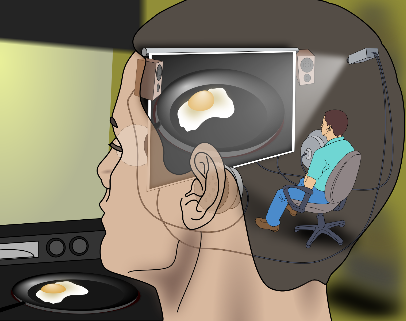
But this literal interpretation (the Cartesian Theater) is nonsensical: if some person truly was watching the Mental Movie, where does its consciousness come from?
Thus, on pain of infinite regression, a theory of consciousness must ensure that the Subject is itself unconscious.
Phenomenal Consciousness
But how could scientists possibly hope to produce such a theory? After all, science is in the business of explaining publicly accessible data. But consciousness is private!
Let’s be specific. Recall your experiences of color. Every photon has a wavelength. Now, suppose you see a flashlight producing light of 700 nanometers. Two things happen:
Take a moment to recall how this second ability comes from. In infancy, red light presents itself frequently. The infant brain slowly consolidates these redundant sensations into a single concept RED within semantic memory. RED also contains facts about apples, strawberries, and the sunset. Later, as Word Comprehension software comes online, the word “red” (and its accompanying audio signature) are bound into RED to enable communicating with other people.
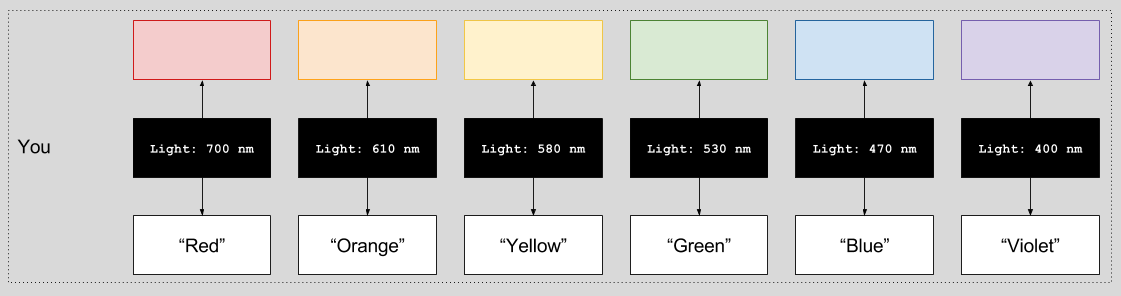
But let’s imagine your friend has some kind of strange mental disorder which “inverts” all the colors of her mental movie. The experience of red to her feels like the experience of violet to us. How would she tell us about her condition?
If you take a moment to chew on this hypothetical, a truly frightening outcome comes into view. Your friend could never learn she has a disorder. In childhood, she would acquire the exact same facts about 700 nm light, and learn the same word to denote this sense data. She would be in full agreement with her peers when they say, for example, “that apple is red”. She would pass any color test. And yet, something unsettling remains…
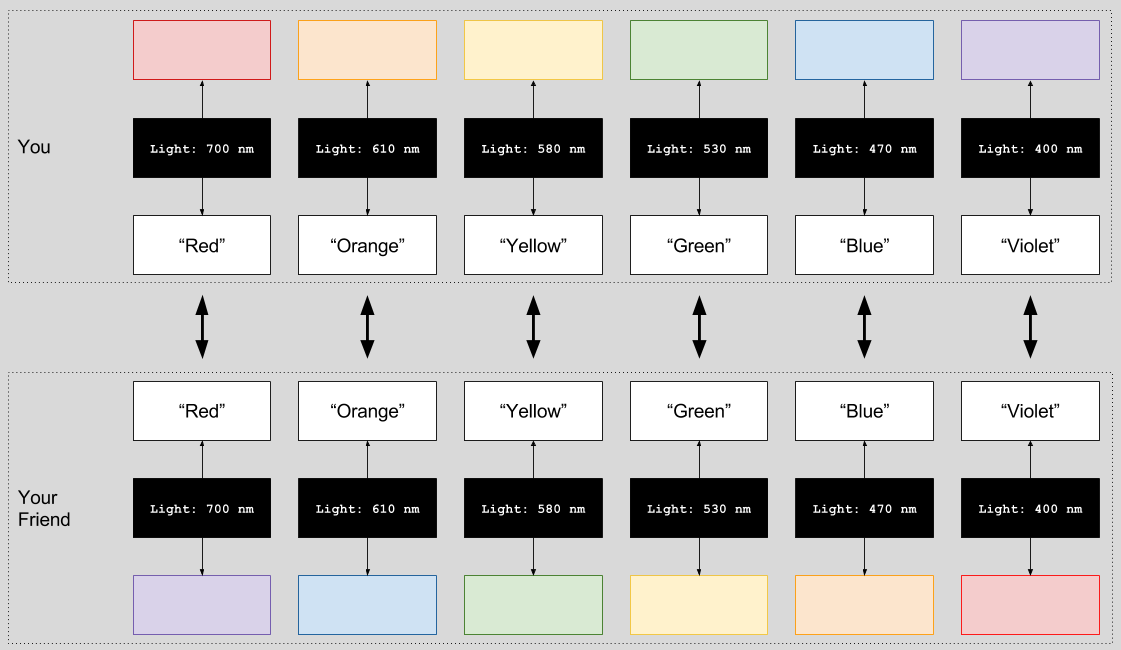
Concepts like RED are studied by computer scientists all the time. But, at least in our thought experiment, the experience of red feels private, even untestable.
The experience of red is known as a quale, and learning more about qualia is one of the central occupations of philosophers of mind. The subject is put most forcefully in David Chalmer’s Conscious Mind, where he coins the phrase The Hard Problem. Indeed, it is hard to see how someone could go about even beginning to construct an solution.
Let’s call this experiential view of consciousness, phenomenal consciousness.
Access Consciousness
Let me now introduce another key figure in philosophy of mind: the philosophical zombie (p-zombie). Imagine one of your friends wakes up and, while behaving exactly as they would have before. If asked, your friend would still claim to feel the same etc, but his experience would be… well, he would have NO experiences.
Now, is such a thing possible? To answer, it helps to distinguish between two kinds of possibility:
If p-zombies are nomologically possible, if a pill for behavior-neutral quale removal could be synthesized, then perhaps we pay ought to give credence to solipsism (“what if I am the only conscious being in the whole world”) and substance dualism (“what if my soul just floats over my body, choosing to reflect its states by magic”).
But, while p-zombies may be metaphysically possible, they are not nomologically possible. Consciousness is an adaptation: neurons and qualia are causally interwoven, and you cannot remove consciousness without crippling an organism.
The remainder of this sequence will focus on making good on the last sentence. In the meantime, let’s give this functional interpretation of consciousness a name: access consciousness.
Retiring Armchair Philosophy
To sum up, we have identified two different views of consciousness:
While philosophical debate surrounding the former has consumed millenia, scientific research into the latter is only a few centuries old. Plainly stated, the science of consciousness has been making huge strides in recent decades, and I intend to share its results.
It is my view that conceptual analysis – armchair philosophy – can only get you so far. The empirically informed will inherit the earth. We live in the age of the neural correlates of consciousness, an age where polymaths weave together seemingly disparate theories into architectures, which tower above the speculations of their ancestors.
This sequence presents a solution to access consciousness. Its cognitive structure will provide tools for reasoning about phenomenal consciousness.Like most of my writing, its contents are not uniquely my own. In fact, this sequence’s main purpose is to sketch an emerging consensus.
Until next time.
Part Of: Philosophy of Mind sequence
Content Summary: 500 words, 5 min read
Once upon a time there was a dualist. He believed that mind and matter are separate substances. Just how they interacted he did not pretend to know-this was one of the “mysteries” of life. But he was sure they were quite separate substances.
This dualist, unfortunately, led an unbearably painful life – not because of his philosophical beliefs, but for quite different reasons. And he had excellent empirical evidence that no respite was in sight for the rest of his life. He longed for nothing more than to die. But he was deterred from suicide by such reasons as:
So our poor dualist was quite desperate.
Then came the discovery of the miracle drug! Its effect on the taker was to annihilate the soul entirely but to leave the body functioning exactly as before. Absolutely no observable change came over the taker; the body continued to act just as if it still had a soul. Not the closest friend or observer could possibly know that the taker had taken the drug, unless the taker informed him.
Do you believe that such a drug is impossible in principle? Assuming you believe it possible, would you take it? Would you regard it as immoral? Is it tantamount to suicide? Is there anything in Scriptures forbidding the use of such a drug? Surely, the body of the taker can still fulfill all its responsibilities on earth. Another question: Suppose your spouse took such a drug, and you knew it. You would know that she (or he) no longer had a soul but acted just as if she did have one. Would you love your mate any less?
To return to the story, our dualist was, of course, delighted! Now he could annihilate himself (his soul, that is) in a way not subject to any of the foregoing objections. And so, for the first time in years, he went to bed with a light heart, saying: “Tomorrow morning I will go down to the drugstore and get the drug. My days of suffering are over at last!” With these thoughts, he fell peacefully asleep.
Now at this point a curious thing happened. A friend of the dualist who knew about this drug, and who knew of the sufferings of the dualist, decided to put him out of his misery. So in the middle of the night, while the dualist was fast asleep, the friend quietly stole into the house and injected the drug into his veins. The next morning the body of the dualist awoke -without any soul indeed- and the first thing it did was to go to the drugstore to get the drug. He took it home and, before taking it, said, “Now I shall be released.” So he took it and then waited the time interval in which it was supposed to work. At the end of the interval he angrily exclaimed: “Damn it, this stuff hasn’t helped at all! I still obviously have a soul and am suffering as much as ever!”
(This parable was inspired by one written by Raymond M. Smullyan)

A truly enormous upgrade. New features are as follows:
It is important to remember that these posts/diagrams are not theories in their own right. Only communicated architectural solutions qualify for this. Instead, these “version” posts give me a skeleton around which I could communicate what lives in my head. They are progress indicators I leave behind as my theories become more powerful.
Memory Hierarchy
This architecture constitutes my first “memory-centric” mental architecture.
Episodic memory is the “parent” of frame and semantic memory. It is the most verbose, and also the most lossy. Both other formats are better preserved across an organism’s lifetime.
Open Questions: I’ve noted indexical relationships between episodic memory and the other two formats. How else do these representational formats interrelate?
Epistemic status: takes three ubiquitous memory categories, and posits a relationship between them. While some have suggested that semantic memory draws from episodic memory, and others that frame memory draws from episodic memory (Atran ), I have not yet discovered gestures at an integration of both inheritance models besides my own.
The Cognitive Roots Of Culture
What is culture? Some people would gesture towards knowledge accretion, such as the knowledge requisite in the forging of bronze weaponry. But others would say that culture is the birthplace of institutions like economies, political parties, and religions.
Cognitive science must explain both. Here, I claim that the former is shared semantic content, and the latter is shared frame content.
Open Questions: How exactly is semantic memory distinct from frame memory?
Epistemic status: This is highly original, and also highly tentative. I’ll feel better about it once I have a clear understanding of how frame files differ from the object files of semantic memory. But it beats having no idea where culture comes from. 🙂
Grounding Construal Level Theory
Construal Level Theory (CLT) is a theory of psychological distance. It posits that the mind retains information in two representations formats: high-level and low-level construals. This dichotomy is, among many other things, used to explain hyperbolic discounting. In my architecture, I identity low-level construals with episodic memory, and high-level construals with semantic & frame memory.
Note: A lot of insight will be unlocked after I unearth the above open questions re: frame memory.
Epistemic Status: Construal Level Theory (CLT) is a rather broad & powerful theory, and enjoys a wealth of experimental evidence. This explanation for CLT is unfortunately ambiguous first draft, but does (I think) gesture at an underappreciated connection with memory science.
Grounding Dual Process Theory
Dual Process Theory (DPT) is a theory of the functional role of consciousness. It posits your brain having two modes of operation
In this architecture, System II processes are identified with working memory. More specifically, your waking experience is broadcast from, and entirely contained within, THIS memory system, and no other. So e.g., I wrote a long time ago that I suspect my phonological loop is a bit atypical. If the above is correct, this means my conscious experience is likewise a tiny bit separated from the norm.
Open Questions: I haven’t finished ingesting this theory, so open questions will have to wait. 🙂
Epistemic Status: This synthesis is not my own. It is almost entirely attributable to Carruthers’ work (e.g., The Centered Mind). It is an interpretation of Global Workspace Theory, which enjoys considerable support (verging on consensus).
Six Pillars Of Selfhood
The self is not a single thing. I submit that your brain accomplishes self-reference in six distinct ways.
Importantly, the format of each self is known. This is documented in the “color coding” in the above graphic.
Open Questions: The interrelationships between the “selves”.
Epistemic Status: Unlike the rest of this architecture, the six pillars is not intended as a theory. It is a taxonomy is meant as an explanatory aid, to assist the process of theorybuilding. (It will graduate to a theory after its mechanisms are unearthed.)
Improved Motor Specificity
Reintroduces the motor details already present in Mental Architecture v0.1.
 Fewer Lacunae