[Sequence] Demystifying Consciousness

Core Sequence

Neurobiology

Selfhood Sequence

Attention sequence

Sleep sequence

Philosophy of Consciousness:

Older Content

Can Consciousness Be Explained?

Part Of: Demystifying Consciousness sequence
Content Summary: 1000 words, 10 min read

Debates about consciousness are as old as Western Civilization itself. Here, we survey 2000 years of intellectual history in 1000 words. 🙂 Wish me luck!

Movie and Subject

We begin with what consciousness is not.

  • Consciousness is not mind. Consciousness is part of mind, but mind including many other algorithms which operate outside of consciousness.
  • Consciousness is not conscience. Our moral circuitry does it computations elsewhere.

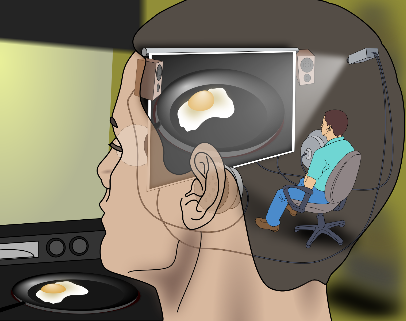
Let me instead put forward a metaphor. Consciousness feels like the movies. More specifically, it comprises:

  1. The Mental Movie. What is the content of the movie? It includes data captured by your eyes, ears, and other senses.
  2. The Mental Subject. Who watches the movie? Only one person, with your goals and your memories – you!

On this view, to explain consciousness one must explain the origins, mechanics, and output of both Movie and Subject.

It would be easy to get such a theory wrong. If we aren’t careful, our metaphor for consciousness might start to look like this:

Consciousness- Cartesian Theater

But this literal interpretation (the Cartesian Theater) is nonsensical: if some person truly was watching the Mental Movie, where does its consciousness come from? 

Thus, on pain of infinite regression, a theory of consciousness must ensure that the Subject is itself unconscious.

Phenomenal Consciousness

But how could scientists possibly hope to produce such a theory? After all, science is in the business of explaining publicly accessible data. But consciousness is private!

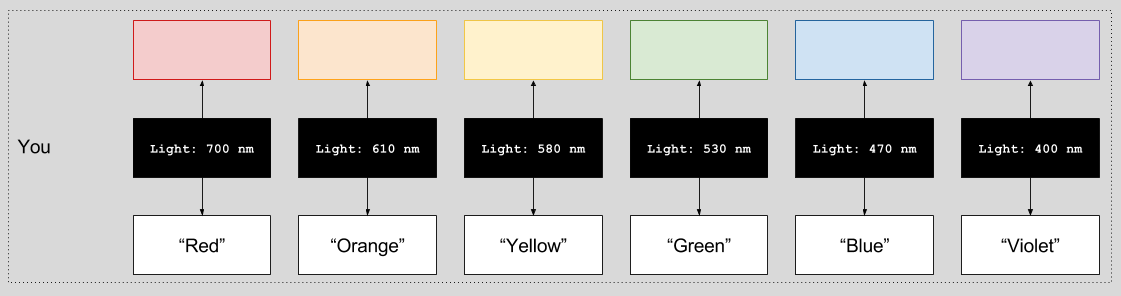
Let’s be specific. Recall your experiences of color. Every photon has a wavelength. Now, suppose you see a flashlight producing light of 700 nanometers. Two things happen:

  1. You experiences the distinctive color of red.
  2. You can truthfully report that “that light beam is red”.

Take a moment to recall how this second ability comes from. In infancy, red light presents itself frequently. The infant brain slowly consolidates these redundant sensations into a single concept RED within semantic memory. RED also contains facts about apples, strawberries, and the sunset. Later, as Word Comprehension software comes online, the word “red” (and its accompanying audio signature) are bound into RED to enable communicating with other people.

Consciousness- Qualia Of Color

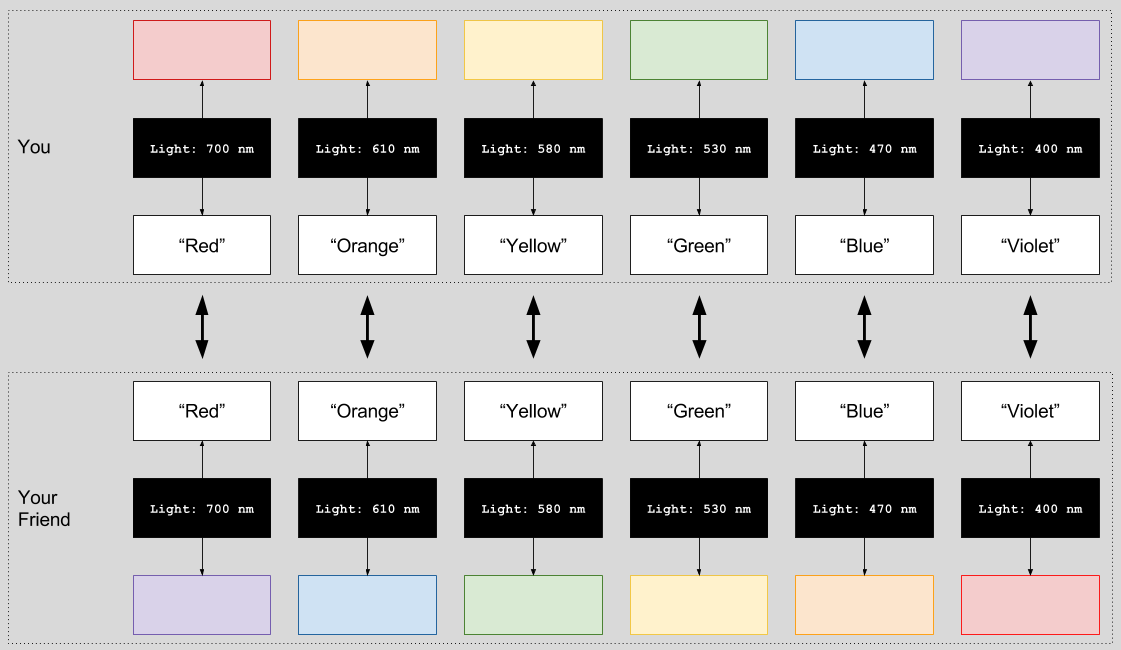
But let’s imagine your friend has some kind of strange mental disorder which “inverts” all the colors of her mental movie. The experience of red to her feels like the experience of violet to us. How would she tell us about her condition?

If you take a moment to chew on this hypothetical, a truly frightening outcome comes into view. Your friend could never learn she has a disorder. In childhood, she would acquire the exact same facts about 700 nm light, and learn the same word to denote this sense data. She would be in full agreement with her peers when they say, for example, “that apple is red”. She would pass any color test. And yet, something unsettling remains…

Consciousness- Qualia Inversion (1)

Concepts like RED are studied by computer scientists all the time. But, at least in our thought experiment, the experience of red feels private, even untestable.

The experience of red is known as a quale, and learning more about qualia is one of the central occupations of philosophers of mind. The subject is put most forcefully in David Chalmer’s Conscious Mind, where he coins the phrase The Hard Problem. Indeed, it is hard to see how someone could go about even beginning to construct an solution.

Let’s call this experiential view of consciousness, phenomenal consciousness.

Access Consciousness

Let me now introduce another key figure in philosophy of mind: the philosophical zombie (p-zombie). Imagine one of your friends wakes up and, while behaving exactly as they would have before. If asked, your friend would still claim to feel the same etc, but his experience would be… well, he would have NO experiences.

Now, is such a thing possible? To answer, it helps to distinguish between two kinds of possibility:

  • Nomological Possibility: is X possible in our universe with our universe, our idiosyncratic particle soup?
  • Metaphysical Possibility: could X be possible in some universe with some completely alien laws of physics?

If p-zombies are nomologically possible, if a pill for behavior-neutral quale removal could be synthesized, then perhaps we pay ought to give credence to solipsism (“what if I am the only conscious being in the whole world”) and substance dualism (“what if my soul just floats over my body, choosing to reflect its states by magic”).

But, while p-zombies may be metaphysically possible, they are not nomologically possible. Consciousness is an adaptation: neurons and qualia are causally interwoven, and you cannot remove consciousness without crippling an organism. 

The remainder of this sequence will focus on making good on the last sentence. In the meantime, let’s give this functional interpretation of consciousness a name: access consciousness.

Retiring Armchair Philosophy

To sum up, we have identified two different views of consciousness:

  1. Phenomenal consciousness, which focuses on experience.
  2. Access consciousness, which focuses on causal signature.

While philosophical debate surrounding the former has consumed millenia, scientific research into the latter is only a few centuries old. Plainly stated, the science of consciousness has been making huge strides in recent decades, and I intend to share its results.

It is my view that conceptual analysis – armchair philosophy – can only get you so far. The empirically informed will inherit the earth. We live in the age of the neural correlates of consciousness, an age where polymaths weave together seemingly disparate theories into architectures, which tower above the speculations of their ancestors. 

This sequence presents a solution to access consciousness. Its cognitive structure will provide tools for reasoning about phenomenal consciousness.Like most of my writing, its contents are not uniquely my own. In fact, this sequence’s main purpose is to sketch an emerging consensus.

Until next time.

[Sequence] Sociality

Culture

Mindreading

Selfhood

Miscellaneous Resources

Related sequences

Lie Detection: Gullible By Default

Part Of: Language sequence
Content Summary: 1300 words, 13 min read

Two Tagging Methods

Imagine a library of a few million volumes, a small number of which are fiction. There are at least two reasonable methods with which one could distinguish fiction from nonfiction at a glance:

  1. Paste a red tag on each volume of fiction and a blue tag on each volume of nonfiction.
  2. Tag the fiction and leave the nonfiction untagged.

Perhaps the most striking feature of these two different systems is how similar they are. Despite the fact that the two libraries use somewhat different tagging systems, both ultimately accomplish the same end. Imagine each book If the labeling was done by a machine inside of a tiny closet – if a library user could not see with her own eyes the method employed, is there any hope of her discovering the truth method employed?

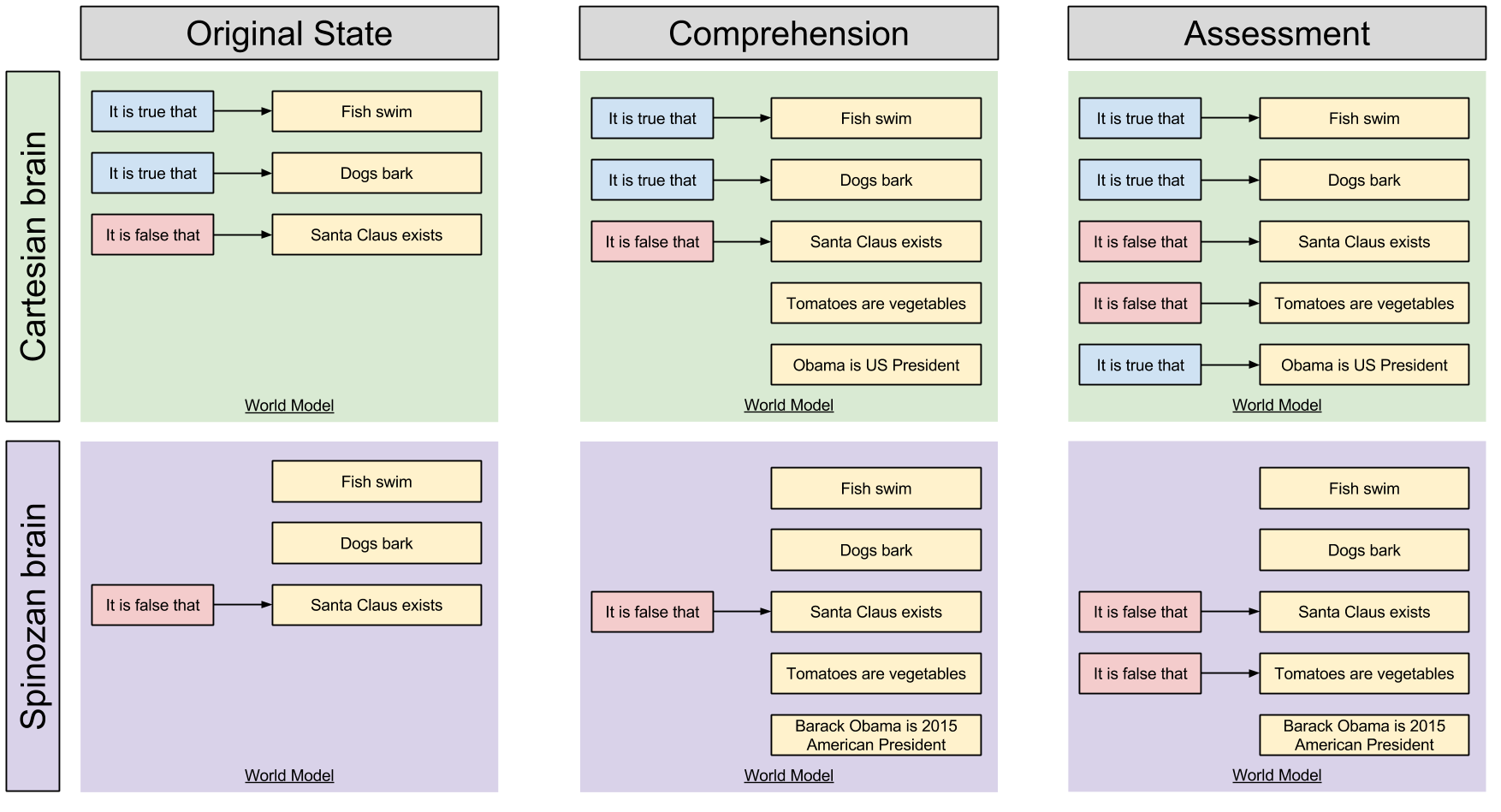
This is exactly the problem faced by cognitive scientists trying to understand the nature of belief. Your brain is responsible for maintaining a collection of beliefs (the mental library). Some of these beliefs are marked true (e.g., “fish swim”); others are marked false (e.g., “Santa Claus is real”). As philosophers in the 18th century discovered, your brain could process truth from falsehood in two distinct ways:

  1. Rene Descartes thought the brain uses the red-blue system. That is, it first tries to comprehend an idea (import the book) and then evaluate its status (give it the appropriate color).
  2. Baruch Spinoza thought the brain uses the tagged-untagged system. That is, it first tries to comprehend an idea (import the book) and then check whether it is fiction (decide whether it needs to be tagged).

Here is a graphical representations of the two brains:

Default Gullibility- Two World Model Updating Systems

Would The Real Brain Please Stand Up?

Ideal mental systems have unlimited processing resources and an unstoppable tagging system. Real mental systems operate under imperfect conditions and a finite pool of resources, which causes these mental processes to sometimes fail. Sometimes, your brain isn’t able to assess beliefs at all.

What happens when a Cartesian red-blue brain is unable to fully assess incoming beliefs? Well, if the world model is left alone after comprehension (middle column), then resultant beliefs are neither marked true nor false, easily distinguishable from more trustworthy beliefs.

What happens when a Spinozan tagged-untagged brain cannot assess an incoming belief? Well, if its World Model processing stops after comprehension (middle column), then the novel claims appear identical to true beliefs.

On the Cartesian system, comprehension is distinct from acceptance. On a Spinozan system, comprehension is acceptance, and an additional (optional!) effort is required to unaccept belief. Cartesian brains are innately analytic, Spinozan brains are innately gullible.

So which is it? Is your brain Cartesian or Spinozan?

Three Reasons Why Your Brain Is Spinozan

Three streams of evidence independently corroborate the existence of the Spinozan brain.

First, scientists have confirmed time and again that distraction amplifies gullibility.

[Festinger & Maccoby 1964] demonstrated that subjects who listened to an untrue communication while attending to an irrelevant stimulus were particularly likely to accept the propositions they comprehended (see [Baron & Miller 1973] for a review of such studies)

When resource-depleted persons are exposed to doubtful propositions (i.e., propositions that they normally would disbelieve), their ability to reject those propositions is markedly reduced (see [Petty & Cacioppo 1986] for a review).

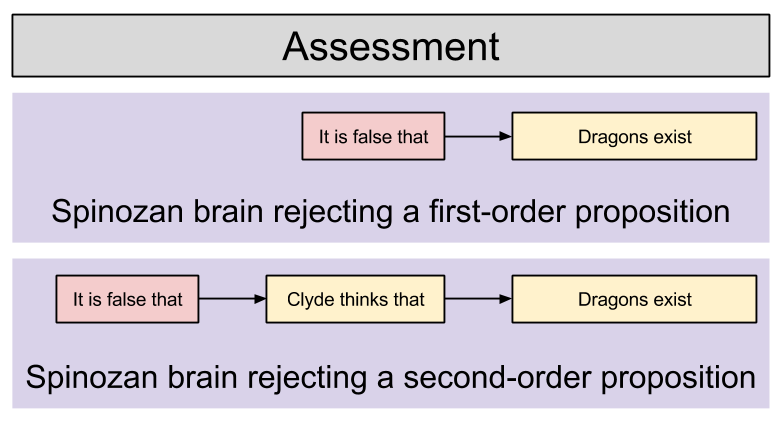
This effect appears in more complex scenarios, too. Suppose your friend Clyde says that “dragons exist”. In this scenario, the brain may not simply wish to reject that (first-order) claim, but also implement lie detection via rejecting the second-order proposition that “Clyde thinks that dragons exist”.

Default Gullibility- Two Types Of Negation (1)

In the context of second-order propositions, distraction causes an even stronger inability to reject claims:

After decades of research activity, both the lie-detection and attribution literatures have independently concluded that people are particularly prone to accept the second-order propositions implicit in others’ words and deeds (for reviews of these literatures see, respectively, [Zuckerman, Depaulo, & Rosenthal 1981] and [Jones 1979]. What makes this phenomenon so intriguing is that people accept these assertions even when they know full well that the assertions stand an excellent chance of being wrong. For example, if an authority asks someone to read aloud a prepared statement (e.g., “I am in favor of federal protection of armadillos”), people [still] assume that the speaker believes the words coming out of the speaker’s mouth. This robust tendency is precisely the sort that a resource-depleted Spinozan system should display.

Not only does dubious position assertions more believable amidst distraction, the opposite of reasonable denials are also likely to be affirmed. That is, resource depletion will cause statements like “Bob Talbert not linked to Mafia” to induce belief in “Bob Talbert linked to Mafia”. The Cartesian model predicts no such asymmetry in response to resource depletion during assessment.

Second, children develop the ability to believe long before the ability to disbelieve.

The ability to deny propositions is, in fact, one of the last linguistic abilities to emerge in childhood [Bloom 1970] [Pea 1980] Although very young children may use the word no to reject, the denial function of the word is not mastered until quite a bit later.

Furthermore, young children are particularly prone to accept propositions uncritically (see [Ceci et al 1987]). Although such hypersuggestibility is surely exacerbated by the child’s inexperience and powerlessness, young children are more suggestible than older children even when such factors are taken into account [Ceci et al 1987].

Third, linguistic evidence shows that negative beliefs take longer to assess, and appear less frequently in practice.

A fundamental assumption of psycholinguistic research is that “complexity of in thought tends to be reflected in complexity of expression”, and vice versa. The markedness of a word is usually considered the clearest index of linguistic complexity… The Spinozan hypothesis states that acceptance is a more complex operation than is acceptance and, interestingly enough, the English words that indicate acceptance of ideas are generally unmarked. That is, our everyday language has us speaking of propositions as acceptable and unacceptable instead of rejectable and unrejectable. Indeed, people even speak of belief and disbelief more naturally than they speak of doubt and undoubt.

People are generally quicker to assess true statements, than false statements [Gough 1965].

How Should We Then Think?

Frankly, this was a difficult article to post. Knowing about biases can hurt people; that is, learning about their own flaws can make people defensive and inflexible.

But this sobering post need not cause us to abandon curiosity and pursuit of truth. It is the mark of an educated mind embrace a thought without flinching, to explore its consequences without fear. It is possible to change your mind.

Takeaways

This article was inspired by [Gilbert 1991] How Mental Systems Believe. Points to remember:

  • How to tell truth from falsehood? You can either tag all beliefs true or false (Cartesian system) or only tag false belief (Spinozan system)
  • Beliefs aren’t always fully analyzed. But in a Spinozan system, unassessed beliefs appear true – the system is credulous by default.
  • Comprehension is belief: gullibility is innate. Only critical thinking is optional, effortful, and prone to failure. Your brain is Spinozan.
    • How do we know? Because distraction causes thinkers to become more gullible
    • How do we know? Because young children are very suggestible, only later acquiring the ability to be skeptical
    • How do we know? Because negative beliefs take longer to assess, have more complex words, and appear less frequently in practice.
  • The great master fallacy of the human mind is believing too much.

References

  • [Baron & Miller 1973] The relation between distraction and persuasion.
  • [Bloom 1970] Language development: Form and function in emerging grammars.
  • [Ceci et al 1987] Suggestibility of children’s memory: Psychological implications.
  • [Festinger & Maccoby 1964] On resistance to persuasive communications.
  • [Gough 1965] The verification of sentences: The effects of delay of evidence and sentence length.
  • [Jones 1979] The rocky road from acts to dispositions.
  • [Pea 1980] The development of negation in early child language.
  • [Petty & Cacioppo 1986] The elaboration likelihood model of persuasion.
  • [Zuckerman, Depaulo, & Rosenthal 1981] Verbal and nonverbal communication of deception.

Granite In Every Soul

Part Of: Awakening To A Social World sequence
Followup To: Intentional Stance: Awakening To A Social World
Content Summary: 400 words, 4 min read

The Origins Of Social Identity

At twelve months of age, children begin ascribing beliefs and desires to others. If beliefs represent the world, then beliefs-about-beliefs are meta-representational. We may call the former 1-beliefs, and the latter 2-beliefs.

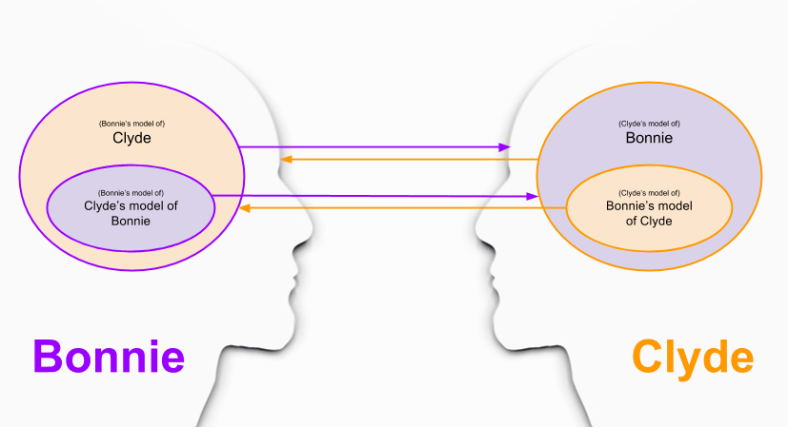
Not all beliefs are about people… but some are! In Awakening To A Social World, we discussed how people-oriented knowledge is stored in relationship models. Specifically, 1-beliefs about significant people in your life are stored in primary models, and 2-beliefs about their impression of you are stored in secondary models.

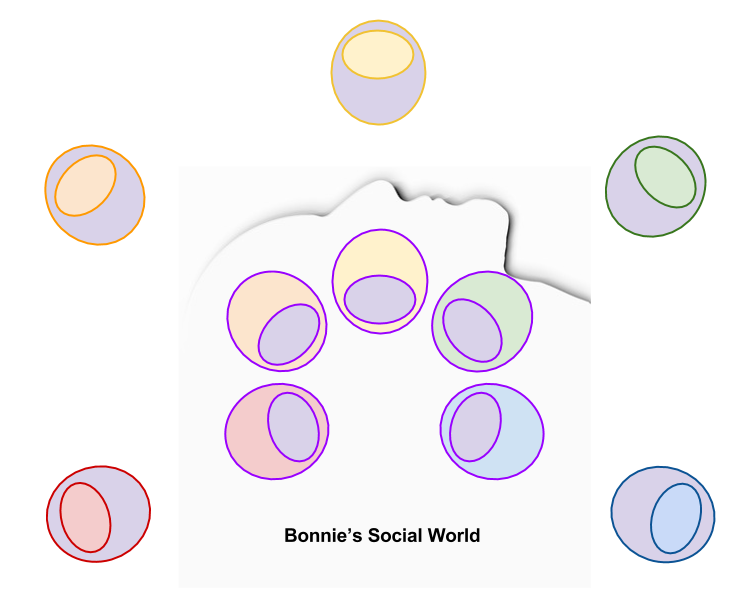
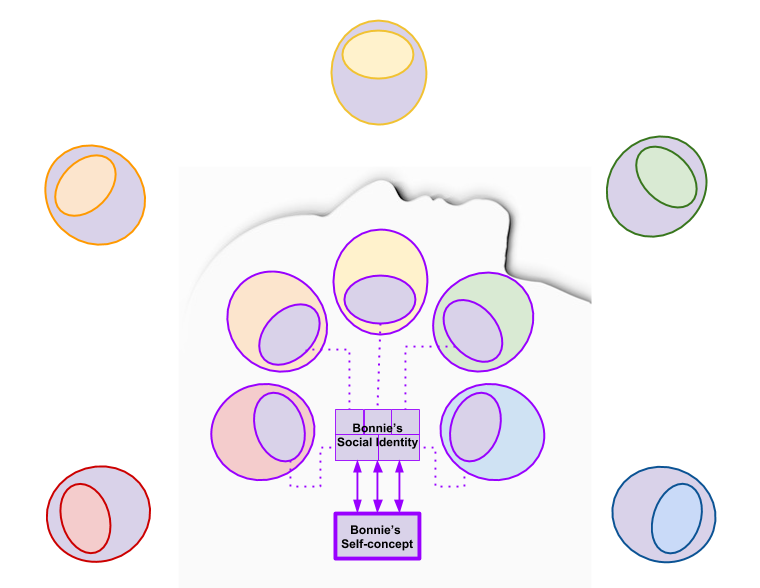
The social mind can be visualized as follows:

Granite Self- Modeling All Relationships

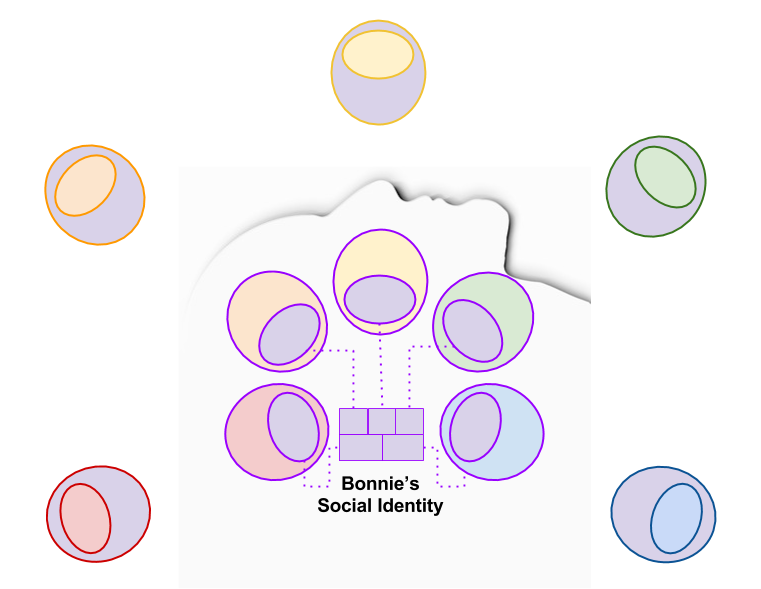
Notice how every person has a color: Clyde, for example, is orange, and Bonnie is purple. Within Bonnie’s mind, her primary models of other people are large ovals, and secondary models are nested inside. Since the large ovals describe other people, they have a variety of colors. Since the nested ovals capture who you are to these people, they are all the same color (in Bonnie’s case, purple).

Importantly, every purple “impression” contributes to Bonnie’s social identity

Granite Self- Relationships Produce External Self

The Sensorimotor River Requires Granite

What good is a social identity? Does it exist solely to give your warm fuzzies and/or social anxiety?

No, selfhood is inextricably linked to behavior. While your behavior may diverge from time to time, it is at least strongly guided by your sense of identity. Call this hypothesized connection the self-motivation thesis.

The flow from perception to action (the sensorimotor river) is the single most important service your mind provides. But imagine, if you will, a  child’s relationship to her best friend, which forms a central role in her social identity. If she moves away, that part of her identity is lost. But this is unacceptable: grief is a healthy response to such an event, but damaging your sense of self (and thus, crippling your motivation) is not healthy.

Social uncertainties and change cause dramatic fluctuations within your social identity, but the sensorimotor river requires consistency. Your brain resolves this tension by injecting granite into your soul: by disconnecting social identity from self-concept.

Granite Self- Social Identity vs Self-Concept

The interplay between the fluctuating identity and the rigid self-concept will be taken up next time, when we discuss self-verification theory.

Agent Detection: Life Recognizing Itself

Part Of: Demystifying Sociality sequence
Content Summary: 1400 words, 14 min read

David Hume once observed:

There is an universal tendency among mankind to conceive all beings like themselves, and to transfer to every object those qualities of which they are intimately conscious. We find faces in the moon, armies in the clouds; and, by a natural propensity, if not corrected by experience and reflection, ascribe malice or goodwill to every thing that hurts or pleases us … trees, mountains and streams are personified, and the inanimate parts of nature acquire sentiment and passion.

Today, we will learn how we came on the ability to discover other animals in the world.

Response Patterns To Predation

Today, we discuss behaviors induced by predation. Did you know that even bacteria can do predation?

  • On detecting energy-laden chemicals, it will swim towards it via a process known as positive chemotaxis.
  • On detecting noxious chemicals, it will instead swim away via negative chemotaxis.

Chemotaxis doesn’t require a nervous system, which is nice because bacteria don’t have one. This nicely illustrates a key lesson in biology: competent behavior does not require comprehension. The only things required here are stimulus-response (SR) maps, which are just as mechanical as the button linking the entrance of your house to a doorbell.

Contra B.F Skinner and his school of radical behaviorism, mammals construct mental representations of their environment. But you can still find SR maps in reflexes (e.g., your knee recoiling from a doctor’s mallet) and fixed action patterns (e.g., the Sphex building her nest).

Of course, S-R maps are metabolically costly, and easy for social predators to outmaneuver. Mammals improved on this approach via re-purposing their endocrine system: the amygdala drives the hypothalamus into one of two modes:

  • Sympathetic nervous system, also known as the fight-or-flight response, prepares your body for action. Symptoms include heart rate increase, tunnel vision, dilated pupils, flushed skin, dry mouth, and slowed digestion.
  • Parasympathetic nervous system, also known as rest-and-digest, restores normal metabolic function (e.g.,  digestion).

The sympathetic nervous system prepares the body for intense activity (amusingly, it is used by both predator and prey).

Two Agency Detection Faculties

Animals with complex nervous systems possess a wide range of sense data. But perceptions don’t include “Lion Warning” labels; instead, sense-data is encoded in neuronal spike trains (roughly, a string of 1s and 0s):

Agency Detection- Interpreting Sense-Data (1)

Fortunately, just as machine learning algorithms feed on data to generate prediction machines, your brain ingests such sensory data to produce inferences about predators and prey. What kinds of algorithms might it use to this effect?

Consider, for a moment, the gazelle. Lion-detector algorithms would surely benefit this creature. However, the perceptual signatures of lions significantly overlaps other gazelles: both have faces, four limbs, the ability to move at great speed, etc.

A gazelle perceives the outline of some as-yet-indeterminate animal concealed in the underbrush: should it simply try to resolve the ambiguity? By no means! While computing identity remains worthwhile, it also pays to immediately invoke the sympathetic system (“prepare for the worst, hope for the best”). We thus see a need for two distinct mental modules:

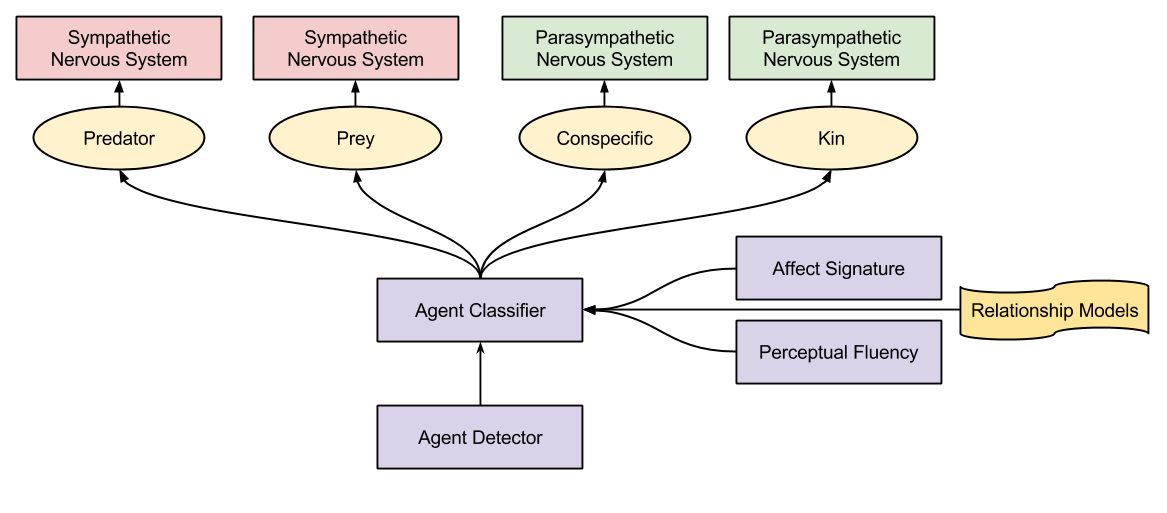
  • The Agent Detector module is responsible for detecting agents generally. The Agent Detector module is informed by multiple algorithms that search for specific features of an environment. 
  • The Agent Classifier module is responsible for differentiating between agents: predator from prey, friend from foe; it answers the question “so there’s an organism over there: what is it?” 

Perceptual Fluency, Relationship Models, Affect Signature

Like all processes subject to natural selection, the Agent Classifier is not built in the service of truth. Tinkering with the existing software is only preserved when the changes maintain or promote that organism’s biological fitness. We can nevertheless see four classifications that would honor this harsh criteria:

  • Predator: noticing that an animal is a predator, enables differential activation of fight-or-flight, which improves chances of survival.
  • Prey: noticing that an animal is prey, enables differential activation of fight-or-flight, which reduces the risk of starvation.
  • Kin: populations engaged in sexual reproduction are genetically motivated to help their kin (c.f., inclusive fitness). Noticing family members underwriting this ability.
  • Conspecific: social populations often engage in tasks which require coordination. Organisms able to recognize one another in such an environment stand to benefit politically.

The above labels are in fact used reached by a wide variety of organisms. How did they arrive at these abilities? The first clue lies in the mere exposure effect: that which is familiar exudes warmth. Two examples:

  • In studies of interpersonal attraction, the more often a person is seen by someone, the more pleasing and likeable that person appears to be.
  • In another study, subjects were shown nonsense symbols that resembled Chinese characters.  Each character was shown from 0–25 times.  The subjects were then asked to rate how they felt about each character. Eleven out of twelve times, the character was liked better when it was in the high frequency category.

The more you encounter a certain perceptual signature that doesn’t attack you, the easier that signature is to decode (perceptual fluency), and the more “good vibes” you get from the experience.

Besides these foundational mechanism, mammals have additional modules underwriting their social interactions. Significant relationships are implemented with relationship models: finite databases in your brain that track your interactions with significant individuals. But Capgras syndrome complicates this picture somewhat. An example:

Mrs. D, a 74-year-old married housewife, recently discharged from a local hospital after her first psychiatric admission, presented to our facility for a second opinion. At the time of her admission earlier in the year, she believed that her husband had been replaced by another unrelated man. She refused to sleep with the impostor, locked her bedroom and door at night, asked her son for a gun, and finally fought with the police when attempts were made to hospitalise her.

It turns out that people associate signs of normal, autonomic emotional arousal on recognizing close relationships. While Mrs. D relational model produced the same memories, her affective response to her husband was found to be damaged: he felt like a stranger to her. Your emotional encoding of significant individuals, their affect signature, is so powerful that your brain will privilege its information over your memories, should they ever contradict.

Here then is the information processing view of life recognizing itself:

Agency Detection- Information Processing v1

The Ability To See Faces

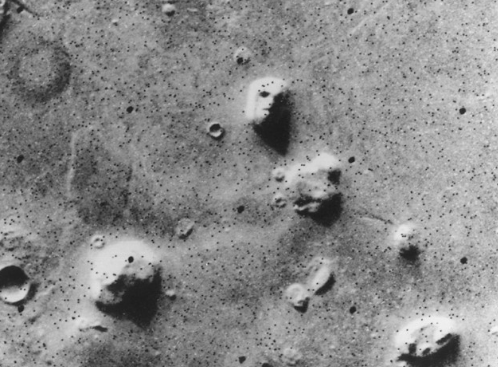
In 1976, NASA’s Viking 1 was orbiting Mars, exploring the surface for possible landing sites. Here’s one of its pictures, in the Cydonia region:

Agent Detection- Face On Mars

Striking, no?

While the popular reaction involved speculation of extraterrestrial intelligence, the scientists were, of course, a bit less credulous. Presented with such examples, it would be easy for us to get lost in the spooky feelings, or in dissecting superstitious tendencies. The most fertile explananda whispers to us but quietly. Why are such false positives more common than false negatives? We will return to this question in a moment.

Richard Feynman once said:

What I cannot create, I do not understand.

Even by this exacting metric, face detection is a solved problem. The software operating your smartphone’s camera is able to detect faces using a machine learning algorithm. We even know which area of your brain operates the wetware version of this algorithm. 

In Defense Of False Positives

For any such binary classification task, four outcomes are possible:

Agency Detection- Binary Classification Outcome Matrix (1)

There are two ways to get face detection wrong. Why are false positives so much more common than false negatives?

This question can only be satisfactorily answered by the fitness landscape. In our environment of evolutionary adaptation (EEA), these two errors induce radically asymmetric costs:

Agency Detection- Binary Classification Outcome Costs (1)

The above cost asymmetry explains this predominance of false positives, tells us why Agency Detector so often sees armies in the clouds.

Takeaways

  • Simple lifeforms simply move away from noxious stimuli. More complex animals instead possess the fight or flight mechanism.
  • Activating fight-or-flight requires two separate abilities: the ability to detect, and the ability to classify, other animals.
  • Animals label their perceptions of one another by three mechanisms: perceptual fluency, affect infusion, and relational models
  • Many different algorithms exist in your brain for detecting agents. One particularly well-understood example is the ability to see faces.
  • False positives appear more frequently because they cost less than false negatives.
    • This explains why we find faces in the moon, and ascribe malice or goodwill to every thing that hurts or pleases us.
Agency Detection- Information Processing v2 (1)

Ecology Embeds Gene-Space In The Biosphere

Part Of: Demystifying Life sequence
Followup To: An Introduction To Natural Selection

Motivations

In the past two posts, we have explored the landscape of gene-space.

  • A Genotype Is A Location.
  • Organisms Are Unmoving Points
  • Birth Is Point Creation, Death Is Point Erasure
  • Genome Differences Are Distances
  • Biological Fitness Is Height

Within this topography, we identified the following features:

  • A Species Is A Cluster Of Points
  • Species Are Vehicles
  • Genetic Drift is Random Travel.
  • Natural Selection is Uphill Locomotion

We can imagine millions of alien worlds with their own landscapes.  Today, we survey the complexities of our biosphere: the fitness landscape of Earth.

Fitness-As-Resource

Let population be members of a species that are in the same geological area (such that its members are able to interbreed). For example, we know of fourteen different populations of the humpback whale. Now, for every population, there exists some maximum number of individuals that the local environment can sustain. This number is known as carrying capacity. Now, for most populations this number is fairly large, especially in fertile environments. What does this concept entail for our fitness landscape?

We can define fundamental fitness to be fitness that would be afforded to some pair of individual organisms in an empty world, with no other organisms competing for the same resources. As we introduce more organisms into a given population cluster, the amount of realized fitness we could afford the original members decreases. When the number of dots equals the carrying capacity, average fitness is 1.0 (such that population as a whole will neither increase nor decrease).

This perspective leads us to viewing realized fitness as a finite resource. This interpretation is entirely compatible with our physics-oriented view of life; life as disentropy engine. There is only so much disentropy to go around in a given volume of spacetime! Call this the fitness-as-resource view.

Biotopic Landscapes

Organisms successful in the jungle are not necessarily well-equipped for the desert. Fitness landscapes change with location. We must embed gene-space into spacetime.

Does every cubic centimeter of Earth’s surface merit its own gene-space? Surely not! Not even the most life-friendly milliliter cannot sustain thousands of lifeforms.  We instead need to zoom out, and consider larger slices of land that can support a more meaningful amount of life. Will any collection of land work? No: we want to carve nature at the joints, and draw lines around ecologically uniform habitats (i.e., biotopes).

If we think of time as a dimension, then it is possible to view the entire universe stretched out throughout eternity as a four-dimensional block. But for our purposes, we only care about Earth across all time; call this smaller 4D rectangle the 4-biosphere. Ecological embedding is the art of finding maximally large 4-biotopes that maintain coherent landscapes..

Ecology- Biotopic Landscapes

Niches → Correlated Peaks

If organism fitness is a resource, what is resource competition? To answer, we must don our fitness-as-resource glasses. The idea here is that every organism comes equipped with disentropy vacuums; that is, machinery for extracting viable energy from its environment.

Let’s get specific. Imagine two different whale species in the same biotope, consuming the same kind of plankton. If the underlying plankton population started dying off, both whale populations would be jeopardized. Their disentropy vacuums would falter, and their collective fitness would plummet concurrently. Resource competition is fitness correlation.

Niches ultimately describe the resource-seeking strategies an organism uses to survive. Organisms with complete overlap of such strategies are said to occupy the same niche. While we could explore niches as a resource-space (the Hutchinsonian view, which has produced the discipline of niche modeling), let us instead view niches in terms of fitness landscapes. On this view, niches simply are correlated fitness peaks.

With this identification in hand, we are now in a position to understand more complete ecological phenomena:

  • The competitive exclusion principle holds that, other things being equal, two species competing for the same resource cannot coexist at constant population values. In our language: housing multiple populations on the same correlated fitness archipellago is an unstable zero-sum game.
  • Niche differentiation is a direct consequence of competitive exclusion. If another population invades and begins to take over your niche, you move to another niche (another resource profile). A classic example of niche differentiation comes from Robert MacArthur’s analyses of different populations of starlings in the same biotope. He observed that, despite their similar lifestyles, each population evolved to live in different cross-sections of trees: some living in the top branches, and others making homes near the base.

With niches under our belt, we now turn to two other, central notions in population ecology: food webs and arms races.

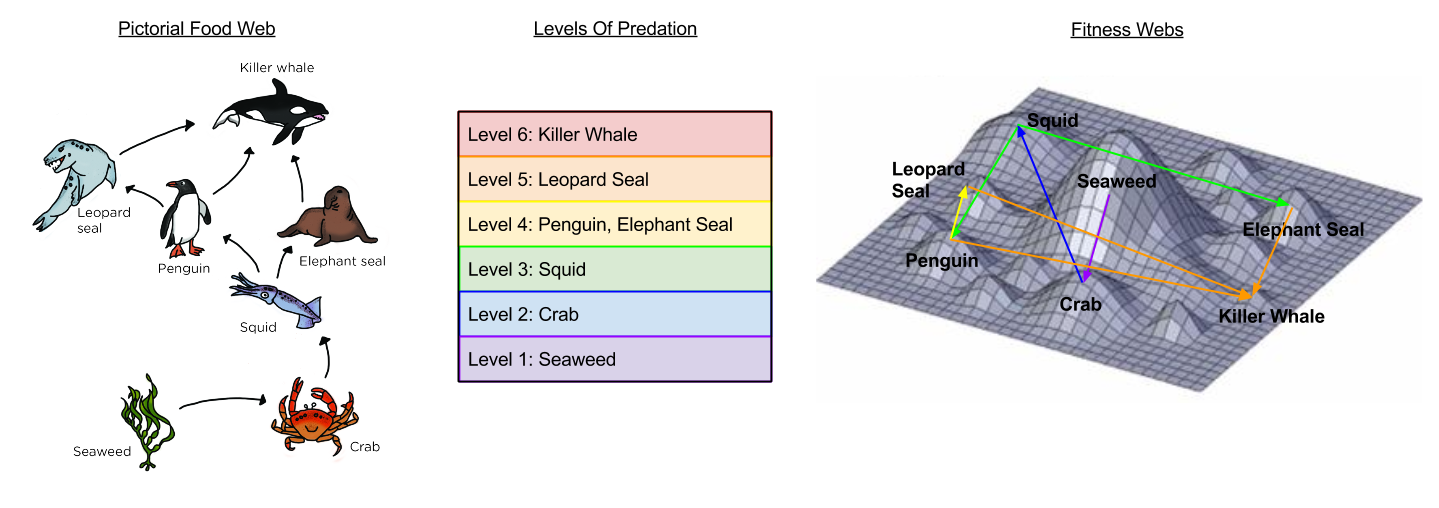
Food Webs → Lossy Fitness Theft

Our fitness-as-resource view provides a natural understanding of food webs. What is the fundamental fitness of the antelope? Zero! Herbivores cannot sustain themselves without vegetation; their existence is contingent on consuming such resources. Antelopes become relatively more reproductively successful only when grass becomes relatively less successful. This is a destructive form of fitness relocation, which I will call fitness theft.

93% of all human consumption of meat comes from three animals (36% pigs, 33% chicken, and 24% cows). None are carnivores. Why?

Consider the energy budget of life. If some blade of grass absorbs X kiloJoules worth of sunlight in its lifecycle, will the cow who ingests it absorb all X units of energy? No: most of the underlying energy was spent maintaining the cellular structure of the animal. Similar analyses can be run at any level of the food web. Life spends energy merely to sustain itself; this is the meaning of metabolism. Therefore, predation is always inefficient, and fitness theft is always lossy.

We can encode food webs into fitness landscape as follows. Diminishing peak size represents energy loss.

Ecology- Example Food Web

Perhaps unsurprisingly, food webs tend to create dynamical population patterns that fluctuate in sync with one another.  Systems theory plays a role in their analysis; here is a visual guide to the underlying differential equations.

Arms Race → Comoving Peaks

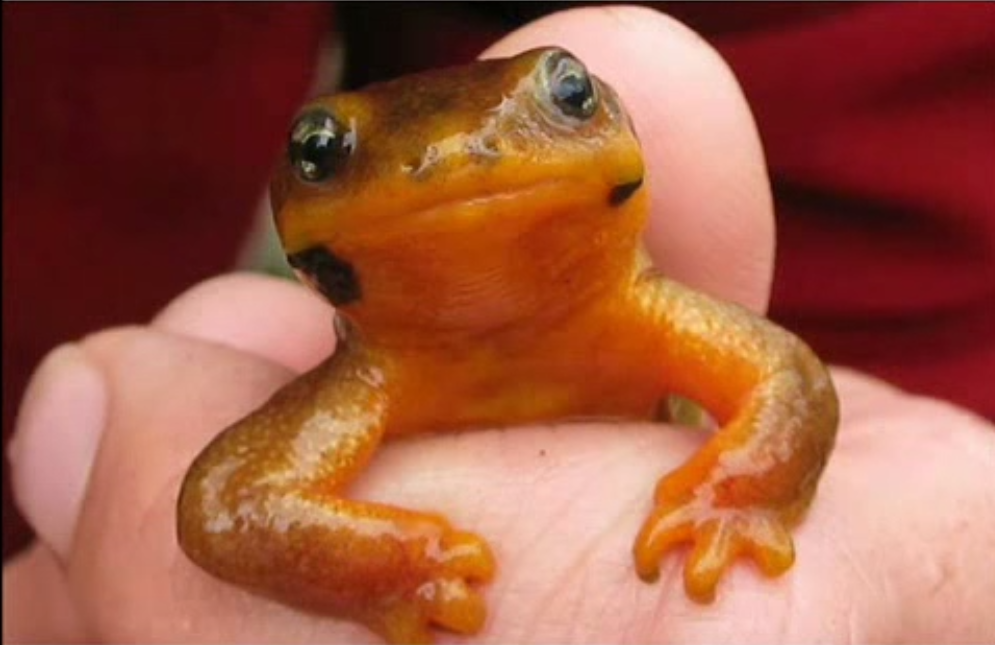
Meet the American rough-skinned newt.

Theoretical Ecology- Newt

Cute, right? Just, if you hold one, please remember to wash your hands before eating. These things secretes enough poison to literally kill an elephant.

Why should this be? I mean, obviously poison is a good safeguard against predation, but none of the newt’s natural predators come close to being elephant-sized. What benefit could the newt possibly derive in developing a poison so gratuitous?  Genetic accidents seems unlikely to explain the immense gap between the practical dose and the actual dose. What gives?

The clue lies in looking carefully at the newt’s predators. It turns out that a nearby species of garter snake has been developing a massively overpowered immunity to the newt’s poison.

If predators can be viewed as “fitness vacuums” in gene-space, then predation can induce natural selection towards novel defense mechanisms. As prey evolve towards more defensible peaks, predators with bolstered offensive capabilities are selected. In this way, the peaks of both species move alongside one another:

Takeaways

As hinted in my reference to systems theory above, theoretical ecology does not always leverage fitness landscape models.

We began this post by naturalizing our notion of gene-space:

  • Fitness is ultimately grounded in energy budgets. Fitness is thus a finite, fungible resource.
  • The fitness landscapes of a desert diverges from that of the ocean. Fitness landscapes are most clearly defined in uniform habitats, or biotopes.

These theoretical additions let us model new ecological behavior:

  • Niches are correlated fitness peaks, where each peak “vacuums up” fitness from the same set of resource.
  • Food webs are fitness theft, where predators gain fitness by reducing fitness of their prey. However, predation is inefficient, which guarantees a finite number of predation levels.
  • Arms races are comoving peaks, which occur when predator and prey attempt to outmaneuver one another in the fitness landscape.

These phenomena suggest that the fitness landscape is better understood as a seascape, whose contours fluctuate & interrelate in subtle ways.

[Sequence] Desmystifying Ethics

Philosophy of Morality

Evolution of Morality

Moral Cognition

Applied Ethics

Epistemic Topography

Related To: [Metaphor Is Narrative]
Content Summary: 1600 words, 16 min read.

Ambassadors Of Good Taste

I concluded my discussion of metaphor with three takeaways:

  • Metaphor relocates inference: we reason about abstract concepts using sensorimotor processes.
  • Metaphor imbues communication with affective flair or style.
  • Weaving metaphors together is narrative paint.

Let me build on such theses with the following aphorisms:

  • Metaphors which generate accurate empirical predictions are apt. Not all metaphors have this quality.
  • Metaphorical aptitude is a continuous scale, with complex empirical predictions generating higher scores.
  • Improving metaphorical aptitude is a design process.
  • Scientists who immerse their empirical results into this process are, in my language, ambassadors of good taste.

This post strives to develop a metaphor with high aptitude. You are witness to what I mean by “design process”.

Anatomy Of A Metaphor

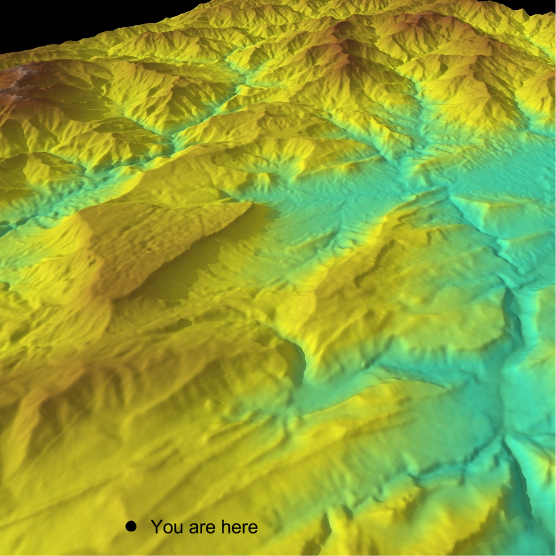
Concept-space is useful because it sheds light on the nature of learning. The central identifications are:

  • A World Model Is A Location.
  • The Reasoner Is A Vehicle
  • Inference Is Travel

Our unconscious selves already use this metaphor frequently (c.f. phrases like “I’m way ahead of you.”) We aren’t inventing something so much as refining it.

To these three pillars, another identification can be successfully bolted on:

  • Predictive Accuracy Is Height

As we will see, pursuing knowledge really is like climbing a mountain.
Epistemic Topology- Your Location

Need For Cognition is Frequency Of Travel

Let’s talk about need for cognition: that personality trait that disposes some people towards critical thinking.

Those who know me, know how deeply I am driven to interrogate reality. Why am I like this? My answer:

I pursue deep questions because I tell myself I am curious → I tell myself I am curious because I pursue deep questions.

Such identity bootstrapping appears in other contexts as well. For example:

I am generous with my time because I tell myself I am selfless → I tell myself I am selfless because I am generous with my time.

Curiosity is an itch, active curiosity is scratching it. In terms of our metaphor:

  • If inference is travel, actively curious people are those who travel more frequently.

Intelligence is Vehicular Speed

Where does intelligence – that mental ability linked to abstraction – fit? Consider the following:

  • Although our society tends to lionize IQ as a personal trait, intelligence is mostly (50-80%) genetic. High-IQ parents tend to have high-IQ children, and vice versa.
  • What’s more, intelligence is highly predictive of success in life. It is so important for intellectual pursuits that eminent scientists in some fields have average IQs around 150 to 160. Since IQ this high only appears in 1/10,000 people or so, it beggars coincidence to believe this represents anything but a very strong filter for IQ.
  • In other words, Nature is not going to win any awards for egalitarianism any time soon.

We interpret intelligence as follows:

  • If the reasoner is a vehicle, intelligence is the speed of her vehicle.

If this topic conjures up existential angst (“I’ll never study again!” :P) check out this post. Speaking from my own life, my need for cognition is comparatively stronger than my intelligence quotient. In the tortoise-vs-hare race, I am the tortoise. 

On Education And Directional Calibration

One might reasonably complain that learning is not a solitary activity – our metaphor is too individualistic.

Let’s fix it. Consider the classroom. A teacher typically knows more than her students; in our metaphorical space, she is elevated above them. But the incomprehensible size of concept-space entails three uncomfortable facts:

  1. Every student resides in a different location.
  2. Knowing the precise location is computationally infeasible (even one’s own location).
  3. Without such knowledge, discovering to that student’s optimal path up the mountain is also infeasible.

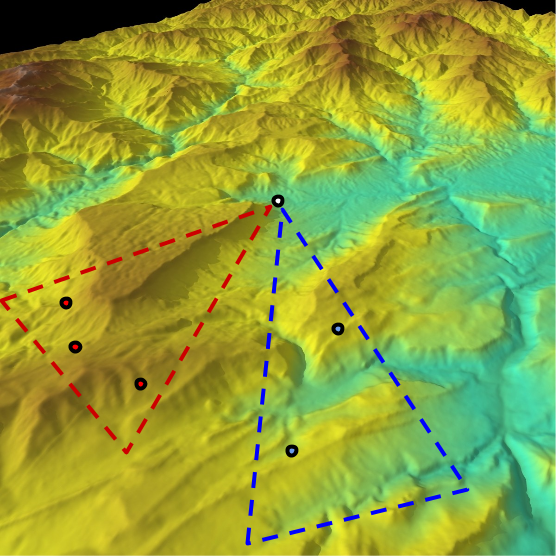
Fortunately, location approximations are possible. Imagine a calculus professor with five students. Three students are stuck on the mathematics of the chain rule, the other two don’t grok infinitesimals. We might imagine the first group in the SW direction and the second are S-SE:
Epistemic Topology- Relative Location Groups (1)

Without knowing anyone’s precise location, the professor (white dot) can provide the red group with worked examples of the chain rule (direct to the NE) and the blue group with stories to motivate the need for infinitesimals (direct to N-NW). While such directional calibration is imprecise, it nevertheless gets them closer to the professors’ knowledge (amplifying their predictive power).

Epistemic Topology- Directional Calibration (2)Notice how each student travels along different speeds (intelligence) and frequencies (work ethic).

On Inferential Distance

If the process of building World Models is a journey, the notion of inferential distance becomes relevant.

Imagine reading two essays and then being quizzed for comprehension. Both have the same word count; one is written by a theoretical physicist, the other by a journalist. The physicist’s writings would probably take longer to understand. But why is this so?

Surely there is a greater inferential distance between us and the theoretical physicist. Is it so surprising that traveling greater distances consume more time?

This intuition sheds light on a common communication barrier, which Steven Pinker frames well:

Why is so much writing so bad?

The most popular explanation is that opaque prose is a deliberate choice. Bureaucrats insist on gibberish to cover their anatomy. Plaid-clad tech writers get their revenge on the jocks who kicked sand in their faces and the girls who turned them down for dates. Pseudo-intellectuals spout obscure verbiage to hide the fact that they have nothing to say, hoping to bamboozle their audiences with highfalutin gobbledygook.

But the bamboozlement theory makes it too easy to demonize other people while letting ourselves off the hook. In explaining any human shortcoming, the first tool I reach for is Hanlon’s Razor: Never attribute to malice that which is adequately explained by stupidity. The kind of stupidity I have in mind has nothing to do with ignorance or low IQ; in fact, it’s often the brightest and best informed who suffer the most from it.

The curse of knowledge is the single best explanation of why good people write bad prose. It simply doesn’t occur to the writer that her readers don’t know what she knows—that they haven’t mastered the argot of her guild, can’t divine the missing steps that seem too obvious to mention, have no way to visualize a scene that to her is as clear as day.

The curse of knowledge expects short inferential distances. Why does this bias (not another) live in our brains?

As we have seen, estimating location is expensive.  So the brain takes a shortcut: it uses a location it already knows about (its own) and employs differences between the Self and the Other to estimate distance. Call this self-anchoring. But the brain isn’t aware of all differences, only those it observes. Hence the process of “pushing out” one’s estimation of Other Locations typically doesn’t go far enough… the birthplace of the curse.

On Epistemic Frontiers, Fences, and Cliffs

It is tempting to view cognition as transcendent. Cognition transcendence plays a key role in debates over free will debates, for example. But I will argue that barriers to inference are possible. Not only that, but they come in three flavors.

Intelligence is speed, but is there a speed limit? There exist physical reasons to answer “yes”; instantaneous learning is as absurd as physical teleportation.  Just as a light cone constrains how physical event spreads through the universe, we might appeal to a cognition cone. Our first barrier to inference, then, is running out of gasoline. Death represents an epistemic frontier, with intellectually gifted people enjoying wider frontiers. Arguably, the frontier of anterograde amnesiacs is much shorter, defined by the frequency at which their memories “reset”.

If most education eases inference, we might imagine other social devices that retard that very same movement. Examples abound of such malicious, man-made epistemic fences. While conspiracy theories typically rely on naive models of incentive structures, other forms of information concealment plague the world. Finally, people steeped in cognitive biases (e.g., cult members within a happy death spiral) cannot navigate concept-space normally.

Epistemic frontiers need not concern us overly much (e.g., educational inefficiencies inhibit progress more than short lifespans).  Epistemic fences are more malicious, but we can still dream of moving away from tribalism.  What about permanent barriers? Might naturally-occurring epistemic cliffs inhabit our intellectual landscape? Yes. Some of the more well-known cliffs include Godel’s Incompleteness Theorems, and the Heisenberg Uncertainty Principle.

We have seen three types of inferential stumbling blocks: finite frontiers, man-made fences, and natural cliffs.  But consider what it means to reject cognition transcendence. Two theses from Normative Therapy were:

  • Motivation: normative structures should point towards their ends in motivationally-optimal ways.
  • Despair: It is not motivationally-optimal to be held to a normative structure beyond one’s capacities.

If these principles seem agreeable, it may be time to reject arguments of the form “all people should believe X”. 

Takeaways

In this post, we developed a metaphor of epistemic topography, or concept-space:

  1. A World Model Is A Location.
  2. The Reasoner Is A Vehicle
  3. Predictive Accuracy Is Height
  4. Intelligence Is Vehicular Speed
  5. Inference Is Travel
  6. Need For Cognition Is Frequency Of Travel

We then used this five-part metaphor to shed light on the following applications:

  • Education is the art of directing people whose locations you do not know towards higher peaks.
  • The Curse Of Knowledge can be explained as incomplete extrapolating from one’s own conceptual location.
  • The inferential journey can be blocked by three kinds of barriers: finite frontiers, man-made fences, and natural cliffs
  • These facts render arguments of the form “all people should believe X” dubious.
The Structure Of Physics

Part Of: Philosophy of Science sequence
Followup To: An Introduction To Structural Realism
Content Summary: 800 words, 8 min read

Motivations

Recall the takeaways from last time:

  1. Realists advance the no-miracles argument: the predictive power of science seems too implausible unless its theories somehow refer to reality.
  2. Anti-realists counter with pessimistic meta-induction: previously successful theories have been discarded; who are we to say that our current theories won’t meet the same fate.
  3. The approximation hypothesis is where these two arguments connect meaningfully: isn’t it more accurate to call older theories approximations rather than worthless?
  4. It is notoriously difficult to describe what “approximation” means.
  5. Some realists have conceded that scientific narratives tend to fail, but produce compelling evidence that scientific equations tend to persist. This position is known as structural realism (where formulae structure means more than the meaning of the variables).

This summary is all fine, until you start to wonder… what precisely does “formulae structure” mean? And how is such a thing approximated?

Vocabulary Sharpening

Before we begin, consider the word “approximate”. It is directional: while we can say that Newtonian Physics approximates General Relativity, such a statement casts the older theory as the actor. This temporal confusion helps no one. What’s worse, in my view, is that “approximation” hints at the end of science, as though our current theories are causally derived from some Ultimate Structure, some Theory Of Everything.

Physicists in the business of approximating quantum mechanics? No! Progress runs in the other direction.

New theories are “pulled up from” a Theory Of Everything? No! Theories are fueled by the earth… data is their breath.

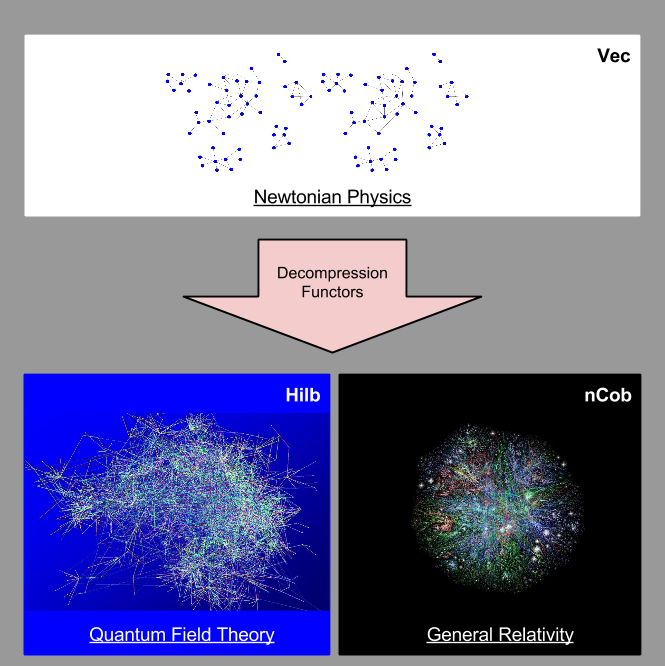
Let us discard the notion of approximation and consider the reverse direction. We might cite “generalization” or “disaggregation” for this purpose. But let me instead use theory decompression.  Here is a sharper expression of the two tasks that lie before us:

  1. What is structure?
  2. How do scientists decompress structure?

The Language Of Categories

Category theory seems the best candidate for a realizer of structuralism.

What is category theory? I’m glad you asked!

  • Category theory divides the world in terms of objects and processes (and meta-processes, and meta-meta-processes, etc).
  • “Processes” are called morphisms, and “meta-processes” are called functors.
  • Meta-processes that inject new information into their target categories are called free functors, those that eject information are forgetful functors.
  • A category, then, looks a lot like a network graph – with morphisms connected various objects together.
    • How can a formula become a graph-like thing? Operations (*, +, etc) become morphisms, variables (x, y, etc) become objects.
  • One way to describe categories is by looking for patterns in the underlying “graph”. These patterns are known as universal constructions.
  • Categories earn adjectives for different combinations of universal constructions.
    • For example, any category equipped with a pattern known as “exponential” is called a closed category.

Categorical Interpretations Of Physics

In what follows, I will leverage some idea in (Baez/Stay 2009) Physics, Topology, Logic and Computation: A Rosetta Stone.

  • Of course, modern physics is composed of two separate theories: Quantum Field Theory, and General Relativity
  • Quantum Field Theory (QFT) is the category Hilb, which is a categorical interpretation of a Hilbert space.
  • General Relativity (GR) is the category nCob, which is a categorical interpretation of the topological notion of cobordism.
  • Both QFT and GR both share the same set of patterns, and hence they share the same adjectives. Both are closed symmetric monoidal categories.
    • Noticing the pattern overlap is now motivating work towards a unified [Physics] Theory Of Everything.
    • As an aside, do you know what other categories share this moniker? Computation and linear logic.
  • Newtonian Physics is the category Vec, which is a categorical interpretation of vector space. It is not closed symmetric monoidal.
    • Note: unlike the rest of this section, take the above line with buckets of salt. It is my own conjecture, used for illustrative purposes.
  • In this setting, what is the meaning of theory decompression? Such a thing might be the construction of free functors, i.e., decompression functors.

Structural Realism- Disapproximation

I intend to flesh out this present section in the coming years. But for now, here is where we leave it.

Harden Your Query

We have successfully hardened the concept of structure, and used it to harden our theory of physics. Consider again our second question:

  • How do scientists decompress structure?

With our newfound understanding of structure, we can make this research question more precise:

  • How does Vec produce the same predictions as Hilb + nCob?
  • How do scientists go about constructing decompression functors?

Category theory is not yet powerful enough to answer these questions. They are, I submit, the most important unsolved questions in all of philosophy of science.

Wrapping Up

Let me close on a note of poetry. The following quote is one of the most beautiful thoughts I have ever encountered. It is attributed to Stephen Hawking.

What is it that breathes fire into the equations and makes a universe for them to describe?

For us, our query has become:

What is it that breathes fire into these categories and makes a universe for them to describe?