Cooking and the Hominin Revolution

Part Of: Anthropogeny sequence
See Also: Born to Run: a theory of human anatomy
Content Summary: 2100 words, 21 min read

The Universality of Cooking

Cooking is a human universal. It has been practiced in every known human society. Rumors to the contrary have never been substantiated. Not only is the existence of cooked foods universal, but most cuisines feature cooked foods as the dominant source of nutrition.
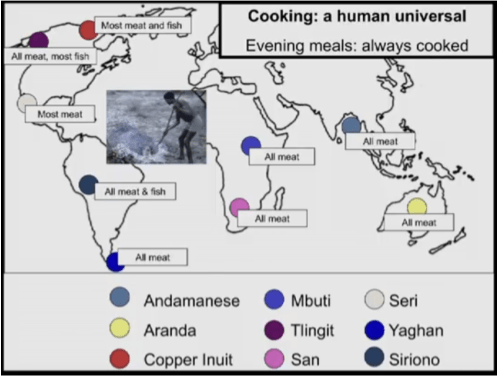
Cooking_ A Human Universal (1)

Raw foodists comprise a community dedicated to consuming uncooked food. Of course, compared to historical hunter-gatherers, modern raw foodists enjoy a wide variety of advantages. These include:

  1. Elaborate food preparation (pounding, purees, gently warming),
  2. Elimination of seasonal shortages (supermarkets)
  3. Genetically enhanced vegetables with more sugar content and fewer toxins.

Despite these advantages, raw foodists report significant weight loss (much more than vegetarians!). Further, raw foodists suffer from increasingly severe reproductive impairments, which have been linked to not getting enough energy.  
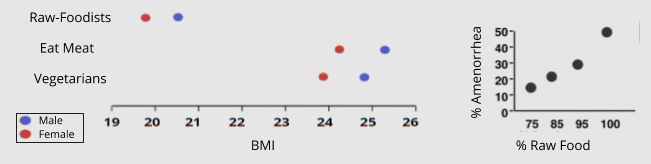
Cooking_ Consequences of Raw-Foodism (1)

Low BMI and impaired reproduction are perhaps manageable in modern times, but are simply unacceptable to hunter-gatherers living at subsistence levels.

The implication is clear: there is something odd about us. We are not like other animals. In most circumstances, we need cooked food.

The Energetics of Cooking

Life exists to find energy in order to make more copies of itself. Feeding and reproduction are the twin genetic imperatives.

Preferences are subject to natural selection. The fact that we enjoy cooked food suggests that cooking provides an energy boost to its recipients. The raw-foodist evidence hints towards this conclusion as well. But there is also direct evidence in rats that cooking increases energy gains.

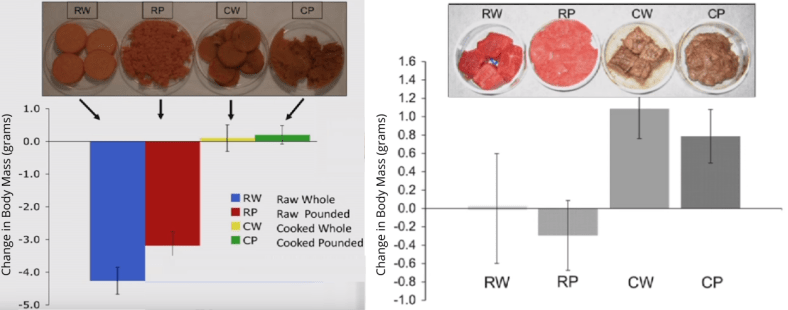
In the following experiments, rat food was either processed/pounded, cooked, neither, or both. After giving this diet over the course of four days, rats in each condition were weighed.
Cooking_ Energy Benefits of Cooking (1).png

For starches (left) and meat (right), cooking is by far more effective at preventing weight loss and promoting weight gain. Tenderizing food can sometimes help, but that technique pales in comparison to cooking.  

The above results were taken from rats. But similar results have replicated in calves, lambs, piglets, cows, and even salmon. It seems to be universally true that cooking improves the energy derived from digestion, sometimes up to 30%.

How does cooking unlock more energy for digestion?

First, denaturation occurs when the internal bonds of a protein weaken, causing the molecule to open up. Heat predictably denatures (“unfolds”) proteins, and denatured proteins are more digestible because their open structure exposes them to the action of digestive enzymes.

Besides heat, three other techniques promote denaturation: acidity, sodium chloride, and drying. Cooking experts constantly harp on these exact techniques, because it aligns with eating preferences.

Second, tender foods is another boon to digestion, because they offer less resistance to the work of stomach acid.  If you take rat food, and inject air into the pellets, that does not augment denaturation. Nevertheless, softening food in this way improves the energy intake of the rat.

Cooking does have negative effects. It can cause a loss of vitamins, and give rise to long-term toxic molecules called Maillard compounds, which are linked to cancer. But from an evolutionary perspective, these downsides are overshadowed by the impact of more calories. In subsistence cultures, better fed mothers have more, happier, and healthier children. When our ancestors first obtained extra calories by cooking their food, they and their descendants past on more genes than others of their species who ate raw.

A Brief Review of Human Evolution

The most recent common ancestor of humans and chimpanzees lived 6 mya (million years ago). But the first three million years of our heritage are not particularly innovative, anatomically. The australopiths were essentially bipedal apes. They could walk comfortably, but retained their adaptations for tree living as well. There is some evidence that australopiths acquired food from a new source: tubers (the underground energy storage system of plants).

Climate change is responsible for the demise of the australopiths. Africa began getting dryer about 3 million years ago, making the woodlands a harsher and less productive place to live. Desertification would have reduced the wetlands where Australopiths found fruits, seeds, and underwater roots. The descendents of Australopithecus had to adapt their diet.

The paranthropes adapted by promoting tubers (underground storage organs of plants) from backup to primary food. In contrast, the habilines (e.g., Homo Habilis) took a different strategy: meat eating. These creatures inherited tool making from the late australopiths (Mode 1 tools, the Oldawan industry- was discovered in Ethiopia 2.6 mya), and used these tools to scrape meat off of bones). The habilines are more ecologically successful, and lead to:

  • 1.9 mya: The erects (e.g., Homo erectus/ergastor) with significantly larger brains and near-modern anatomies.
  • 0.7 mya: The archaics (e.g., Homo Heidelbergensis) appear, who eventually give rise to the Neanderthals, Denisovans, and us.
  • 0.3 mya The moderns (e.g., Homo Sapiens) emerge out of Africa, and completely conquer the globe.

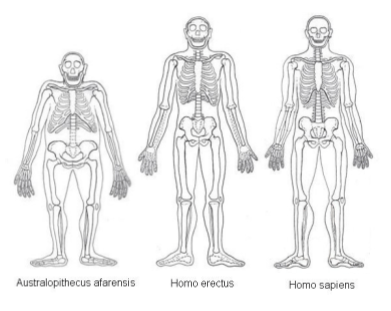
Here is a sketch of how our body plans have changed across evolutionary time:
Cooking_ Hominin Anatomy Comparison

Explaining Hominization

The transition from habiline to erects deserves a closer look. We know erects evolved to be persistence hunters. But a number of paradoxes shroud their emergence:

  1. Digestive Apparati. The erect diet appears to be mainly meat and tubers. Both require substantial jaw strength and digestive apparati. Yet the Homo genus features a dramatically reduced digestive apparatus. How was smaller mouths, weaker jaws, smaller teeth, small stomachs, and shorter colons an adaptive response to eating meat and starches?
  2. Expensive Tissue. Australopiths brain size stayed relatively constant at 400 ccs (10% of resting metabolism). Erect brains began to grow. This transition ultimately yielded a 1400 cc brain (20% of resting metabolism) in archaic humans. How did the erects find the calories to finance this expansion?
  3. Time Budget. The above anatomical features of erects are geared towards endurance running, which suggests that their lifestyle involved persistence hunting. Chimps have about 20 minute intervals in between searching for & chewing food. Thus, chimps can only afford to spend 20 minutes hunting before giving up. How did erects perform the risky behavior of persistence hunting, which consumes 3-8 hours of time?
  4. Thermal Vulnerability. As part of their new hunting capabilities, erects became the naked ape (with a new eccrine sweat gland system to prevent overheating). But Homo Erectus also managed to migrate to non-African climates such as Europe. How did these creatures stay warm?
  5. Predator Safety. Erects lost their anatomical features for arboreal living, which suggests they slept on the ground. Terrestrial sleeping is quite dangerous on the African savannah. How did erects avoid predation & extinction?

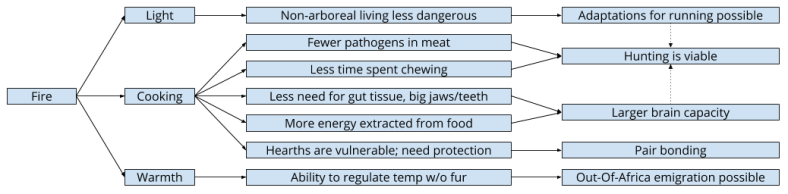
All of these confusing phenomena can be explained if we posit H. erectus discovered the use of fire, and its application in cooking:

  1. Digestive Apparati. As we have seen, the primary role of cooking is to “externalize digestion”, and to increase the efficiency of our digestive tract. Cooked meat and starches are incredibly less demanding to process than their raw alternatives. This explains our reduced guts. By some estimates, the decrease in digestive tissue corresponds with a 10% energy savings by our erect ancestors.
  2. Expensive Tissue. Cooking increases the metabolic yield of most foodstuffs by ~30%. For reference, a 5% increase in ripe fruit for chimpanzees reduces interbreeding interval (time between children) by four months. 30% is an absurdly large energy gain, enough to “change the game” for the erects..
  3. Time Budget. Cooking freed up massive amounts of time otherwise spent chewing. Chimpanzees can take 4-7 hours per day chewing; humans only need one hour per day. This frees up massive amounts of time, which can be used for e.g., hunting.
  4. Thermal Vulnerability. It is very difficult to explain a hairless Homo Erectus thriving on the colder Asian continent without control of fire.
  5. Predator Safety. It is very difficult to explain how erects were not preyed upon to extinction without fire to identify & deter predators. Hadza hunter-gatherers comfortably sleep through the night, typically by taking turns “on watch” while the others rest.
Cooking_ Overall Argument (3)

The Archaeological Record

We are positing that erects learned to create and controlling fire 2 mya. Is that a feasible hypothesis?

Habilines had learned how to create stone tools 2.6 million years ago. By the time of the erects, techniques to create these tools had persisted for 600,000 years. So it is safe to say that our ancestors were able to retain useful cultural innovations.

Independent environmental reasons link fire-making with H Erectus. The Atlas mountain range is the most likely birthplace of this species, and this dry area fires triggered by lightning are an annual hazard. Hominins living in such environments would be more intimately familiar with fire than those with less combustible vegetation zones.

Erects would have seen sparks when they hit stones together to make tools. But the sparks produced by many kinds of rock are too cool to catch fire. However, when pyrites (a fairly common ore) are hit against flint, the results are used by hunter-gatherers to reliably produce fire. The Atlas mountain range is renowned for being exceptionally rich in minerals:

Why is Morocco one of the world’s great countries for minerals? No glaciers! Many of the world’s most colorful minerals are found in deposits at the surface, formed over time by the interaction of water, air and rock. Glaciers remove all of that good stuff (as happened in Canada recently, geologically speaking) –  and with no recent glaciation, Morocco hosts many fantastic occurrences of minerals unlike any in parts of the world stripped bare during the last Ice Age.

Since this mountain range contains pyrites, early erects could have found themselves inadvertently making fire rather often.

Once it is created, fire is relatively easy to keep going. And it does not take much creativity to stick food a fire. Moreover, modern-day chimps prefer cooked food over raw; it is hard to imagine H Erectus finding cooked food distasteful. All of these considerations suggest an early control of fire is at least plausible.

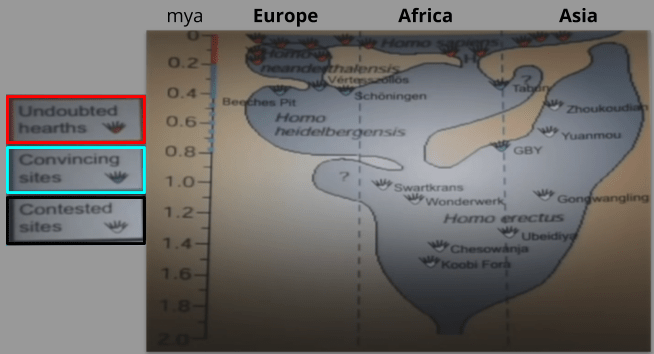
We can consult the archaeological record to see record of man-made fire (i.e., hearths). This is bad news for the cooking hypothesis! There is strong evidence for hearths dating back to 800 mya and the advent of archaic humans. Before then, there are six sites that seem to be hearths; but these are not universally acknowledged as such.
Cooking_ Archaeology Evidence (1)

But absence of evidence isn’t evidence of absence, right?

No! That idiom is wrong. Silence is evidence of absence. It’s just that the strength of the evidence depends on the nature of the hypothesized entity.

  • If you think an unidentified planet orbits the Sun, a lack of evidence would weigh heavily against the hypothesis.
  • If you think an unidentified pebble orbits the Sun, a lack of evidence doesn’t say much one way of the other.

Wrangham argues that evidence of hearths are more fragile than e.g. fossils, and points to facts like there are zero hearths recorded for modern humans during European “ice ages” – but we know these must have existed. It is possible that the contested hearth sites will ultimately be vindicated, and that we just can’t see much evidence.

Despite these claims about evidential likelihood, the silence of the archaeological record is undeniably a significant objection to the theory.

Weighing The Evidence

Is the cooking hypothesis true? Let us weigh the evidence, and contrast it with alternative hypotheses.

The most plausible alternative hypothesis is that archaic humans H. Heidelbergensis discovered cooking. But the emergence of that species involved an increase in brain size, and more sophisticated culture & hunting technology.  Neither adaptation seems strongly connected to cooking. In contrast, the H. Erectus adaptations would have all been strongly affected by cooking. 

Moreover, alternative hypotheses must still answer the five paradoxes of hominization:

  1. Digestive Apparati. Why did erects evolve smaller mouths, weaker jaws, smaller teeth, small stomachs, and shorter colons?
  2. Expensive Tissue. How did the erects find the calories to finance more brain tissue?
  3. Time Budget. How could erects afford spending 3-8 hours per day engaged in the risky strategy hunting?
  4. Thermal Vulnerability. Erects also managed to migrate to non-African climates such as Europe. How did these creatures stay warm?
  5. Predator Safety. Erects slept on the ground. How did they avoid predation?

The habilines ate meat. It is unclear how they did so (hunting or scavenging), but we have strong evidence that they did. Meat is a much higher quality food than tubers (cf. paranthropes) or fruit (cf. chimpanzees). The meat-eating hypothesis argues that meat eating was the primary driver of hominization.

Meat-eating resolves the Expensive Tissue paradox (meat allows for brain growth) and Digestive Apparati (carnivores are known to have smaller guts). But it doesn’t address why a meat-eater would develop smaller canines. And it struggles to explain how the reduction in gut size is compatible with the tuber component of the erect diet. And what about time budget, thermal vulnerability, and predator safety? The meat eating hypothesis fails to address these paradoxes entirely.

Which is more likely to occur in the next twenty years: undisputed evidence for early control of fire, or an alternate theory that resolves all five hominization paradoxes?

My money is on the former.

References

  • Wrangham (). Catching Fire: How Cooking Made Us Human
  • Aiello & Wheeler(1995). The expensive tissue hypothesis: the brain and the digestive system in primate and human evolution.

An Introduction to Domestication

Part Of: Anthropogeny sequence
Content Summary: 1300 words, 13 min read.

The Domestication Syndrome

Since our emigration out of Africa 70,000 years ago, Homo Sapiens have domesticated many other species, including

  • dogs (18 kya, first domesticated in Germany)
  • goats, sheep (11 kya)
  • cattle, pigs, cats (10 kya)
  • llamas, horses, donkeys, camels, chickens, turkeys (5 kya)
  • foxes (50 years ago)

Consider the domestication of wolves into dogs. An important part of the environment of a species is other species- not merely its predators or pathogens but its symbionts. In this case, canines began to get food from human campsites. Dogs that were less aggressive were (by unconscious preference and conscious intent) more successful at extracting resources. This process is known as artificial selection.

Most ancient dogs kept by hunter-gatherers share a common body shape. More recently however, humans have conducted pedigree breeding: influencing the morphologies of different dog breeds. We have used this power to sculpt breeds as diverse as the Chihuahua and the Great Dane.

The defining feature of domestication is docility: a reduction in reactive aggression. All domesticated species exhibit this feature, in comparison to their wild counterparts. Not all species are capable of this sort of control. For example, humanity has tried for centuries to domesticate big fauna such as zebras, lions, and hippos. However, some breeds have reproductive and aggressive styles that prohibit domestication.

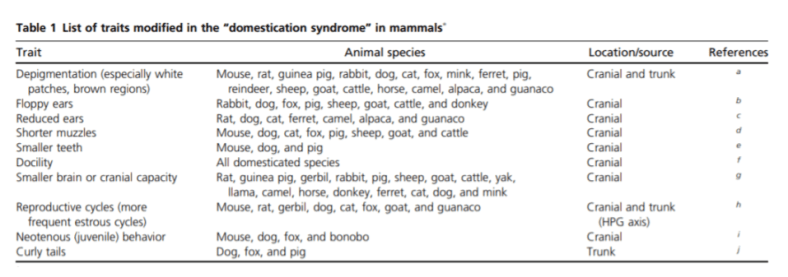
But domestication doesn’t just bring about a change in behavior. It also brings with it a bewildering number of anatomical changes, to essentially all domesticated species. The domestication syndrome include:

  • Docility (agreeableness, reduction in irritability)
  • Depigmentation (especially white patches, brown regions)
  • Floppy ears
  • Shorter ears
  • Shorter jaws
  • Smaller teeth
  • Smaller brains (10-15% reduction in volume)
  • More neotenous behavior (juvenile behavior that extends into adulthood).
  • Curly tails

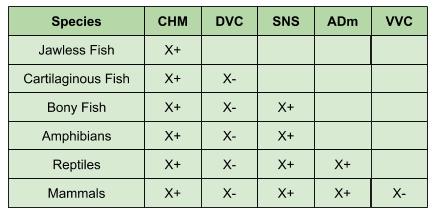
Most domesticated species express some aspect of the domestication syndrome, as we can see in the following table:

Self-Domestication_ The Domestication Syndrome (1)

Three Theories of Domestication

The sheer complexity of the domestication syndrome requires an explanation. What is the link between floppy ears and docility?

Three hypotheses suggest themselves:

  1. Multiselection. Are the symptoms of domestication all expressions of human preferences? Do we simply like curly tails and floppy ears?
  2. Environment. Is there something about proximity to humans that incentivizes these changes?
  3. Byproduct. When the genes for aggression are altered, does that somehow incidentally cause these other changes?

Animal husbandry practices are lost to the sands of time. Nevertheless, there is a way to test multiselection directly: by creating a domesticated species in the laboratory.

In 1959, Dmitri Belyaev began trying to domesticate silver foxes. He used exactly one criterion for selection: he only bred pups that exhibited the least aggression. Skeptics thought it would take centuries to complete the domestication process. But changes in temperament were seen after only four generations. At twelve generations, “elite” foxes began to emerge with dog-like characteristics: wagging their tails, allowing themselves to be petted etc. At twenty generations, the entire population was considered fully domesticated.

https://www.youtube.com/watch?v=0jFGNQScRNY

Despite only selecting for docility, Belyaev’s foxes exhibited the full domestication syndrome. The foxes inexplicably developed floppy ears, curly tails, white patches, etc etc. The multiselection hypothesis is false.

Is there something about proximity to humans that selects for the domestication syndrome? The environment hypothesis seems false for two reasons.

  1. First, when they return to the wild, domesticated species take a long time reverting their characteristics. In fact, often domestication gives them a selective advantage over their wild cousins.
  2. Second, as we will see in the next section, self-domesticated species such as bonobos exhibit the syndrome despite their evolution not being influence by hominids.

The byproduct hypothesis is our only remaining explanation for the domestication syndrome. But what specific system produces these changes? 

The Biological Basis of Domestication

In order to fully explain aggression reduction, we must understand it at a biological level.

The primary basis of aggression reduction is a shrinking amygdala and periaqueductal gray (PAG). These modules comprise the negative valence system which learn which stimuli are negatively-valenced, and forward them to the mobilization system (e.g., snake → bad → run away). Serotonin inhibits the negative valence system, and domesticated animals have much high concentrations of serotonin receptors in these regions. Finally, it appears that these changes mostly act across development. The negative valence system comes online only slowly: there exists a socialization window in the first month of a wolf’s life, where it can learn “humans are okay”. Domestication primarily acts by increasing the socialization window from one to twelve months. If a dog isn’t exposed to a human in its first year, it’s now-active fear system will kick in: it will be wild for the rest of its life.

So what biological system is able to a) expand the socialization window, and b) induce the rest of domestication syndrome? The leading hypothesis involves a feature of development called the neural crest.

A blastocyst has no brain. To correct this unfortunate situation, every vertebrate genome contains instruction for constructing a neural tube. This structure emerges via folding.

The neural crest resides between the epidermis and the neural tube. These neural crest cells (NCCs) then proceed to migrate to a certain number of other anatomical structures to assist development. When the NCC migration malfunctions, the resultant disease is called a neurocristopathy. Many neurocristopathies result in outcomes similar to the domestication symdrome! For example, here is the effect of piebaldism:

Self-Domestication_ Piebalism

The mild neurocristopathy hypothesis (Wilkins et al, 2014) holds that domestication syndrome is a byproduct of changes to the NCC migration pattern.

Self-Domestication_ Mild Neurocristopathy Hypothesis

The hypothesis, however, is not very detailed (how exactly is NCC migration changed? What are the genomic and epigenomic contributions?). It is more of a promissory note than a mechanistic account. And there are other holistic hypotheses on offer, including genetic regulatory networks (Trut et al 2004) and action of the thyroid gland (Crockford 2000). It seems clear that, in the coming decades, a detailed mechanistic theory of domestication will emerge to vindicate the byproduct hypothesis.

Two Kinds of Domestication

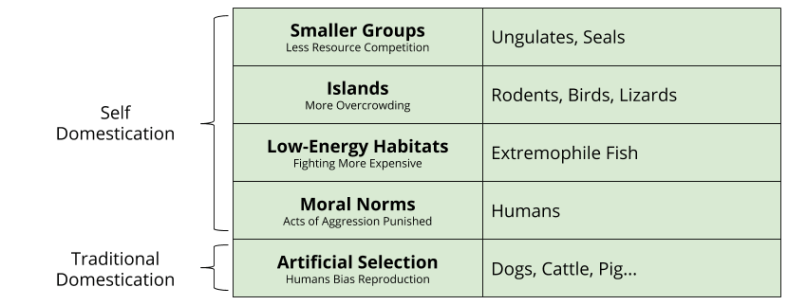
Natural selection explains why the “design requires a designer” trope is obsolete. For the same reason, domestication can occur in the absence of a domesticator. More precisely, change in a species ecological niche can itself select against aggression.  Because aggression is very relevant to survival, we see plenty of species that have increased, and plenty that have decreased their rates of aggression. We call those less aggressive species self-domesticated: they became more peaceful in the absence of humans. What’s more, these species also exhibit the domestication syndrome.  

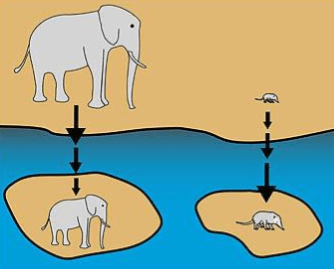
Another example is embedded in Foster’s Rule. Islands tend to be geologically more recent than continents, so their populations derive from the continent rather than vice versa. Islands tend to have fewer predators, but also fewer resources. Reduced predation increases the size of small animals (e.g., dodos evolved from pigeons), but limited resources decreases the size of big animals (e.g. the 3ft tall dwarf elephant).  

Self-Domestication_ Foster's Rule

Because islands have fewer predators, they also tend to have higher population densities; as such, reactive aggression is a less useful strategy. Selection favors the less aggressive. And we can see the domestication syndrome in island species. For example, the Zanzibar red colobus monkey has diverged from the continental red colobus along the same trajectory as dogs diverged from wolves.

Other examples of self-domestication can be found with group size reduction (ungulates, seals) and low-energy habitats (extremophile fish).

Finally, bonobos provide a particularly relevant example of self-domestication. Because food is more plentiful (don’t have to compete with gorillas for vegetation), females can spend time close to one another. Proximity produces bonding, and female coalitions exert pressure on bonobo behavior.

  • In chimps, bullying women increases reproductive success. Chimps will systematically beat up all females in their group as a coming-of-age ritual.
  • In bonobos, female coalitions retaliate against male aggression, making it unprofitable. Sexual selection then acts against reactive aggression.

So we can see that domestication (i.e., reduction in aggression) can come in two flavors: traditional vs self-domestication.

Self-Domestication_ Categories of Aggression Reduction (1)

As we will see next time, Homo Sapiens is yet another example of a self-domesticated species. See you then!

Related Resources

  • Wilkins et al (2014). The “domestication syndrome” in mammals: a unified explanation based on neural crest cell behavior and genetics

[Excerpt] Replicators and their Vehicles

Original Author: Richard Dawkins, The Selfish Gene
See Also: [Excerpt] The Robot’s Rebellion
Content Summary: 800 words, 4 min read

The First Replicator

Geochemical processes gave rise to the “primeval soup” which biologists and chemists believe constituted the seas some three to four thousand million years ago. The organic substances became locally concentrated, perhaps in drying scum round the shores, or in tiny suspended droplets. Under the further influence of energy such as ultraviolet light from the sun, they combined into larger molecules. Nowadays large organic molecules would not last long enough to be noticed: they would be quickly absorbed and broken down by bacteria or other living creatures. But bacteria and the rest of us are late-comers, and in those days large organic molecules could drift unmolested through the thickening broth.

At some point a particularly remarkable molecule was formed. We will call it the Replicator. It may not necessarily have been the biggest or the most complex molecule around, but it had the extraordinary property of being able to create copies of itself.

A molecule which makes copies of itself is not as difficult to imagine as it seems at first, and it only had to arise once. Think of the replicator as a mold or template. Imagine it as a large molecule consisting of a complex chain of various sorts of building block molecules. The small building blocks were abundantly available in the soup surrounding the replicator. Now suppose that each building block has an affinity for its own kind. Then whenever a building block from out in the soup lands up next to a part of the replicator for which it has an affinity, it will tend to stick there. The building blocks which attach themselves in this way will automatically be arranged in a sequence which mimics that of the replicator itself. It is easy then to think of them joining up to form a stable chain just as in the formation of the original replicator. Should the two chains split apart, we would then have two replicators, each of which can go on to make further copies.

Replicator Competition

The primeval soup was not capable of supporting an infinite number of replicator molecules. For one thing, the earth’s size is finite, but other limiting factors must also have been important.

But now we must mention an important property of the copying process: it is not perfect. mistakes will happen. I hope there will be no misprints in this book, but if you look carefully you may find one or two. We do not know how accurately the first replicator molecules made their copies. Their modern descendants, the DNA molecules, are astonishingly faithful compared with the most high-fidelity human copying process, but even they occasionally make mistakes, and it is ultimately these mistakes which make evolution possible. Mistakes were made, and these mistakes were cumulative.

Replicators with a comparatively worse design must actually have become less numerous because of competition, and ultimately many of their lines must have one extinct. There was a struggle for existence among replicator varieties. They did not know they were struggling, or worry about it; the struggle was conducted without any hard feelings, indeed without feeling of any kind. But they were struggling, in the sense that any mis-copying which resulted in a new improved level of stability, or a new way of reducing the stability of rivals, was automatically preserved and multiplied.

This process of replicator improvement was cumulative. Ways of increasing stability and of decreasing rivals’ stability became more elaborate and more efficient. Some of them may even have ‘discovered’ how to break up molecules of rival varieties chemically, and to use the building blocks so released for making their own copies. These proto-carnivores simultaneously obtained food and removed competing rivals. Other replicators perhaps discovered how to protect themselves, either chemically, or by building a physical wall of protein around themselves. This may have been how the first living cells appeared.

Replicator Self-Improvement

Replicators began not merely to exist, but to construct for themselves containers, vehicles for their continued existence. The replicators that survived were the ones that built survival machines for themselves to live in. The first survival machines probably consisted of nothing more than a protective coat. But making a living got steadily harder as new rivals arose with better and more effective survival machines. Survival machines got bigger and more elaborate, and the process was cumulative and progressive.

Was there to be any end to the gradual improvement in the replicators’]techniques? What weird engines of self-preservation would the millennia bring forth?  Four thousand million years on, what was to be the fate of the ancient replicators?

They did not die out, for they are past masters of the survival arts. But do not look for them floating loose in the sea; they gave up that cavalier freedom long ago. Now they swarm in huge colonies, safe inside gigantic lumbering robots, sealed off from the outside world, communicating with it by tortuous indirect routes, manipulating it by remote control..

They are in you and in me; they created us, body and mind; and their preservation is the ultimate rationale for our existence. They have come a long way, those replicators. Now they go by the name of genes, and we are their survival machines.

[Excerpt] Self-domestication and human homosexuality

Excerpts are not my writing! This comes from Richard Wrangham’s book:

The Goodness Paradox: The Strange Relationship Between Virtue and Violence in Human Evolution

It was a fun read. Recommended!

Human homosexuality is not adaptive

The hypothesis that human homosexuality is adaptive (genetically advantageous) has not been rejected lightly. Homosexual behavior can be frequently found among wild animals, and traits that are widespread are likely to be adaptive.

So when evolutionary biologists began to study human homosexual behavior, they tended to search for ways to explain how a same-sex preference might have been favored in natural selection. Homosexual behavior among other animals offered some ideas.

Close study reveals how homosexual behavior can be adaptive.

  1. Scarcity of opposite-sex partners. Among Laysan albatrosses in Hawaii, two parents are needed for chicks to be reared successfully. When there are not enough males, females pair together. Their sexual behavior includes courtship and pseudo-copulation. Females in same-sex pairs are fertilized by an already mated male, who then ignored the resulting eggs and chicks. The female pair brings them up without male help.
  2. As a prosocial device. In animals whose choice of sexual partner is not a response to a shortage of opposite-sex partners, homosexual behavior sometimes appears to be adaptive by promoting useful social relationships. In troops of Japanese monkeys, females form temporary homosexual mating partnerships even when other males are available. Among savanna baboons, males form alliances that they use in fights against others. Allies reciprocally fondle one another’s genitals, apparently to demonstrate their commitment to the bond.

Researchers have sought evidence that the kinds of reproductive or social benefits that animals gain from same-sex sexual interaction might be found in human. In theory, humans could form same-sex partnerships in response to a short supply of members of the opposite sex. Certainly, partner availability influences us. Women and men in single-sex institutions such as prisons, schools, monasteries, and ships often temporarily shift their sexual activity toward their own sex. Nevertheless, of course, many individuals feel an exclusive attraction to members of their own sex, regardless of the availability of the opposite sex.

Further, homosexual couples tend to have smaller families than same-sex couples, and there is a lack of evidence that their sexual orientation leads them to give exceptional help to their genetic kin. These data suggest that homosexual behavior in humans is not biologically adaptive.

Unfortunately, the conclusion that same-sex behavior is not adaptive has sometimes been associated with a negative view of homosexuality. But normative value and biological purpose are independent considerations. Many tendencies that we regard as morally reprehensible clearly evolved, including numerous kinds of sexual coercion, lethal violence, and social domination. Equally, many morally delightful tendencies did not evolve, such as charity to strangers and kindness to animals. Our decisions about which behavior we like or dislike should never be attributed to adaptive value.

The biological basis of homosexuality

Same-sex sexual attraction is often stable over a lifetime, and there is good evidence that is is partly heritable. These features make human homosexuality different from most animal homosexuality.

One particular area of the brain responds to androgens (sex hormones) in the fetal stage: the third interstitial nucleus of the anterior hypothalamus (INAH3). The INAH3 is larger in heterosexual men than in women, and has been found to be intermediate-sized in homosexual men. In an adult rams, experimentally reducing the comparable nucleus (oSDN) causes them to change his sexual-partner preference from female to male.

Homosexual preference is more likely in males who receive low testosterone exposure before birth. A standard method for assaying prenatal testosterone exposure is to measure the length of the ring finger (the fourth finger) compared to the length of the second finger: increased prenatal exposure to testosterone tends to be associated with relatively long ring fingers. The largest surveys of homosexual men in the United States, China, and Japan have found a tendency for homosexual women to have relatively long ring fingers, whereas homosexual men have relatively short ring fingers. Homosexual men also tend to have somewhat feminized face shapes and shorter, lighter bodies than heterosexual men, most likely from relatively low exposure to testosterone in the womb. In general, females who have been exposed to higher-than-usual levels of androgens, and males who have been exposed to lower-than-usual levels, appear to have a higher likelihood of being homosexual.

Homosexuality as a by-product of self-domestication

The evidence that exclusive homosexual preference is common but not adaptive makes it a prime candidate for being an evolutionary by-product.

Elsewhere, I have presented the self-domestication hypothesis: the theory that H. sapiens domesticated itself; that is, it selected against reactive aggression. Testosterone is involved both in male violence, but also sexual preference.

But since reduced testosterone is a common effect of domestication, homosexual orientation in this species appears to be explicable ultimately as an incidental consequence of selection against reactive aggression.

Some additional evidence are suggestive:

  • The only nonhuman animal in which exclusive homosexual preference is known is a domesticated species – namely, sheep.
  • At least 19 species of domesticated animals show homosexual behavior, though it occurs in their wild relatives as well.
  • Our two closest primate relatives are chimpanzees and bonobos. Chimpanzees are non-domesticated (highly aggressive) and have long ring fingers suggesting high prenatal exposure to testosterone. Bonobos are self-domesticated (placid), and have short index fingers.
  • Homo neanderthalensis morphology indicates they were quite an aggressive species (non-domesticated), and they shows a large finger-length ratio. The 100,000-year-old H. sapiens at Qafzeh is in-between the ratios for living humans and the five Neanderthals.

Thus, it may be that self-domestication (the source of our species’ remarkable ability for cooperation) yielded homosexual behaviors as a by-product.


[Sequence] History

I have blogged some on the history of ancient Israel, here:

I have also done some research on the Middle Ages, and the Bronze Age collapse of civilization. I’m hoping to someday present these data, in context of the theory of cliodynamics.

Related Content

[Sequence] Anthropogeny

Primary Sequence

Ancillary Material

Material From Other Sequences

Moral Foundations Theory

Part Of: Demystifying Ethics sequence
Content Summary: 1700 words, 17 min read

The contents of our social intuitions is not arbitrary. They are not entirely plastic to changes in environment. Rather, the brain are built with innate social intuition generators, which bias the content of social judgments.

Generator 1: Care/Harm

Parents care for their children. This imperative of natural selection is directly expressed in caregiving mechanisms in the brain. While the proper domain of caregiving is one’s kin, other modules (such as the mammalian attachment module) can elicit caregiving behaviors towards non-kin.

For primates living in close proximity, male violence is an increasingly noxious threat. Accordingly, Cushman et al (2012) show evidence for a violence aversion device, which triggers a strong autonomic reaction to actions of violence committed by oneself (but not others). Here is an example of their experimental apparatus: underneath the X is a fake leg. Even though they knew the action was harmless, delivering the blow caused significant visceral distress, compared to watching it being done by someone else. moral foundations_ violence aversion (1)

The violence aversion device is sensitive to calculations of personal force which is used to generate feelings of agency in the brain. The alarm only triggers when our body directly delivers force onto another person. This explains why the alarm triggers in the footbridge dilemma (“push the fat man to save five lives”) but not the trolley problem (“flip a switch to kill one and save five”).

Generator 2: Proportional Fairness

Main Article: Evolutionary Game Theory

When interacting with other organisms, one can act purely selfishly or cooperatively. The Prisoner’s Dilemma illustrates that acting in one’s self-interest can lead to situations where everyone loses. There is strong evolutionary pressure to discover cooperative emotions: devices that avert the tragedy of the commons.

The Iterated Prisoner’s Dilemma (IPD) makes game theory more social, where many players compete for resources multiple times. While one-off PD games favor selfish behavior, IPD can favor strategies that feature reciprocal altruism, such as Tit-for-Tat. More generally, IPD strategies do best if they are nice, retaliating, and forgiving.

Social equality is a special case of proportionality: when contributions are equal, so too should rewards. But when contributions are unequal, most adults affirm reward inequality. We have a deep intuitive sense of karma: what people deserve depends on how much effort they expend.

Generator 3: Dominance

Main Article: An Introduction to Primate Societies

When animals’ territory overlaps, they often compete for access to resources (e.g., food and reproductive access).

Fighting is accompanied with risk: the stronger animal could be unlucky, the weaker animal could lose their life. Similar to human warfare, both sides suffer less when the weaker side preemptively surrenders. The ability to objectively predict the outcome of a fight is therefore advantageous.

Suppose the need for fight-predictions is frequent, and do not often change (physical strength changes only slowly over an animal’s life). Instead of constantly assessing physical characteristics of your opponent, it is simpler to just remember who you thought was stronger last time.

This is the origin of the dominance hierarchy. The bread and butter of dominance hierarchies is status signaling. Dominant behaviors (e.g., snarling) evokes submissive behaviors (e.g., looking away).

Generator 4: Autonomy

Consider the following facts.

  1. The earliest groups of humans seem to have been governed by an egalitarian ethic, much as surviving communities of nomadic hunters and gatherers still are.
  2. That ethic is unique among other species of great apes that are our closest cousins. Most notably, chimps and gorillas live in bands led by despotic alpha males.
  3. As human societies developed settled agriculture and then civilization, despotism and hierarchy reemerge.

How can we explain these things? Perhaps a new emotional system evolved: autonomy. It motivated groups of non-dominant humans to form coalitions against any potential alpha despot. This trend is born out in the data: about half of all murders cross-culturally have an anti-bullying motive. But murder is not the only sanctioning device, followers also use techniques such as criticism, ridicule, disobedience, deposition, and desertion (Boehm, 2012).

Our species never lost its capacity for despotism. But in the human inverted hierarchy, our species discovered a newfound will to tear down authority figures, which created within us a capacity for egalitarianism. These two systems (Autonomy and Dominance) live in tension with one another, and one can “gain the upper hand” by changes in the broader cultural milieu (cf., agriculture and the collapse of egalitarian societies).

Generator 5: Purity / Disgust

Main Article: The Evolution of Disgust

The human brain comes equipped with two systems:

  1. Poison monitoring is a faculty of the digestive system. It evolved to regulate food intake and protect the gut against harmful substances.
  2. Infection avoidance is a faculty of the immune system. It evolved to protect against infection from pathogens and parasites, by avoiding them.

In humans, these two systems were entangled in the emotion of disgust. This explains the otherwise baffling diversity of disgust elicitors & behaviors.

Disgust motivated the creation of food taboos (e.g., don’t eat pork) and purity laws (e.g., don’t put your feet on the table).

Generator 6: Group Loyalty

Two people can put Us ahead of Me by belonging to a cooperative group, provided that group members can reliably identify one another. Specifically, we possess a group membership device which uses symbols to delineate different factions. Members of the ingroup are treated warmly (ethnocentrism); members of the outgroup are treated poorly (xenophobia). We even pay more attention to members of the ingroup, leading to such phenomena as outgroup homogeneity (c.f., evangelical Christians describing non-evangelicals as “the world”).

Ethnic psychology describes modules in our brain responsible for constructing groups. We are particularly interested in constructing stereotypes of other groups. Our brains already come equipped with folk biology modules that delineate different species of flowers, for example. Gilwhite et al (2001) adduce evidence that ethnic groups are treated as biological “species” in the human brain.

The Right Kind of List

We’ve discussed six intuition generators: care/harm, proportional fairness, dominance, autonomy, purity/disgust, and group loyalty.  

Is our list too long? So many mechanisms to explain human social behavior would seem to violate parsimony. Are we adorning our theory with epicycles? Are we overfitting our model?

In fact, I affirm the massive modularity hypothesis: that the human brain contains dozens of mental modules, each of which have distinctive phylogeny, ontogeny, anatomy, behavioral profile, and ecological motivation. I have not conjured these entities to explain morality. Rather, I am drawing a small subset from my overarching project to describe the architecture of mind.

Implications for the Norm System

Recall the the moral/conventional distinction:

  • Conventional judgments (should / should not) are intuitions of socially appropriate behavior, and associated with embarrassment.
  • Moral judgments (good / evil) are also judgments about behavior, but more associated with anger, inflexibility, condemnation, and guilt.

Jonathan Haidt claims that these generators are responsible for moral intuitions. But the above generators also underlie the structure of our conventional norms. After all, there are plenty of mildly disrespectful behaviors that even the most conservative people would not describe as evil.

We have identified dozens of other specialized modules in the human brain. Why is e.g.,  feeling of knowing (recognition memory) not on our list? Because there were no biocultural pressures to integrate it with the norm acquisition and norm evaluation systems. We call our six modules social intuition generators because they have become intertwined with our normative machinery.

moral foundations_ module view

An Explanation of American Politics

People are genetically and environmentally disposed to respond to certain generators more strongly than others. Social matrices encode how many stimuli activate a given social intuition, and how strongly. 

People with similar matrices tend to gravitate towards similar political parties. When you measure the social matrices of American citizens, you can see large differences between the social intuitions of Democrats and Republicans (Graham et al, 2009).

moral foundations_ social matrices by political party (2)

These differences in social matrices explain much of American politics.

  • Why do Democrats praise entitlements, but Republicans denounce them? Because Democrats heavily emphasize Care for the poor, whereas Republicans more strongly reverberate to questions of Proportional Fairness (moral hazard).
  • Why are Democrats more skeptical of patriotism than their Republican counterparts? Perhaps because they respond to Loyalty to country less.
  • How can both groups claim to value Proportional Fairness? There are two competing explanations for poor outcomes: environmental (bad luck) or personal (poor character). Liberals tend to focus on the former, conservatives on the latter.
  • How can both groups claim to value Autonomy? For liberals, Autonomy responds ethnic oppression: perceived injustices done in the name of one’s tribe. The foundation is expressed as group symmetry. For conservatives, Autonomy responds to government oppression: perceived injustices in the form of taxes, nanny state, and regulations. The foundation is expressed as political liberty.

Looking Forward

Moral Foundations Theory is the invention of Jonathan Haidt, who introduces the concept in his excellent 2012 book The Righteous Mind: Why Good People are Divided by Politics and Religion. You can explore your moral matrix at yourmorals.org.

This post is 90% exposition, and 10% innovation. I innovate in the preceding two sections, by a) linking the six “taste buds” to mental modules that modulate inputs to the normative system, and b) broadening its reach to conventional (non-moral) norms.

In his book, Haidt makes the case the conservatives are more ethically sophisticated, because their moral judgments respond to a larger number of taste buds. But besides appealing to the ethos of Durkheim and Burke, Haidt doesn’t investigate the normative status of the social intuition generators in sufficient detail.

Here are three questions I would like to explore, at some point:

  • What is the normative status of e.g., disgust? If we could dampen or amplify disgust reactions in human beings, what would be the end result?
  • Social matrices encode different modes of existence that are hard to comprehend unless they are lived. What sort of social matrices are underexplored? Does there exist entirely novel modes of existence that we simply have not yet tried out?
  • What does the moral matrix of a successful metamorality look like? How do we promote positive outcomes when moral communities must live with one another?

Related Resources

  • Boehm (2012). Hierarchy in the Forest: The Evolution of Egalitarian Behavior
  • Haidt (2012). The Righteous Mind: Why Good People are Divided by Politics and Religion.
  • Graham et al (2009). Liberals and conservatives rely on different sets of moral foundations.
  • Cushman et al (2012). Simulating murder: the aversion to harmful action
  • GilWhite et al (2001). Are ethnic groups biological “species” to the human brain? Essentialism in our cognition of some social categories

The Evolution of Disgust

Part Of: Affective Neuroscience sequence
Content Summary: 1400 words, 14 min read.

Introduction

Why did disgust evolve? Why does it play a role in morality? Should it?

One of the best ways to understand an emotion is to build a behavioral profile: a list of its responses (outputs) and elicitors (inputs).

Disgust Responses

One of the striking features of disgust is how diverse its set of responses. These include an affect program:

  • Gape face. This is characterized by a nose wrinkle, extension of the tongue, and wrinkle upper brow.
  • Feeling of nausea. In fact, the physiological signature of intense disgust closely matches physical nausea.
  • A withdrawal reflex. This reflex need not be physical retreat, but can also yield motivation to remove the offending object.

But disgust also produces an inferential signature:

  • Sense of oral incorporation. That is, the subjective feeling that the offending object is already in one’s mouth.
  • Offensiveness tagging. Even after the object has been removed, it will continue to be treated as offensive indefinitely.
  • Asymmetric transmission logic. See the law of contagion: a clean object that touches something gross is contaminated, but not vice versa.

Disgust Elicitors

Even more diverse than its outputs, the elicitors of disgust include cultural universals, including:

  • Organic decay.
  • People and objects associated with illness
  • Compromised body envelope. These include: cuts, gashes, lesions, or open sores.
  • Substances that have left the body. These include feces, vomit, spit.  

Swallowing the saliva that is currently in your mouth is innocuous, but even imagining yourself drinking a glass of spit (even if it is (was?) your own, is disgusting. These last two elicitors are body perimeter tracking: they not only police the boundaries of the body in peripersonal space, but also seem to enforce a no re-entry policy: anything that exits or becomes detached triggers it.

There exists another suite of elicitors that are culturally tuned

  • Specific foods.  Some foods are deemed disgusting even when they have never been tried (e.g., liver).
  • Specific living animals. These can include: flies, maggots, worms, rates, lice, tics, slugs, snails, and spiders…
  • Specific sexual practices. These can include: homosexuality, pedophilia, bestiality, necrophilia, …
  • Specific morphological signatures. Deviations from bodily normality, however that is construed in a particular culture. These can include: the elderly, disabled, little people, …

It is worth emphasizes that disgust over sexual practices and morphological signatures varies widely across cultures and across individuals. For example, ancient Greece mostly didn’t find homosexuality disgusting but 20th century Americana mostly did.

Finally, people comprise another category of elicitors.

  • Moral transgressors. These can include: murderers, rapists, …
  • Members of an out-group. These can include: untouchable caste, Jews (in Nazi Germany), …

Neuroscientific data suggest that, when people are deemed sufficiently disgusting, brain areas associated with mindreading become deactivated. This is likely the neural basis of dehumanization.

The Entanglement Thesis

Taken together, here is the behavioral profile of disgust:

disgust_ behavioral profile

Puzzle: Why should the sight of a person with leprosy evoke a gape face and a feeling of nausea? Leprosy has nothing to do with digestion.

Solution: Disgust is a kludge! It is the unholy merger of two separate systems.

Poison monitoring is a faculty of the digestive system. It evolved to regulate food intake and protect the gut against ingested substances that are poisonous or otherwise harmful. It was designed to expel substances entering the gastrointestinal system via the mouth. It also acquires new elicitors very quickly.

Infection avoidance is a faculty of the immune system. It evolved to protect against infection from pathogens and parasites, by avoiding them. Not specific to ingestion, but serves to guard against coming into close physical proximity with infectious agents. This involves avoiding not only visible pathogens and parasites, but also places, substances and other organisms that might be harboring them.

Any theory of disgust should explain the unity of responses to disgust. Here is how entanglement theory does it:

  • Poison monitoring produces the affect program. Gape face, nausea and withdrawal all serve digestive (and not immunological) purposes.
  • Infection avoidance produces (most of) the inferential signature. The tendency to monitor disgusting things even when not immediately exposed, and the asymmetric logic of contamination, make perfect sense when tracking the spread of parasites.

Any theory of disgust should explain the diversity of elicitors of disgust. Here is how entanglement theory does it:

  • Poison monitoring is sensitive to certain foods (namely, those that are associated with toxicity)
  • Infection avoidance explains the aversion to certain living animals (flies are more likely to carry disease than dogs), apparently disease-infected substances, to certain sexual practices (sexual practices can bring increased risk of disease) and morphological deviations (e.g., violates of facial symmetry correlate with parasites). It also explains the general tendency for disgust to monitor the body perimeter: which is, after all, how pathogens can enter the body!

Any theory of disgust should explain cultural variation of the elicitors. Here is how entanglement theory does it:

  • The poison monitoring system is very quick to learn features the Garcia effect: one-shot learning.
  • In women, aversion to deviant sexual practices (and not other forms of disgust) vary with where they are in the ovulation cycle.

disgust_ entanglement thesis

Besides the increase in explanatory power, phylogenetic and ontogenic data also support the independence of these two systems:

  • Researchers disagree whether disgust is unique to humans, or whether homologies exist in the animal kingdom. Both are right: animals show clear signs of the existence of both systems but the systems are expressed separately.
  • Ever wonder why children don’t seem to mind disgusting objects & behaviors? It is because poison monitoring appear very early (within first year of life) but infection avoidance emerges significantly later.

The Evolution of Disgust

Why should the poison avoidance and pathogen monitoring have become entangled in the course of human evolution? Why didn’t poison avoidance become entangled with e.g., FEAR instead?

First, the two systems both care about digestion. Food intake can bring both poison and pathogens into the body, and as such it is monitored by both systems.

Why did entanglement only happen in humans, specifically? Compared to other primates, early hominids adopted a unique lifestyle, that combined scavenging with a nascent ultrasociality. These two characteristics put enormous adaptive pressure on the pathogen avoidance system to innovate.

Perhaps the most important reason for entanglement has to do with signaling. As hominids began to increasingly emphasize social cooperation, there became a need to communicate pathogenic information. Before the emergence of language, the pathogen avoidance module had an inferential signature – but how to communicate this contamination tagging information with others? The functionally-overlapping toxin monitoring system had a clearly visible output: the gape face. Plausibly, the two modules merged such that pathogen monitoring system could co-opt gape face to communicate. We can call this the gape face as signal theory.

My Take on the Theory

The theory I have presented here was developed by Daniel Kelly’s book Yuck! The Nature and Moral Significance of Disgust. The theory strongly complements Mark Schaller’s work on the behavioral immunity system. The overlap between these two researchers will become clear next time, when we turn to the social co-optation of the disgust system.

I personally find the entanglement thesis (the merger of toxin monitoring and pathogen avoidance systems) compelling, given its tremendous explanatory power outline above.

Despite accepting the overall architecture, Kelly’s theory for why the architecture evolved (gape face as signal) strikes me as incomplete.

I also feel like this theory will remain incomplete until we discover how toxin monitoring and parasite avoidance are implemented in dissociable neurobiological structures (i.e., modules).

After the psychological mechanisms are mapped to their physical roots, we could attempt to integrate our knowledge of disgust with other systems:

  • What is the relationship of disgust to the generalized stress response? Stress & the immune systems co-evolved to share the HPA axis, after all.
  • How is disgust implemented in the microbiome-gut-brain axis, which also has links to both the digestive system (enteric nervous system) and the immune system (e.g., leaky gut)?
  • How does the MGB axis differentially produce both disgust and other social phenomena like anxiety?

Open questions are exciting! To me, it suggests a clear research program where we can start integrating our newfound theory of disgust into the broader picture of visceral processes (the hot loop).

Takeaways

The human brain comes equipped with two systems:

  1. Poison monitoring is a faculty of the digestive system. It evolved to regulate food intake and protect the gut against harmful substances.
  2. Infection avoidance is a faculty of the immune system. It evolved to protect against infection from pathogens and parasites, by avoiding them. 

In humans, these two systems were entangled in the emotion of disgust. This explains the otherwise baffling diversity of disgust elicitors & behaviors.

Related Resources

  • Kelly (2013). Yuck! The Nature and Moral Significance of Disgust.
  • Fessler & Haley (2006). Guarding the Perimeter: the inside-outside dichotomy in disgust and bodily experience.

[Excerpt] The Tragedy of Commonsense Morality

Part Of: Demystifying Ethics sequence
Content Summary: 1500 words, 15 min read.

Excerpts are not my writing! This comes from Joshua Greene’s excellent book:

Moral Tribes: Emotion, Reason, and the Gap between Us and Them

The book goes on to present an interesting solution to the below problem. Check it out!

The Tragedy of the Commons

The following parable – entitled tragedy of the commons – originates from Garrett Hardin’s 1968 paper:

A single group of herders shares a common pasture. The commons is large enough to support many animals, but not infinitely many. From time to time, each herder must decide whether to add another animal to her flock. What’s a rational herder to do? By adding an animal to her herd, she receives a substantial benefit when she sells the animal at market. However, the cost of supporting that animal is shared by all who use the commons. Thus, the herder gains a lot, but pays only a little, by adding an additional animal to her herd. Therefore, she is best served by increasing the size of her herd indefinitely, so long as the commons remains available. Of course, every other herder has the same set of incentives. If each herder acts according to her self-interest, the commons will be completely eroded, and there will be nothing left for anyone.

You may recognize the economic structure of this game from the Prisoner’s Dilemma. To win such a game, you must find the magic corner; that is, to accomplish cooperative outcomes despite the temptation of selfishness.

The problem of cooperation is the central problem of social existence. Fortunately, our brains come equipped with the following mechanisms, all of which foster cooperation.

  1. Concern for others. Two prisoners can find the magic corner if they place some value on each other’s payoffs in addition to their own.
    • Faculties: empathy, violence aversion.
  2. Direct reciprocity. Two prisoners can find the magic corner if they know that being uncooperative now will deny the benefits of future cooperation.
    • Faculties: punitive motivation, forgiveness, gratitude
  3. Commitments. Two prisoners can find the magic corner if they are committed to punishing each other’s uncooperative behavior.
    • Faculties: shame, guilt, loyalty.
  4. Reputation. Two prisoners can find the magic corner if they know that being uncooperative now will deny us the benefits of future cooperation with others.
    • Faculties: gossip, embarrassment.
  5. Assortment. Two prisoners can find the magic corner by belonging to a cooperative group, provided that group members can reliably identify one another.
    • Faculties: identity markers, tribalism

We have cooperative brains, it seems, because cooperation provides material benefits, biological resources that enable our genes to make more copies of ourselves. Out of evolutionary dirt grows the flower of human goodness.

The Tragedy of Common Sense Morality

To the east of a deep, dark forest, a tribe of herder raise sheep on a common pasture. Here the rule is simple: each family gets the same number of sheep. Families send representatives to a council of elders, which governs the commons. Over the years, the council has made difficult decisions. One family, for example, took to breeding exceptionally large sheep, thus appropriating more of the commons for itself. After some heated debate, the council put a stop to this. Another family was caught poisoning its neighbors’ sheep. For this the family was severely punished. Some said too severely. Others said not enough. Despite these challenges, the Eastern tribe has survived, and its families have prospered, some more than others.

To the west of the forest is another tribe whose herders also share a common pasture. There, however, the size of a family’s flock is determined by the family’s size. Here, too, there is a council of elders, which has made difficult decisions. One particularly fertile family had twelve children, far more than the rest. Some complained that they were taking  up too much of the commons. A different family fell ill, losing five of their six children in one year. Some thought it was unfair to compound their tragedy by reducing their wealth by more than half. Despite these challenges, the Western tribe has survived, and its families have prospered, some more than others.

To the north of the forest is yet another tribe. Here there is no common pasture. Each family has its own plot of land, surrounded by a fence. These plots vary greatly in size and fertility. This is partly because some Northern herders are wiser and more industrious than others. Many such herders have expanded their lands, using their surpluses to buy land from their less prosperous neighbors. Some Northern herders are less prosperous than others simply because they are unlucky, having lost their flock or their children to disease. Still other herders are exceptionally lucky, possessing large fertile plots of land, not because they are especially industrious but because they inherited them. Here in the North, the council of elders doesn’t do much. They simply ensure that herders keep their promises and respect one another’s property. The vast differences in wealth among Northern families has been the source of much strife. Each year, some Northerners die in winter for want of food and warmth. Despite these challenges, the Northern tribe has survived, and its families have prospered, some more than others.

To the south of the forest is a fourth tribe. They share not only their pasture but their animals, too. Their council of elders is very busy. The elders manage the tribe’s herd, assign people to jobs, and monitor their work. The fruits of this tribe’s labor are shared equally among all its members. This is a source of much strife, as some tribe members are wiser and more industrious than others. The council hears many complaints about lazy workers. Most members, however, work hard. Some are moved to work by community spirit, others by fear of their neighbor’s reproach. Despite these challenges, the Southern tribe has survived. Its families are not, on average, as prosperous as those in the North, but they do well enough, and in the South no one has ever died in winter for want of food or warmth.  

One summer, a great fire burned through the forest, reducing it to ash. Then came heavy rains, and before long the land, once thick with trees, was transformed into an expanse of gently rolling grassy hills, perfect for grazing animals. The nearby tribes rushed in to claim the land. This was a source of much strife. The Southern tribe proclaimed that the new pastures belonged to all people and must be worked in common. They formed a new council to manage the new pastures and invited the other tribes to send representatives. The Northern herders scoffed at this suggestion. While the Southerners were making their big plans, Northern families built houses and stone walls and set their animals to graze. Many Easterners and Westerners did the same, though with less vigor. Some families sent representatives to the new council.

The four tribes fought bitterly, and many lives, both human and animal were lost. Small quarrels turned into bloody feuds, which turned into deadly battles. A Southern sheep slipped into a Northerner’s field. The Northerner demanded a fee to return it. The Southerners refused to pay. The Northerner slaughtered the sheep. The Southerners took three of the Northerner’s sheep and slaughtered them. The Northerners took ten of the Southerner’s sheep and slaughtered them. The Southerners burned down the Northerners farmhouse, killing a child. Ten Northern families marched on the Southerner’s meeting house and set it ablaze, killing dozens of Southerners, including many children. Back and forth they went with violence and vengeance, soaking the green hills with blood.

The tribes of the new pastures are engaged in bitter, often bloody conflict, even though they are all, in their different ways, moral peoples. They fight not because they are fundamentally selfish but because they have incompatible visions of what a moral society should be. These are not mere scholarly disagreements, although their scholars have those, too. Rather, each tribe’s philosophy is woven into its daily life. Each tribe has its own version of moral common sense. The tribes of the new pastures fight not because they are immoral but because they view life on the new pastures from very different moral perspectives. I call this the Tragedy of Commonsense Morality.

Five psychological tendencies tend to exacerbate intertribal conflict:

  1. Naked group selfishness. Human tribes are tribalistic, favoring Us over Them.
  2. Moral disagreement. Tribes have genuine disagreements about how societies should be organized, with different emphases on e.g., the rights of individuals versus the greater good.
  3. Authority question begging. Tribes have distinctive moral commitments, whereby moral authority is vested in local individuals, texts, traditions and deities that other groups don’t recognize as authoritative.
  4. Asymmetry capitalization. Tribes are prone to biased fairness, allowing group-level self-interest to distort their sense of justice
  5. Punitive escalation. The way we process information about social events can cause us to underestimate the harm we cause others, leading to the escalation of conflict.

Morality is nature’s solution to the Tragedy of the Commons, enabling us to put Us ahead of Me. But nature has no ready-made solution to the Tragedy of Commonsense Morality, the problem of enabling Us to get along with Them. And therein lies our problem. If we are to avert the Tragedy of Commonsense Morality, we’re going to have to find our own, unnatural solution: what I’ve called a metamorality, a higher-level moral system that adjudicates among competing tribal moralities, just as a tribe’s morality adjudicates among competing individuals.